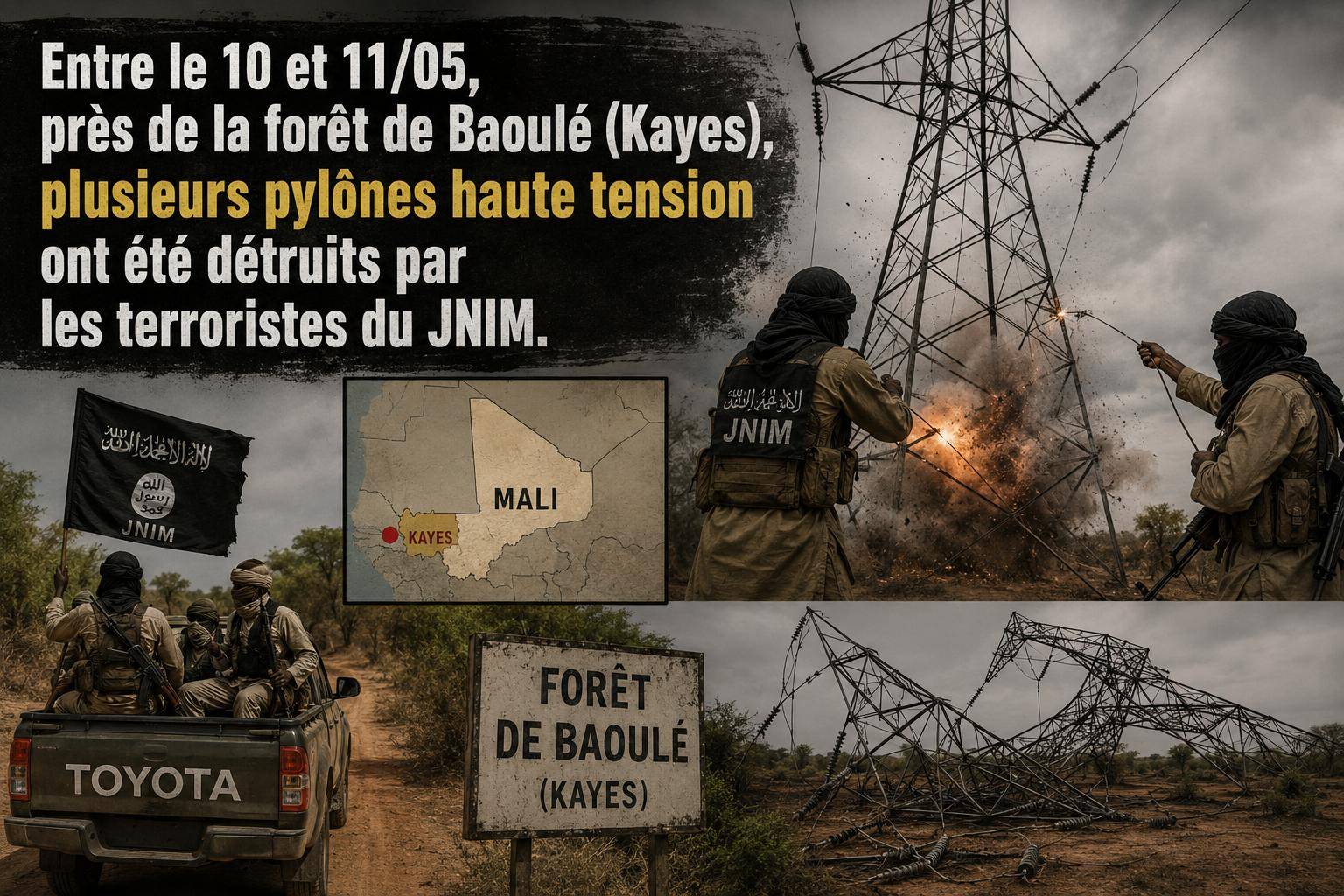
The weekend of May 10 and 11, 2026, marked a devastating turning point for the energy sector in Mali. Near the Baoulé forest reserve in the Kayes region, militants from the Groupe de Soutien à l’Islam et aux Musulmans (JNIM) successfully dynamited several high-voltage transmission towers. This strategic act of sabotage occurred under the watch of the Africa Corps, a Russian partner whose operational effectiveness is facing intense scrutiny. As the capital, Bamako, endures record-breaking heat and water shortages in total darkness, the insurgent threat is now looming over the vital hydroelectric dams of Manantali and Sélingué.
JNIM shifts strategy toward economic warfare
This is no longer a simple rural insurgency; it has evolved into an undeclared siege. After systematically cutting off major supply routes to the capital by burning commercial trucks and passenger buses, the JNIM has escalated its tactics. By targeting power lines in the Kayes area, the insurgents are striking at the heart of daily life in Bamako and the stability of the transitional government.
The precision of the attacks is deeply concerning. The pylons, located in remote and difficult-to-access areas of the Baoulé forest, were brought down with technical expertise. This destruction has triggered a massive blackout, plunging entire neighborhoods of the capital into a distressing darkness and worsening an already fragile energy situation.
Security failures and the role of Russian partners
There is a bitter irony in the fact that these acts of sabotage took place in regions supposedly secured by the Africa Corps and the Forces Armées Maliennes (FAMa). Questions are being raised about how insurgent groups can transport explosives and destroy massive steel structures without detection, especially as the country has turned toward Moscow for total security.
On the ground, the reality is stark. While Russian paramilitaries are proficient in wartime communication and displays of force in urban centers, their ability to prevent hybrid attacks on critical infrastructure appears limited. The failure of drones and mixed patrols to safeguard the power grid highlights a fundamental question regarding the actual benefit of this partnership for the civilian population.
Humanitarian consequences for the residents of Bamako
For the people of Bamako, this latest sabotage is the final straw. The capital is currently suffering through an unprecedented heatwave, with temperatures reaching 45°C. Without electricity for fans or power for water pumps, daily survival has become an unbearable struggle.
Although the government highlights fuel convoys protected by the FAMa and Africa Corps, these efforts fail to compensate for the loss of the high-voltage network. Health facilities are on the front lines of this crisis, with maternity wards and emergency rooms operating under dire conditions, putting thousands of lives at risk every day.
Regional risks: The threat to Manantali and Sélingué dams
The most alarming developments may be yet to come. According to various security sources, JNIM threats are now directed at the Manantali and Sélingué dams. This is no longer just a crisis for Mali, but for all of West Africa. These facilities are the energy and water lifelines for the sub-region.
A successful strike on these installations would do more than just leave Bamako in the dark for months. Such a disaster would directly impact Sénégal and Mauritanie, which rely on shared energy agreements. Furthermore, it would jeopardize irrigated agriculture across the entire river basin, potentially sparking a massive food crisis. The shift from attacking trucks to destroying pylons, and potentially dams, marks a dangerous escalation in a strategy of chaos that the military and its allies are struggling to contain.
The transitional government and its Russian allies are now facing a critical moment. The narrative of territorial liberation is being undermined by the systematic destruction of vital infrastructure. The presence of the Africa Corps, which represents a significant financial commitment for Mali, has yet to secure the national economy or protect essential services. The time for triumphant communiqués has passed; urgent protection of sensitive sites is required. If the dams are compromised, the state’s credibility will vanish. The citizens of Bamako are waiting for more than just promises of sovereignty—they need water, light, and genuine security.