Final address of outgoing president sets stage for new governance
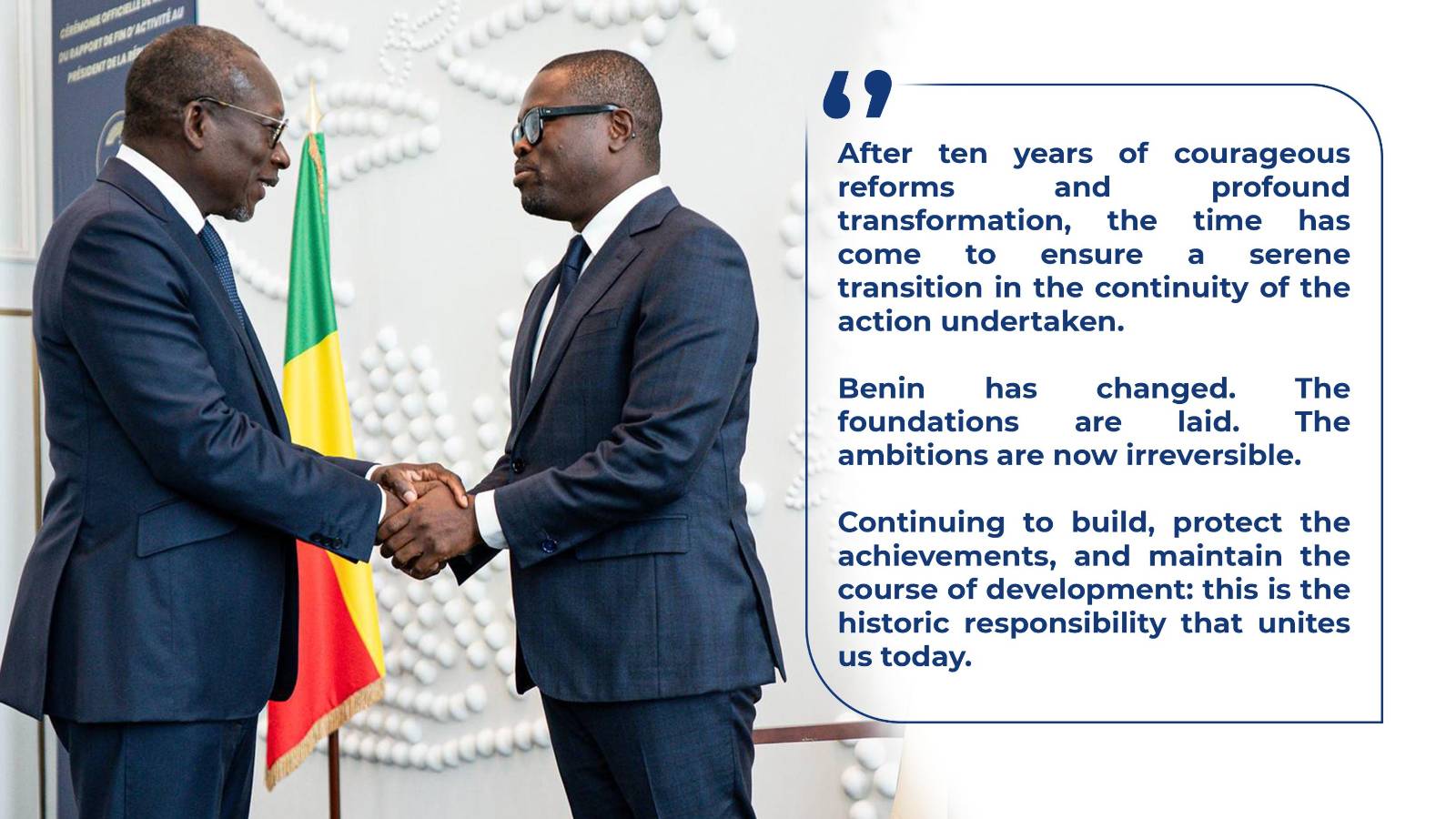
The Republic of Bénin is on the cusp of a historic political transition. As President Patrice Talon prepares to hand over power to his elected successor Romuald Wadagni, his farewell address to the nation marked the conclusion of a transformative decade under the banner of the « Rupture »—a period that fundamentally reshaped the country’s economic, social, and institutional landscape.
The outgoing president’s mixed legacy
In a nationally televised address, the outgoing head of state presented a balanced assessment of his tenure, which began in 2016. The era was defined by sweeping structural reforms, aggressive fiscal consolidation, and accelerated infrastructure development. Yet Talon did not shy away from acknowledging the challenges faced along the way.
« This journey demanded immense sacrifices from the people of Bénin, » he reflected. « Though some measures were unpopular, they were essential to lift the nation from underdevelopment and restore its standing on the global stage. » His words underscored both the necessity of the reforms and the resilience of the citizens who endured them.
Technocratic succession signals continuity
The core of Talon’s message was forward-looking. By publicly endorsing Romuald Wadagni—his former Minister of Economy and Finance, and the architect behind the country’s macroeconomic strategy—he signaled a transition rooted in institutional stability and policy continuity. For the departing president, Wadagni’s ascent ensures the preservation of key national recovery initiatives while paving the way for a new phase of governance centered on consolidation.
Decade of transformation: key achievements
The Talon administration leaves behind a nation visibly reshaped across several critical domains:
- Macroeconomic stability: Public finances were overhauled, and the country’s sovereign credit rating improved significantly.
- Urban renewal: A sweeping road construction program transformed key cities, enhancing connectivity and mobility.
- Industrial growth: The establishment and activation of the Glo-Djigbé Industrial Zone (GDIZ) catalyzed economic diversification.
Incoming leader inherits a nation transformed—but challenges loom
While Wadagni inherits a country with stronger macroeconomic foundations, the road ahead remains demanding. The new administration faces pressing social demands, including restoring purchasing power and ensuring inclusive growth. Political tensions also require de-escalation, while the rising threat of terrorism in border regions demands urgent attention.
Top priorities for the incoming president include:
- Economic equity: Addressing inequality and distributing the benefits of growth more evenly across society.
- Social cohesion: Easing political divisions and fostering dialogue with opposition forces.
- National security: Strengthening border defenses and countering insurgent activity in the north.
Democracy preserved amid regional instability
Perhaps most notably, Patrice Talon’s decision to step down after two terms reaffirms Bénin’s commitment to democratic alternation—a stark contrast to the constitutional manipulations seen in neighboring West African nations. This adherence to constitutional limits reinforces the country’s democratic credentials and sends a stabilizing signal across the subregion.
As inaugural preparations gather pace in Cotonou, the capital, Bénin stands at the threshold of a new chapter. The « Rupture » era is closing, and in its place, a pragmatic vision for the future is taking shape—one built on continuity, accountability, and national unity.