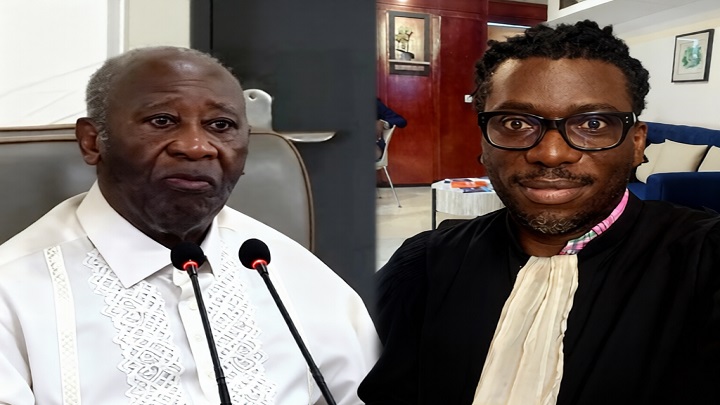
Debates surrounding the political future of Côte d’Ivoire’s leading figures have intensified following the reelection of Laurent Gbagbo as leader of the Parti des Peuples Africains – Côte d’Ivoire (PPA-CI). In the aftermath of the party’s first ordinary congress held in Abidjan, prominent lawyer Ange Rodrigue Dadjé argued that criticisms of President Alassane Ouattara’s continued involvement in politics are no longer valid.
Ouattara’s political longevity under scrutiny
Ange Rodrigue Dadjé’s remarks came as a direct response to the persistent backlash against President Ouattara’s decision to remain in politics despite earlier pledges of retirement. Speaking on May 15, 2026, he asserted, « There is no longer justification for reproaching President Ouattara for choosing to stay in politics after announcing his retirement ».
The timing of these comments coincides with a significant political shift in Côte d’Ivoire. Just months before the PPA-CI’s congress, Laurent Gbagbo had signaled his intention to step back from active political roles. In an October 2025 interview with journalist Alain Foka on AFO Media, the former president declared, « There is no retirement in politics, but I will refrain from holding political office, whether within my party or in the state. I have given enough ». At 81 years old and after his 2021 acquittal by the International Criminal Court (ICC), many assumed Gbagbo was preparing to pass the torch to a new generation of PPA-CI leaders.
Gbagbo’s unexpected return to politics
However, the first ordinary congress of the PPA-CI, held on May 14–15, 2026, took an unexpected turn. Under thunderous applause from delegates, Laurent Gbagbo declared, « I remain for the struggle », signaling his continued leadership of the party. This decision has reignited discussions about the challenges political veterans face when attempting to retire, particularly in a landscape where their supporters remain vocal.
The situation with Gbagbo mirrors earlier controversies surrounding President Ouattara’s political career. In 2020, the president faced intense criticism after reversing his decision not to seek a third term, a move the opposition—including the PPA-CI—condemned as a breach of trust. Yet, Ouattara justified his 2025 presidential bid for a fourth term by citing the need to ensure national stability amid regional security and economic challenges. « This decision is carefully considered and a duty to the nation », he stated.
Can political leaders ever truly retire?
The PPA-CI’s congress has underscored a recurring question in Ivorian politics: Can long-standing leaders disengage from public life when their followers continue to demand their leadership? The debate extends beyond personalities to the very nature of political parties, where grassroots loyalty often dictates the trajectory of careers.
For observers, Gbagbo’s renewed leadership and Ouattara’s prolonged political engagement highlight the tension between personal ambition and the expectations of a base that views these figures as indispensable. The congress outcome suggests that in Côte d’Ivoire, political retirement may be more of an ideal than a practical reality.