
Mali offers 2 billion cfa reward for iyad ag ghaly and jihadist leaders
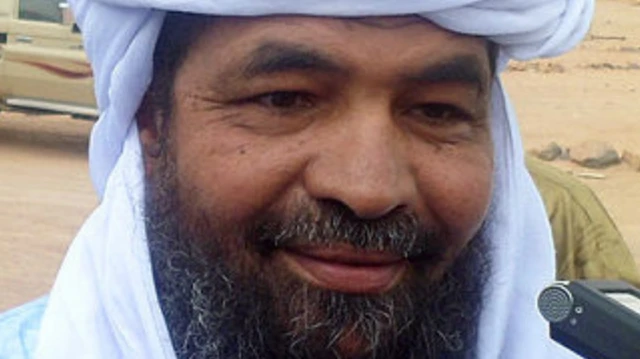
The Malian government has escalated its fight against terrorism by announcing a substantial financial reward for the capture of Iyad Ag Ghaly, the notorious leader of the Jama’at Nusrat al-Islam wal-Muslimin (JNIM), and several of his associates. This move comes in response to coordinated attacks that have shaken the nation’s stability in recent months.
Government’s decisive action against jihadist networks
In an official statement released by the Ministry of Security and Civil Protection, the Malian authorities revealed a bounty of up to 2 billion CFA francs for the capture of Iyad Ag Ghaly, alongside other high-profile figures linked to the JNIM and the Front de Libération de l’Azawad (FLA). The announcement underscores the government’s commitment to dismantling these groups, which have been linked to a surge in violence across the country.
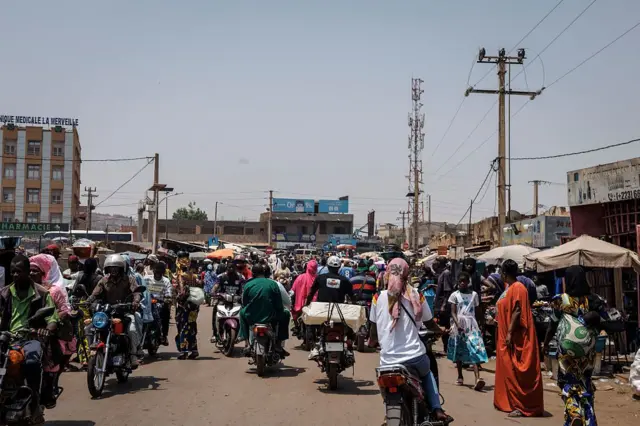
The communiqué, broadcast on national television, called on citizens to support security forces by providing actionable intelligence. Seven individuals are now listed as priority targets due to their alleged roles in orchestrating attacks that have destabilized key regions, including the recent assaults on Kidal and Kati.
Breakdown of the bounties
The rewards reflect the severity of the threats posed by these individuals:
- Iyad Ag Ghaly (JNIM leader): 2 billion CFA francs
- Amadou Koufa (Macina Katiba leader) and Abdoulaye Mohamed (Habib): 1.5 billion CFA francs each
- Algabas Ag Intallah (FLA political-military figure): 1 billion CFA francs
- Ghita, Bilal Chérif, and Abderrahmane Al Banna (FLA leaders): 500 million CFA francs each
These figures were implicated in the April 25 coordinated attacks that led to the death of Defense Minister Sadio Camara, a pivotal moment that intensified the government’s crackdown on armed factions.
Profile of Iyad Ag Ghaly: From rebel to jihadist kingpin
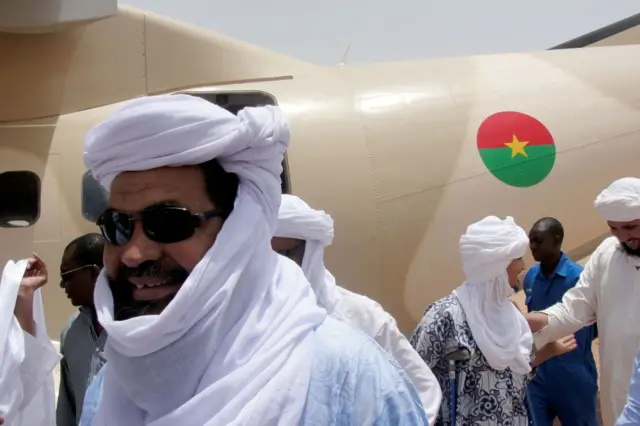
Born in 1958 in Boghassa, near Kidal, Iyad Ag Ghaly’s journey from Tuareg rebel to jihadist leader is marked by decades of conflict and shifting alliances. His early years were shaped by regional instability, including stints in Libya under Muammar Gaddafi’s regime, where he fought in foreign conflicts before returning to Mali in the 1990s.
During that decade, he founded the Mouvement Populaire de Libération de l’Azawad (MPLA) and later the Mouvement Populaire de l’Azawad (MPA), launching rebellions against the Malian state. After signing a peace accord in 1992, his focus shifted toward radical Islamism, culminating in his alliance with Al-Qaeda in the Islamic Maghreb (AQMI) in 2007.
In 2012, he established Ansar Dine, merging with AQMI to wage jihad across northern Mali. By 2017, he consolidated his influence by founding the Group for the Support of Islam and Muslims (GSIM/JNIM), a coalition of Sahelian jihadist factions aligned with Al-Qaeda. Today, he is widely regarded as the most dangerous figure in the Sahel, with the Timbuktu Institute describing him as a master of economic warfare.
His strategy has evolved beyond direct military confrontation. By targeting critical infrastructure—such as roads, power lines, and supply chains—he aims to cripple the Malian economy and erode public trust in the government. Analysts suggest his ultimate goal is not to govern but to destabilize Bamako’s authority and force regime change.
An international arrest warrant has been issued against Ag Ghaly by the International Criminal Court (ICC), which accuses him of crimes against humanity and war crimes committed between 2012 and 2013. Despite his fugitive status, his network continues to operate across Mali, Niger, and Burkina Faso, posing a persistent threat to regional security.
The government’s latest measures signal a new phase in the battle against terrorism, but the stakes remain high as civilians bear the brunt of the violence.