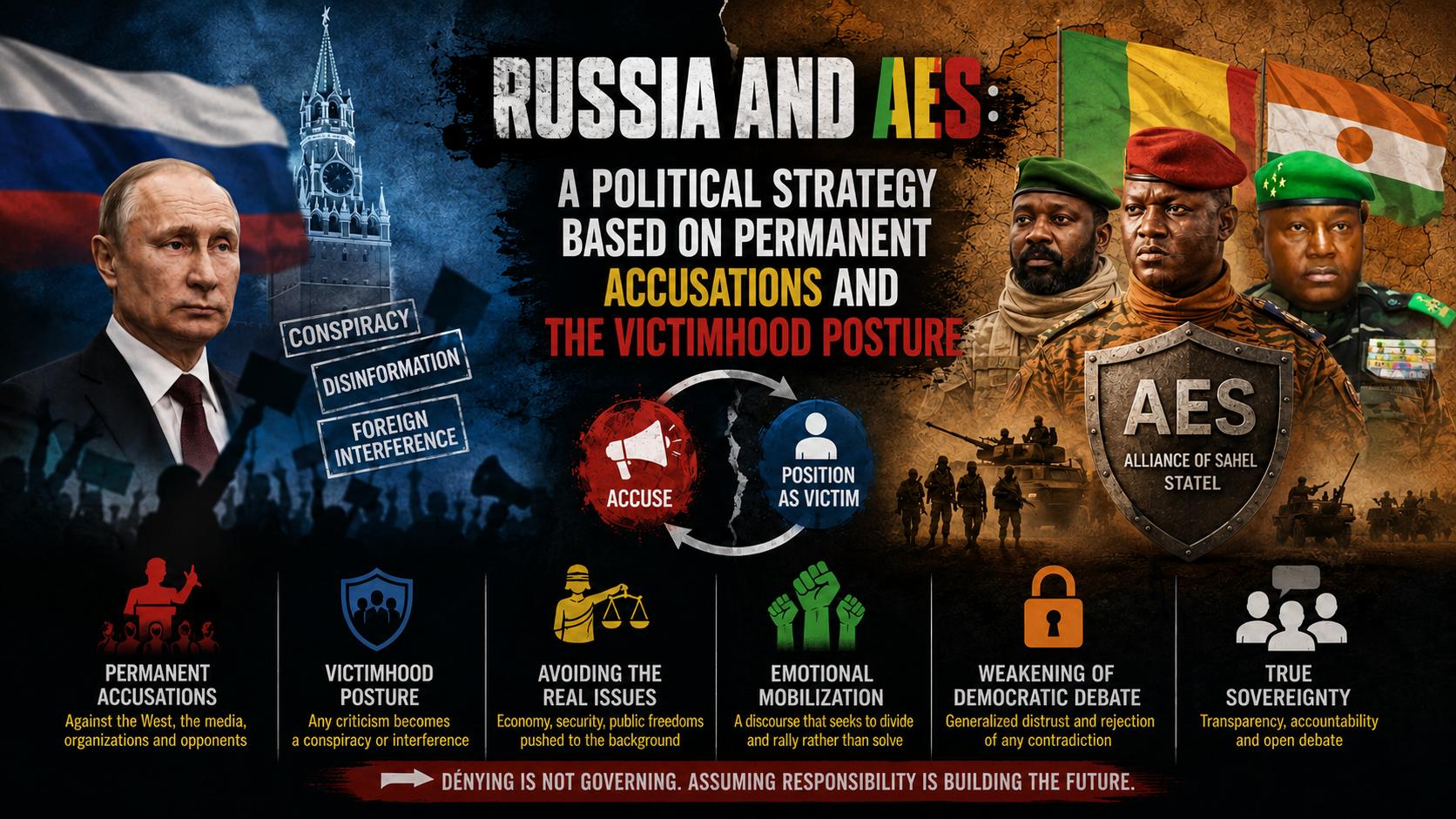
Over recent years, both the Russian Federation and the governments of the Alliance of Sahel States (AES) have integrated the practice of publicly denouncing their adversaries into their political communication strategies. Whether targeting Western powers, international media outlets, regional bodies, or domestic opponents, accusations have become a recurring theme. Yet, a striking contradiction persists: when these same actors face criticism themselves, they swiftly shift from accusers to the aggrieved.
This approach to political discourse has evolved into a near-uniform pattern. Any challenge to their policies is met with claims of fabricated conspiracies, orchestrated disinformation campaigns, or foreign interference. Dissent is framed not as constructive feedback but as a coordinated assault aimed at undermining their legitimacy or obstructing their pursuit of sovereignty.
Such a strategy serves a clear political purpose. By casting themselves as victims of external enemies, leaders divert attention away from pressing domestic issues. Economic hardships, ongoing insecurity, restrictions on civil liberties, and the mixed outcomes of certain policies fade into the background. Public debate is supplanted by an emotional narrative designed less to address concerns than to rally support through perceived grievances.
The AES member states exemplify this trend. Authorities frequently attribute their challenges to external pressures, whether sanctions, former colonial powers, or foreign actors. However, when citizens, journalists, or human rights organizations highlight internal shortcomings, these critiques are seldom addressed substantively. Instead, they are dismissed as part of an orchestrated destabilization effort orchestrated from abroad.
Russia, too, has embraced a comparable logic on the global stage. Criticism of its foreign policy, military engagements, or human rights records is often countered with claims of relentless Western hostility. This rhetoric not only deflects attention from legitimate concerns but also reframes dissent as further proof of an alleged campaign of persecution.
Yet, this strategy carries inherent weaknesses. Effective governance demands the capacity to engage with opposing views, respond to criticism with reasoned arguments, and remain accountable to citizens. The habitual dismissal of challenges as conspiracies risks eroding democratic discourse and fostering widespread distrust.
Accusing others is a straightforward tactic. Assuming responsibility is far more demanding. Through their persistent victim narratives, Russia and several AES leaders risk conveying an impression that their primary objective is to evade substantive discussion. Criticism, no matter how pointed, is not inherently a conspiracy; it can also serve as an opportunity to refine policies, address shortcomings, and bolster public trust.
True sovereignty is not merely demonstrated through the denunciation of real or imagined adversaries. It is built on transparency, accountability, and the willingness to engage in open debate. Without these principles, the narrative of perpetual victimhood loses its credibility and increasingly appears as a political communication tool rather than a substantive response to the challenges faced by these nations.