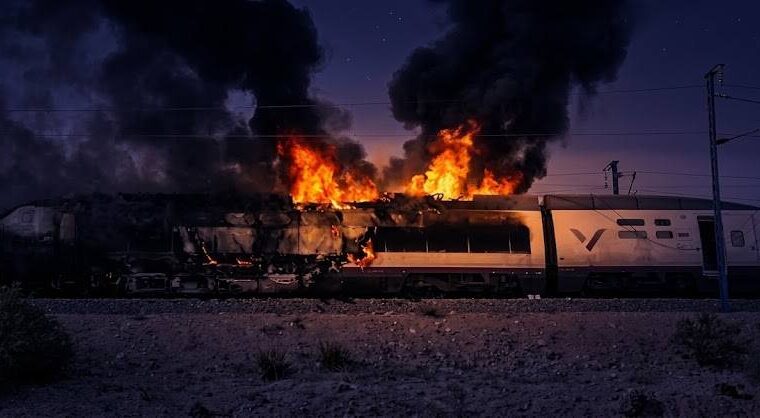
The Spanish rail network reached a critical juncture on Monday afternoon when a fire broke out aboard an AVE high-speed train traveling the Madrid-Barcelona corridor, forcing an emergency evacuation of 283 passengers near Ricla, Zaragoza. The incident, which occurred just before 4:05 p.m. local time, marked a decisive moment for Renfe Operadora as it navigated the immediate safety response and subsequent operational fallout that disrupted one of Spain’s busiest rail arteries.
Critical evacuation unfolds as fire breaks out on board
The blaze originated in the rear cabin of an AVE train en route from Madrid’s Puerta de Atocha station—departing at 2:27 p.m.—to Figueres, with a scheduled stop in Barcelona. Upon detecting the fire, onboard personnel and emergency protocols were activated without delay, ensuring the swift transfer of all passengers to a secure location. Firefighters reached the scene rapidly and successfully contained the flames, preventing any injuries among the evacuated travelers.
Despite the absence of immediate casualties, the fire’s sudden appearance on a high-speed corridor underscored the need for rapid, decisive intervention. The incident occurred on October 12, coinciding with Spain’s National Day and the conclusion of an extended weekend, a period typically associated with elevated passenger volumes and heightened travel demand.
Madrid-Barcelona rail link paralyzed for hours
The emergency response extended beyond the affected train, leading to the temporary suspension of high-speed services between Madrid and Barcelona. Trains en route were halted at intermediate stations, while several scheduled departures were canceled. Travelers faced significant delays, rerouting challenges, and uncertainty regarding onward journeys—impacting thousands of passengers across the network.
Renfe Operadora acknowledged the widespread disruption and announced immediate measures to support affected passengers, including the option to modify or receive full refunds for canceled tickets. Behind the scenes, technical teams conducted safety assessments and infrastructure inspections to ensure the resumption of services met stringent operational standards.
Investigation begins to uncover the root cause
While the evacuation concluded with no reported injuries, authorities emphasized the need to determine the fire’s precise origin. Investigations are now underway to assess whether technical failure, equipment malfunction, or other factors contributed to the incident. Findings from these inquiries will inform future safety protocols and preventive measures across Spain’s high-speed rail network.
The event serves as a reminder of the critical importance of robust emergency response in high-speed rail travel, where split-second decisions and coordinated action between onboard staff, operators, and emergency responders are essential to passenger safety and service continuity.
From disruption to recovery: Renfe’s coordinated response
Following the successful containment of the fire and completion of safety checks, Renfe gradually restored high-speed services along the Madrid-Barcelona corridor. Although the exact duration of the service interruption remained uncertain in the initial aftermath, the company prioritized restoring normal operations as quickly as possible while ensuring that no compromises were made in safety standards.
The incident, though localized in its origin, revealed how even a single operational disruption can ripple across an entire national network, affecting tens of thousands of travelers. As Spain’s AVE high-speed rail system faces this turning point, the lessons learned from this fire will likely shape future safety enhancements and emergency preparedness across the country’s rail infrastructure.