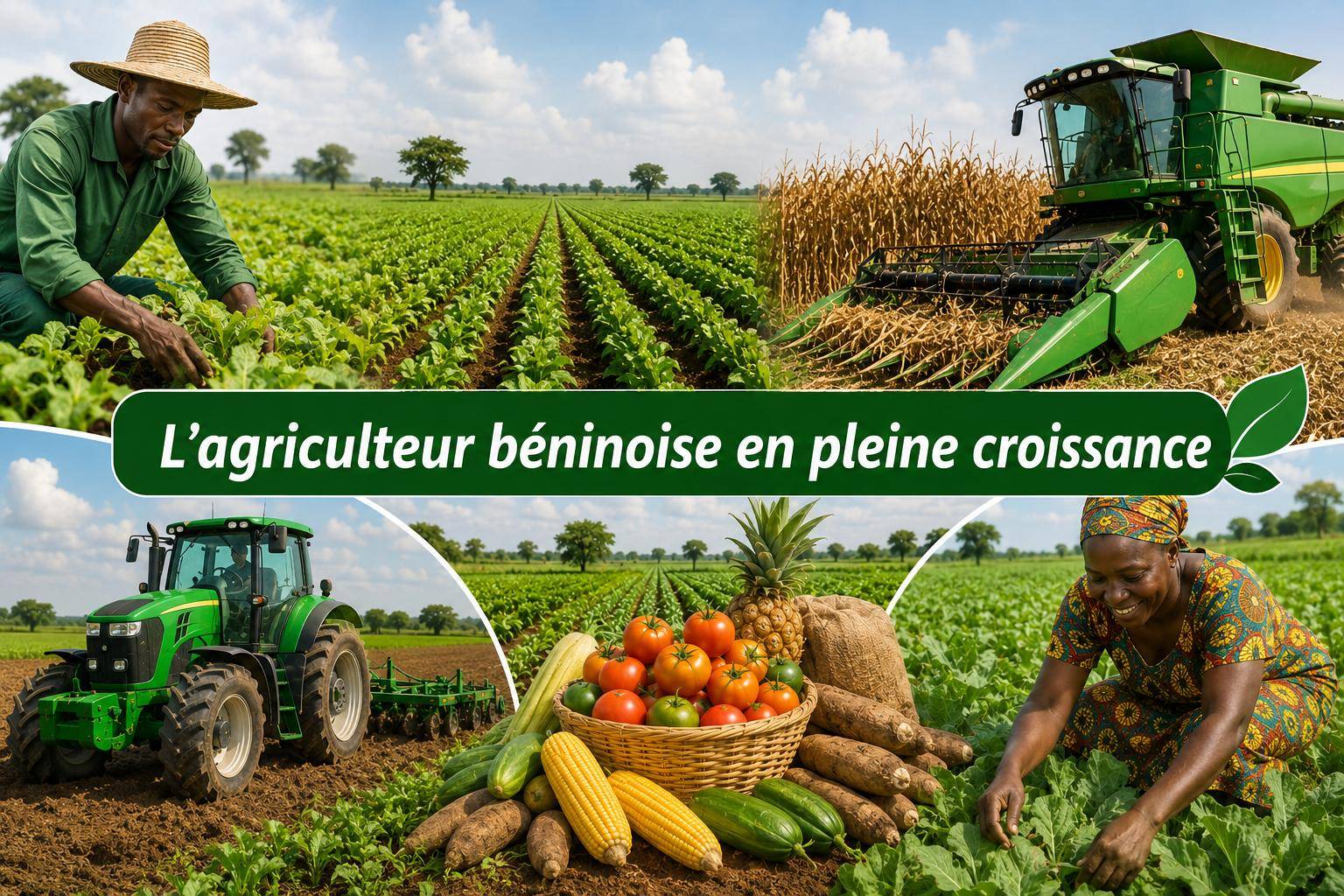
The agricultural landscape in Bénin has undergone a seismic shift since 2016, evolving from a sector plagued by stagnation into the driving force behind the nation’s economic growth and food security. Through bold reforms, substantial subsidies, accelerated mechanization, and strategic land development, the country has shattered production records across key crops, cementing agriculture as the backbone of its prosperity.
From subsistence to surplus: record-breaking harvests redefine agriculture
The government’s proactive agricultural policy, spearheaded by President Patrice Talon, has delivered transformative results. Within a decade, production volumes across major crops have surged, reshaping not only the domestic market but also the country’s position in regional and global trade.
Maize, a staple in Bénin’s diet, serves as a prime example of this agricultural renaissance. Production more than doubled from 1.3 million tonnes in 2016 to 2.5 million tonnes in 2025, far exceeding domestic demand of 1 million tonnes. While this surplus strengthens food security, it also introduces the challenge of managing cross-border trade flows to stabilize local prices and protect farmers’ income.
The soybean sector reflects the country’s industrial ambitions. Once a minor crop yielding just 140,000 tonnes in 2016, production has skyrocketed to 606,016 tonnes in the 2024–2025 season—over four times the initial output. This boom directly feeds modern processing facilities in the Glo-Djigbé Industrial Zone (GDIZ), while a significant portion is exported, diversifying revenue streams for the nation.
Rice production has also reached new heights, climbing from 204,000 tonnes before 2016 to 1 million tonnes in 2025. Cotton, long regarded as Bénin’s ‘white gold,’ has seen steady growth, with annual production consistently exceeding 640,000 tonnes and a record 766,273 tonnes in 2021. The nation remains Africa’s top cotton producer, with ambitions to surpass 1 million tonnes in the near future.
Other high-value crops have flourished as well. Pineapple production has nearly doubled from 244,000 tonnes to 470,000 tonnes, with projections to reach 600,000 tonnes. Cashew nut output has more than doubled, rising from 91,000 tonnes to 187,000 tonnes in 2023, supported by state subsidies that cover 500 FCFA of the 600 FCFA cost per certified seedling—boosting both yield and producer income.
Financial safeguards: 110 billion FCFA shields farmers from global shocks
The agricultural miracle in Bénin would not have been possible without robust state intervention. As global fertilizer and input prices soared, threatening to cripple local farmers, the government launched a sweeping subsidy program allocating 110 billion FCFA for the 2022–2025 agricultural campaigns. This financial shield stabilized production costs, prevented yield collapses, and safeguarded the nation against food insecurity during turbulent economic times.
Irrigation and mechanization: ending the era of rain-dependent farming
Modernizing infrastructure has been central to breaking free from climate dependency. Before 2016, only 6,200 hectares—just 2% of the national potential—were equipped for irrigation. Today, 25,440 hectares across 67 municipalities have been developed, quadrupling the irrigated area. The long-term goal is to expand this to 50,000 hectares, enhancing resilience and unlocking higher yields.
Mechanization has also transformed farming practices. The tractor adoption rate, below 8% in 2016, has doubled, with over 400,000 hectares now cultivated using 5,000 subsidized tractor kits. The government has invested in training 6,000 tractor operators and 300 mechanics to ensure sustainable use. By 2026, the mechanization rate is projected to reach 30%, with 8,000 active kits in operation—marking a definitive end to labor-intensive, low-efficiency agriculture.
Financial restructuring and ecological renewal: building a sustainable future
The overhaul of financial instruments has unlocked new opportunities. The restructured National Agricultural Development Fund (FNDA) has financed over 3,000 projects totaling 19 billion FCFA, while the Municipal Development Support Fund (FADeC-Agriculture) has facilitated 330 communal investments worth 68 billion FCFA. These reforms aim to strengthen governance and expand impact across thousands of rural enterprises.
Agricultural revival has gone hand-in-hand with environmental stewardship. Over 3 million hectares of degraded land have been rehabilitated, reversing decades of soil depletion that affected 80% of Bénin’s arable land before 2016. Sustainable land management practices have restored fertility and prevented further degradation.
The revival of inland waters—once polluted and underutilized—has breathed new life into fisheries. Total fish production has surged by 79%, and high-quality shrimp from Bénin has regained access to the European Union market, a testament to improved regulatory compliance and ecological recovery. Livestock production has also flourished, with meat output rising by 53% and egg production by 43%, positioning the country to meet 75% of domestic demand in the coming years.
Agriculture as an economic engine: the road ahead
By embedding agriculture within a broader market economy and reinforcing state capacity, Bénin has redefined rural development. The sector is no longer a fragile subsistence activity but a modern, competitive industry capable of generating wealth across the value chain. The challenge now lies in sustaining this momentum, deepening market integration, and ensuring that growth translates into equitable prosperity for all farmers and rural communities.
The foundation has been laid. The next chapter must focus on governance, innovation, and inclusive expansion to secure agriculture’s role as the cornerstone of national development.