Under the leadership of President Romuald Wadagni, the Bénin government is rolling out an ambitious strategy to transform its agricultural export sector. By integrating advanced seed technology and cutting-edge logistics, the country is set to redefine its position in the global fruit market.
Reinventing the agricultural value chain
For decades, Bénin’s agriculture has been the backbone of its economy, yet the sector has long grappled with systemic challenges: reliance on raw, unstandardized exports and inefficient post-harvest logistics, leading to significant losses. The government’s new approach shifts the focus from mere production to end-to-end value chain mastery, ensuring maximum value capture.
Key export crops like pineapple, cashew, and mango have been targeted due to their high global demand and stringent quality requirements. The anticipated economic impact is substantial: increased export revenues, secured incomes for local farmers, and the creation of skilled jobs within new technological and logistical infrastructures. Through the Projet d’Appui à la Compétitivité des Filières Agricoles et à la Diversification des Exportations (PACOFIDE), Bénin is transitioning from subsistence farming to a competitive agro-industry.
Glo-Djigbé: the seed innovation hub
The Economic Special Zone (ZES) of Glo-Djigbé is at the heart of this transformation, hosting an industrial-scale vitroplants production unit nearing completion. With an annual capacity of 13.5 million plants, this facility is a game-changer for the sector.
During a recent oversight visit, Minister of Agriculture, Livestock, and Fisheries Adin Yeton Bloukounon Goubalan emphasized the pivotal role of seed technology: “In every agricultural powerhouse, seed technology is the cornerstone of sectoral transformation. No nation can achieve agricultural revolution without controlling its seed industry.”
The economic benefits are twofold:
- For farmers: Access to healthy, uniform, and high-yielding plants, eliminating the unpredictability of traditional seeds. Farmers will now have disease-resistant, internationally compliant planting material.
- For trade balance: Sustainable yield increases per hectare without expanding cultivated land, optimizing production costs and enhancing competitiveness against regional rivals.
To ensure a smooth technological transition, the government is developing 1,000 hectares near the former Glo-Djigbé airport site into elite and demonstration fields. This open-air laboratory will multiply and validate the performance of new pineapple vitroplants before mass distribution, guaranteeing farmers maximum return on investment.
Cotonou’s fruit terminal: the missing link in export logistics
Producing high-quality crops is futile if perishable goods spoil before reaching their destination. This is where the PACOFIDE’s second strategic pillar comes into play: a state-of-the-art fruit terminal at the Cotonou International Airport.
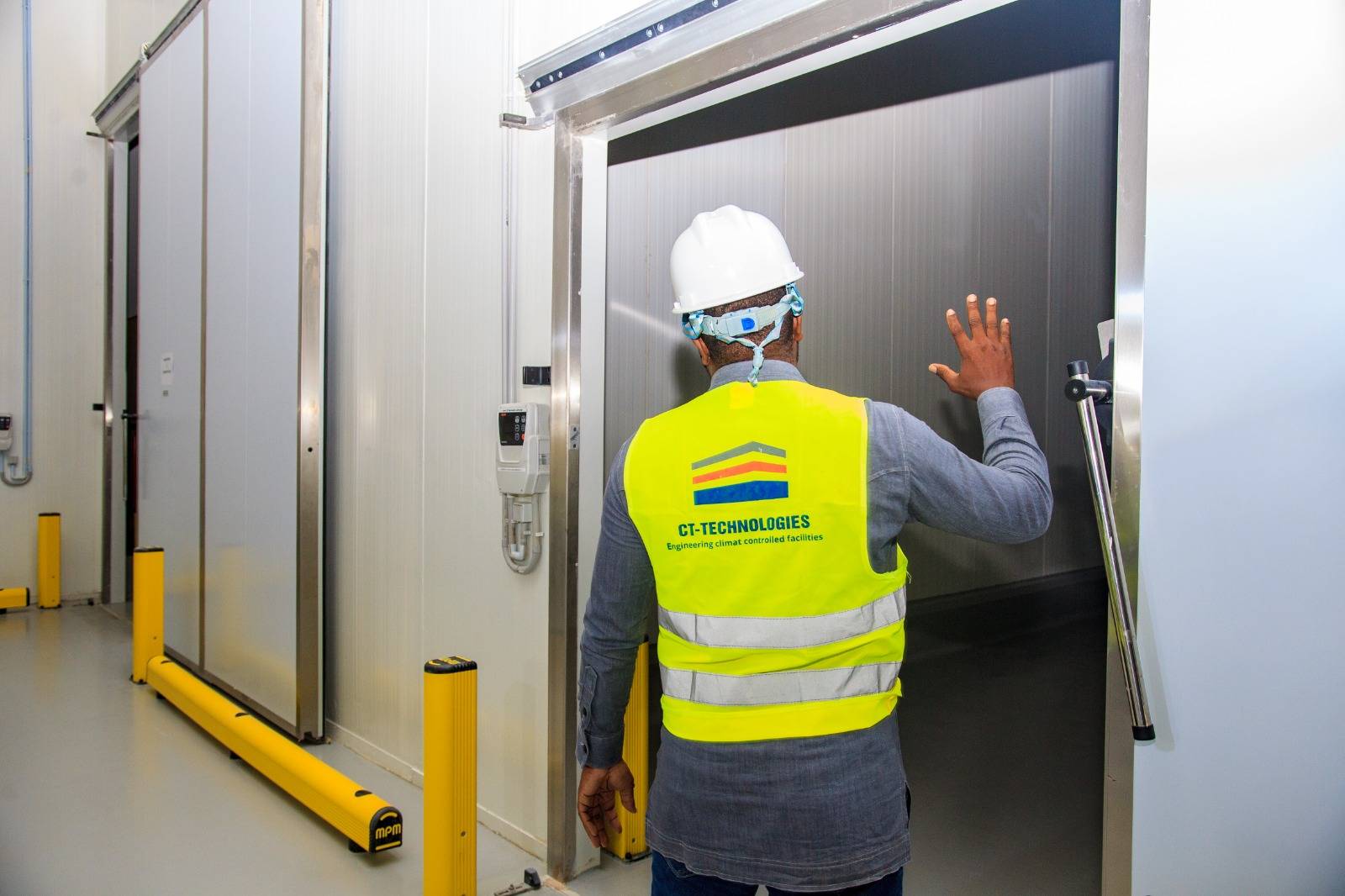
Designed as a logistics powerhouse, the terminal features cold storage, refrigerated spaces, freezing units, and dedicated customs and import-export zones. It can simultaneously handle up to 736 fruit pallets, ensuring the cold chain remains unbroken from farm to flight.
The financial impact is immediate. By maintaining optimal temperatures throughout the supply chain, Bénin drastically reduces freight losses. Fruits like pain de sucre pineapple and fresh produce will arrive in European and Asian markets with impeccable freshness, enabling negotiation of premium prices.
A policy shift celebrated on the ground
The ministerial oversight visit confirmed that construction timelines are strictly adhered to. Minister Bloukounon Goubalan praised the quality of the infrastructure, highlighting the government’s commitment to economic sovereignty: “Seeds are the primary production factor. By mastering seed technology, we enhance our competitiveness. Bénin is taking control of its seed industry.”
This integrated approach, bridging scientific research and logistical efficiency, addresses a long-standing structural gap. It also reassures private investors and international partners of Bénin’s growing reliability as an agricultural player.
By connecting the high-tech seed production of Glo-Djigbé’s ZES with the efficiency of Cotonou’s fruit terminal, the Bénin government is laying the foundations for a resilient, export-driven agricultural economy. This industrial and scientific wager aims not just to increase volumes but to structurally transform the national economy. By controlling its seeds and cold chain, Bénin ensures that the wealth generated by its land remains predominantly in the hands of its local stakeholders. The green revolution in Bénin is underway—and it now has the technological muscle to make its mark globally.