From sovereign declarations to strategic paralysis
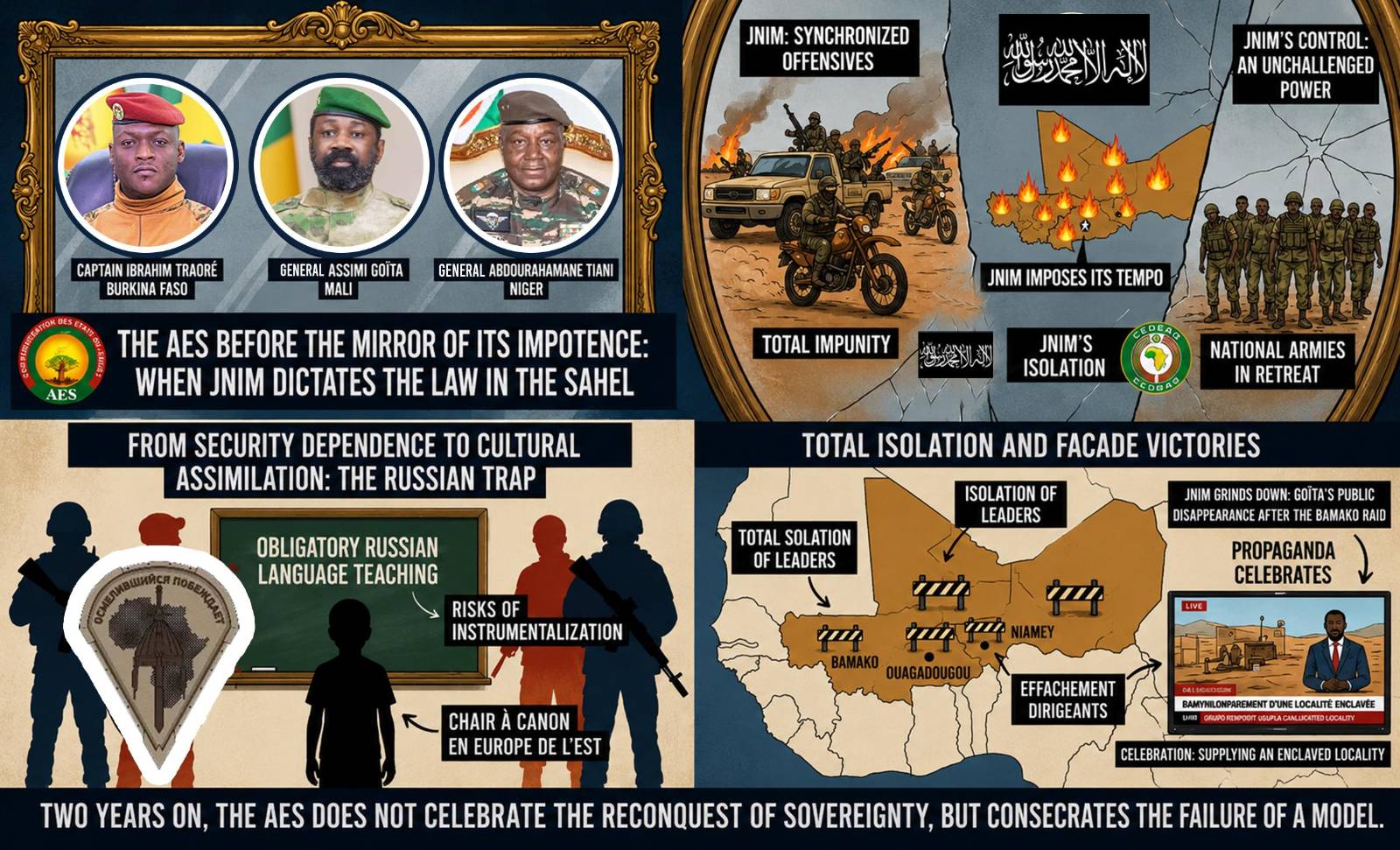
The Alliance of Sahel States (AES), launched with great fanfare two years ago, now faces a harsh reality. Behind the bold rhetoric of sovereignty from Bamako, Ouagadougou and Niamey, the battlefield tells a different story: the only force capable of coordinated action, setting its own pace and striking at will, remains the Group for the Support of Islam and Muslims (JNIM).
Political amateurism and the grandiloquent posturing of military regimes are crumbling under the relentless efficiency of this terrorist network. JNIM orchestrates large-scale, highly synchronized offensives, targeting multiple strategic regions simultaneously and overwhelming even well-equipped national armies. Neither the theoretical pooling of intelligence services within the AES nor the total geopolitical alignment with Moscow has managed to halt the bleeding.
Russia’s grip tightens beyond the battlefield
To compensate for this void, Captain Ibrahim Traoré and his counterparts have tied their nations’ fates to Russia. Yet this partnership has evolved far beyond mere military cooperation or the presence of former Wagner mercenaries (now rebranded as Africa Corps). The decision to introduce Russian as a mandatory language in Burkinabè school curricula starting next term marks a profound ideological shift. Officially framed as an act of cultural decolonization, this move actually serves as a psychological and structural preparation for the country’s youth.
Beneath the surface of linguistic reform lies a more troubling prospect for the future of Burkina Faso’s children. By embedding Russian in early education, the regime is laying the groundwork for deeper integration of future generations into Moscow’s sphere of influence. In the medium term, the risk is that these young people—once sent to Russia under the guise of studies or academic training—could be exploited. Amidst a backdrop of global confrontation, the concern is justified: the Sahel’s youth may end up as cannon fodder or human shields in conflicts far from home, their lives traded for Russia’s military support to the juntas.
A leadership trapped in isolation and hollow victories
As this cultural transition unfolds, JNIM continues its systematic undermining of the three regimes. By paralyzing their leaders, the armed group has confined them to near-total isolation. In Mali, the prolonged public absence of Assimi Goïta—following a deadly raid in Bamako that reportedly claimed the life of the Defense Minister—exemplifies this isolation vividly.
The conclusion is stark: while terrorists steadily expand their territorial control, the military leaderships wallow in political absurdity. Today, official propaganda channels celebrate minor logistical successes or token defensive responses as major triumphs. This admission of impotence speaks volumes.
At the two-year mark, the AES does not celebrate the restoration of sovereignty but underscores the failure of its model. By conflating wartime propaganda with genuine military strategy—and swapping Western dependence for cultural and military subjugation to Moscow—the juntas have allowed JNIM to dictate the tempo. The Sahel has not been liberated; it has merely exchanged one overlord for another, with its youth bearing the heaviest burden.