From rhetoric to reality: the double standard of Burkina Faso’s leadership
The stark contrast between official declarations and ground-level policies has never been more glaring. While authorities in Ouagadougou trumpet a narrative of “reclaimed sovereignty,” their actions reveal a troubling dependency on foreign powers. In a move that defies both logic and national dignity, the government has restricted local initiatives and NGOs from assisting the most vulnerable citizens under the guise of controlling humanitarian aid. Yet, in the same breath, these same authorities extend an open hand to Moscow, begging for shipments of wheat to feed a population caught in the grip of economic and security crises.
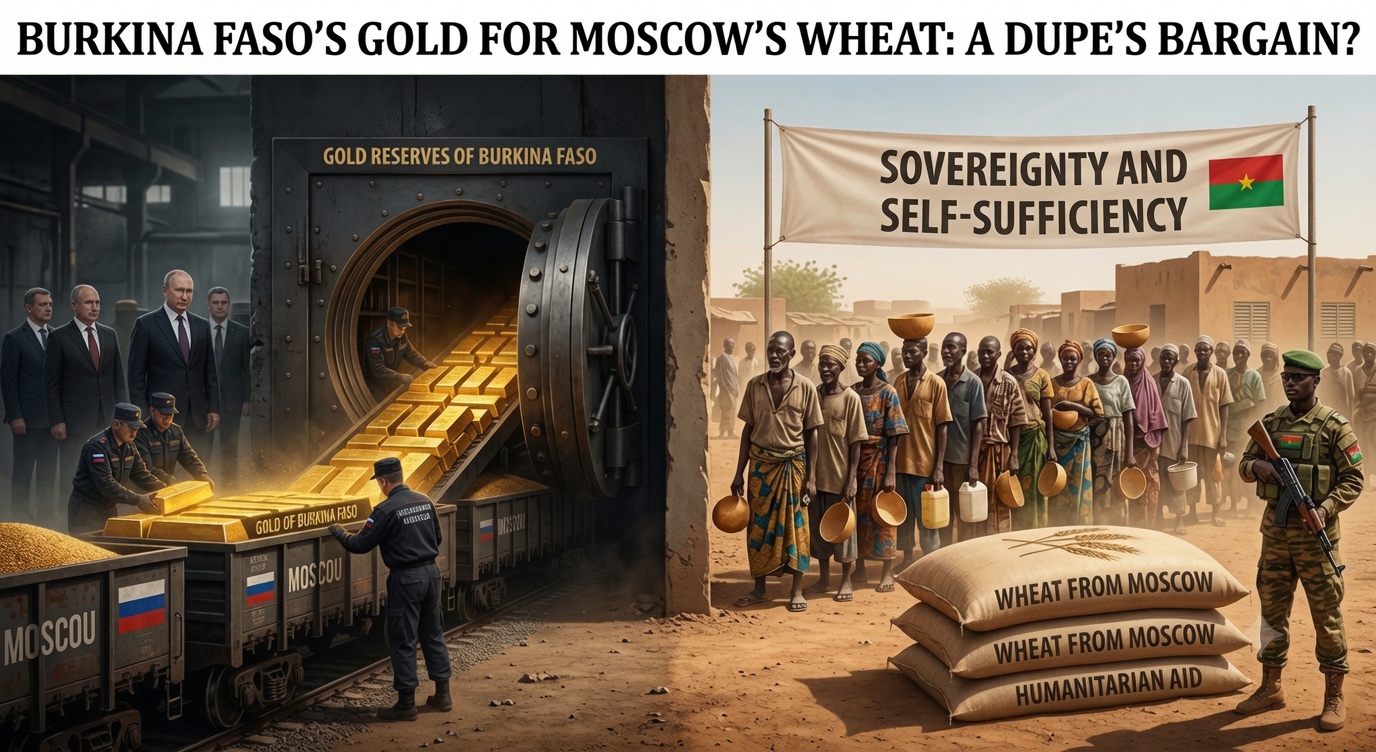
The recent visit of Russia’s foreign minister laid bare the true nature of this unequal “partnership.” With diplomatic finesse, the Kremlin’s envoy celebrated Burkina Faso’s decision to transfer and store its national gold reserves in Moscow’s central bank. For a regime that rose to power promising to dismantle neocolonial chains, this act borders on economic surrender. The transfer of a nation’s gold reserves to a foreign power, while its people face hunger, is more than an irony—it is a damning admission of failure.
A sovereignty built on borrowed bread
The government’s insistence on self-sufficiency rings hollow when basic food needs can only be met through external aid. A nation’s sovereignty is not measured by the strength of its slogans, but by its ability to feed its people without begging at foreign doors. Yet Burkina Faso, one of West Africa’s top gold producers, now depends on Russian wheat shipments to stave off famine. This is not a triumph of geopolitical maneuvering; it is the unmistakable mark of a leadership that has failed its citizens.
The gold-for-wheat deal exposes deeper contradictions. While Ouagadougou’s coffers should be fueling agricultural development, infrastructure, and support for local farmers, the nation’s wealth is instead being pledged to a foreign power. Observers question how these resources are being allocated and whether they truly serve the public good. The silence from authorities only deepens the skepticism.
The humanitarian blockade: a strategy wrapped in control
Worse still is the government’s active suppression of domestic solidarity. By restricting the work of citizen initiatives and NGOs, authorities are not only undermining grassroots assistance but also ensuring that every morsel of food reaching the hungry is framed as a gift from the state, not an act of communal compassion. This centralization of aid serves a dual purpose: it reinforces the regime’s control over the population and strips away the dignity of self-help.
In regions where state presence is weak or non-existent, local organizations and humanitarian groups often fill critical gaps. By stifling their efforts, the government risks leaving vulnerable communities without assistance, while simultaneously using aid as a tool for political leverage. The message is clear: dependence on the state is the only path to survival.
The cost of unfulfilled promises
The Burkinabè people have been repeatedly called upon to endure sacrifices in the name of national sovereignty and security. Yet, as insecurity persists and economic hardship deepens, these sacrifices feel increasingly futile. How can a nation claim true independence when its survival hinges on the goodwill of a foreign patron, to whom it has entrusted its most precious asset?
The contrast is jarring: while Burkina Faso’s gold is shipped to Moscow to shore up political survival, ordinary citizens grapple with empty stomachs and dashed hopes. The leadership’s confusion of independence with a mere change of overseer has not liberated the nation—it has merely traded one form of dependency for another, at an exorbitant human cost.
At its core, this crisis is not about choosing one foreign partner over another. It is about whether Burkina Faso’s partnerships are truly advancing the nation’s autonomy or merely masking a deeper failure. Real sovereignty is not forged in diplomatic halls or through resource deals; it is built on the daily security, prosperity, and dignity of a people. When the gap between promise and reality widens, the illusion of progress collapses under the weight of unmet needs.