Ouagadougou — When the town crier announced that free screening was being offered, Awa hesitated. “If they told me I had the disease, how would I pay for treatment?” the 48-year-old mother of six recalled from her village of Ipendo in Burkina Faso’s Centre-Ouest region. Despite her fears, she decided to go after thinking about her children. Her story mirrors that of thousands of women who live with the constant threat of cervical cancer due to limited access to healthcare.
Before Burkina Faso adopted the World Health Organization’s global strategy to eliminate cervical cancer, screening coverage was alarmingly low—below 8%—with rural areas hit hardest. Women often traveled long distances to reach equipped facilities, facing financial barriers for both transport and treatment. Trained healthcare workers were scarce, and awareness campaigns were nearly nonexistent.
Breaking barriers with bold health policies
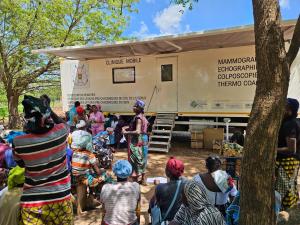
To tackle these challenges, the Burkinabè government implemented sweeping reforms. As Professor Nayi Zongo, a public health physician and coordinator of the National Cancer Control Program, explains, “A decree was passed to make screening and treatment for precancerous lesions completely free. We also upgraded peripheral health centers and launched mobile clinics to reach women where they live and work.”
These mobile units have become a lifeline for rural women. By visiting villages, farms, markets, and even family compounds, they eliminate the need for women to abandon their daily routines for medical appointments. “Screening is now brought directly to communities, allowing women to safeguard their health without disrupting their lives,” says Professor Zongo.
The initiative combines multiple strategies: financial accessibility through free care, geographic reach via mobile units, and community mobilization. Burkina Faso has also leveraged media campaigns on TV and radio, participated in events like Pink October, and formed a national cancer coalition involving civil society, community leaders, and the media to drive demand for screening. This holistic approach has turned cervical cancer prevention into a national priority.
The WHO’s support was instrumental in turning this vision into reality. The organization provided technical guidance for national guidelines, trained healthcare workers in detection and treatment, and supported community outreach. “WHO stood by us to strengthen our capacity and ensure no woman is left behind, no matter where she lives,” emphasizes Professor Zongo.
Transforming lives through mobile health campaigns
The results speak for themselves. Between October 2024 and September 2025, mobile clinics conducted 468 outreach sessions across Burkina Faso. These efforts reached nearly 2 million women, performed 106,446 screenings, treated 715 precancerous lesions, and conducted 113 follow-up exams. Beyond the numbers, these actions represent saved lives and protected families.
Dr. Seydou Coulibaly, WHO Representative in Burkina Faso, highlights the significance of this achievement: “This success proves that with strong political will and context-specific solutions, even the toughest barriers can be overcome.” He adds, “The removal of financial and geographic obstacles through free care and mobile clinics sets a powerful example for Africa.”
For women like Awa, the impact is deeply personal. “We farm, garden, and sell vegetables at the market. When we heard about screening, I was afraid, but hearing other women’s stories convinced me,” she shares. “On the day of the test, the health workers explained everything step by step. When the result came back negative, I felt immense relief. Now, I urge every woman to get screened—early detection makes treatment so much easier.”
For many women, these mobile clinics are their first introduction to cervical cancer awareness. This initial education is crucial, as it opens the door to prevention and early intervention, ultimately saving lives and empowering communities.
The initiative goes beyond healthcare—it embodies dignity, social justice, and the future of families. Each mobile clinic visit sends a clear message: health is a right, not a privilege. In Burkina Faso, that right is becoming a reality.