
Chad boosts agricultural export management through specialized training
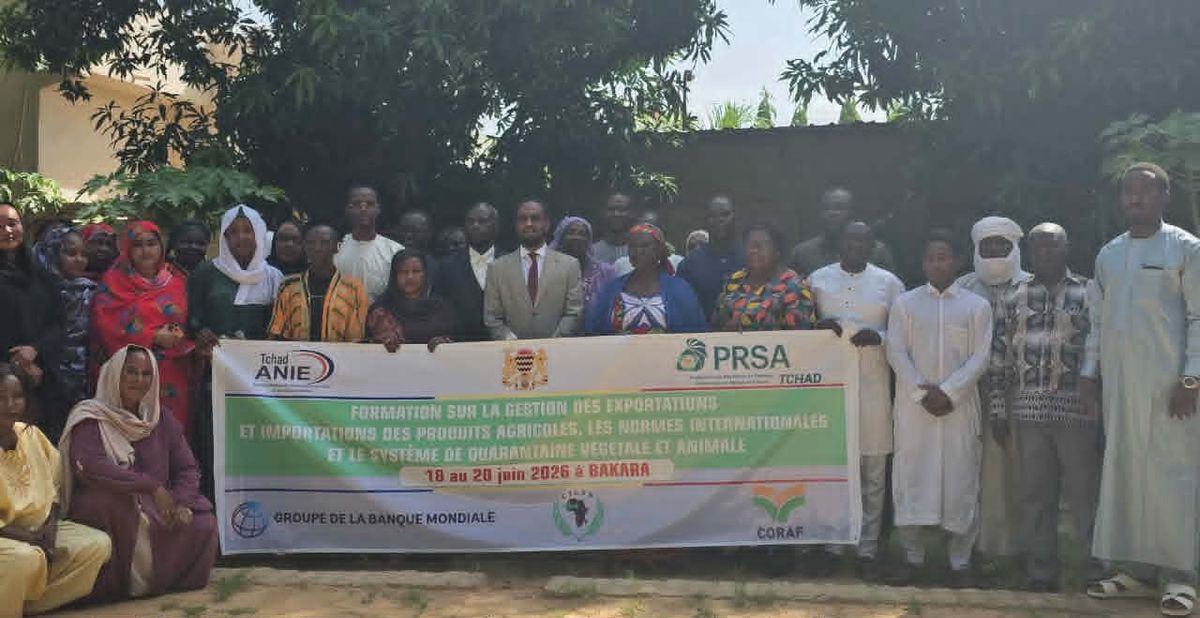
In a significant move to bolster the nation’s trade capabilities, a specialized training program focused on managing agricultural exports and imports commenced in Bakara. This initiative, held on June 18, 2026, was organized through a collaboration between the World Bank and the National Agency for Investment and Exports (ANIE) as part of the Agricultural Sector Resilience Program (PRSA).
Addressing hurdles in international trade
The workshop specifically targets the technicalities of international standards and plant and animal quarantine systems. During the session, Gotoraye Arnaud, the coordinator for the PRSA-TD agricultural market dashboard, pointed out that Chadian producers often struggle to reach foreign markets. These difficulties stem from intricate export protocols, the necessity of meeting rigorous safety and quality benchmarks, and the strict application of sanitary and phytosanitary regulations.
The training aims to equip participants with the practical skills needed to navigate international certifications, manage export supply chains efficiently, and mitigate potential customs risks.
Strategic alignment with Tchad Connexion 2030
Dadi Adoum Arsin, the Deputy Director General of ANIE, emphasized that this program is a core component of the government’s broader strategy. The national vision prioritizes economic diversification, the local processing of Chadian goods, and the expansion of the private sector. These goals are central to the Tchad Connexion 2030 National Development Plan, which seeks to transform the private sector into a primary driver of job creation and regional economic integration.
Achieving economic sovereignty requires a shift toward not only increasing production but also expanding sales beyond national borders. With the implementation of the African Continental Free Trade Area, Chadian businesses now have access to a market of over 1.4 billion people. To succeed in this competitive landscape, investing in quality control, standardization, and professional training is essential.
Fostering a robust trade ecosystem
ANIE is dedicated to building a supportive environment where local enterprises can access vital trade information, technical assistance, and networking opportunities. The agency intends to serve as a facilitator for growth and a global representative for Chadian excellence in international markets.
This training session brought together a diverse group of professionals from both the public and private sectors, including experts in agricultural trade, sanitary inspection, production, and processing. It represents a concrete step toward making Chadian agriculture more competitive and ensuring the country is well-integrated into regional and global economic systems.