The landscape of large-scale public contracts in Senegal has undergone a dramatic shift over the past two decades. While French corporations once held a near-monopoly on critical infrastructure projects—from ports and stadiums to industrial zones—their dominance has dwindled to a mere fraction of today’s market. In their place, Chinese, Turkish, Tunisian, and Emirati firms now control the majority of Senegal’s most transformative ventures.
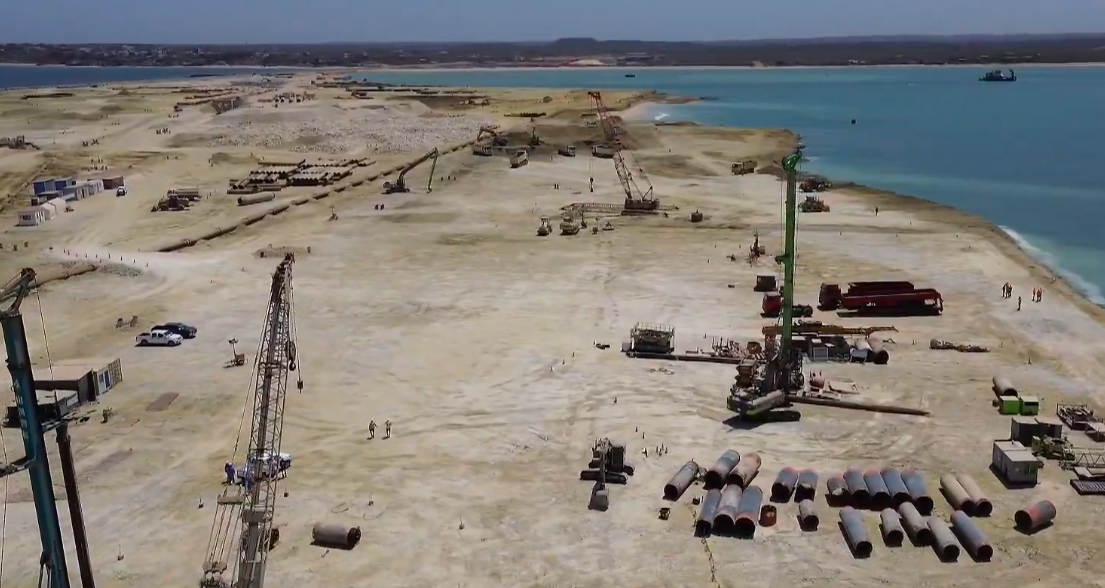
Consider the Ndayane deep-water port, a $2 billion mega-project south of Dakar designed to accommodate the world’s largest container ships. Though the contract was awarded to the Emirati firm DP World, the construction consortium is overwhelmingly led by Chinese companies. David Gruar, the project director for DP World, confirmed that while French firms were among the competitors, the winning bid came from a group 20% cheaper than the French offering. The implications for Senegal’s economy are immense: the port is expected to revolutionize logistics, job creation, and regional connectivity, propelling the country into a new era of trade and development.
Just a short distance away, the new city of Diamniadio stands as another symbol of this geopolitical realignment. Built to alleviate Dakar’s overcrowding, the sprawling urban project includes a stadium, railway station, hotels, and residential buildings—most of which were constructed by Turkish contractors. The industrial zone, designed to attract foreign investors, is populated by Tunisian and Chinese firms, with no French presence to be found, according to local industry sources. Bohoum Sow, Secretary-General of the APROSI industrial association, noted, “We don’t have any French companies here. The Chinese and Tunisians have been the ones responding to our needs.”
Why Chinese firms are winning over Senegal’s market
The rise of Chinese contractors in Senegal isn’t accidental—it’s strategic. Over the past twenty years, Beijing has made Africa a cornerstone of its economic diplomacy, investing billions in infrastructure, energy, and manufacturing. Unlike their Western counterparts, Chinese companies often pair financial support with technical training, local partnerships, and a willingness to adapt to Senegal’s specific demands. Take the example of a cardboard packaging factory staffed by Senegalese workers under Chinese supervision. The facility, which did not exist before, now supplies a critical industry lacking in Senegal’s economy. “They saw a need and filled it,” Sow remarked. “Their flexibility is unmatched.”
This tailored approach contrasts sharply with the traditional model favored by French firms, which often prioritize short-term profitability over long-term integration. The result? A Senegalese government increasingly turning to Beijing for solutions that align with its development goals. “It’s a win-win,” Sow acknowledged. “Senegal needs infrastructure, and China has understood that. The times have changed—and so have our partners.”
Can French companies reclaim their foothold?
Despite this shift, French firms haven’t disappeared entirely from Senegal’s market. Some have adapted by embracing local partnerships, transferring expertise, and investing in Senegalese talent. The Ragni Group, a French lighting specialist, secured a €70 million contract to install 36,000 solar streetlights across Senegal—partly funded by the French Development Bank. To win the bid, Ragni established a local subsidiary led by Senegalese executives, prioritizing job creation and knowledge transfer. “We focused on flexibility, quality, and cost,” explained Birama Diop, director of Ragni’s Senegalese subsidiary. “And it worked.”
Caroline Richard, head of Proparco’s Senegal office, believes French firms still have opportunities—if they adopt a more collaborative and adaptive model. “The bar is rising, and French companies excel when the requirements are high,” she said. “There’s enormous potential here for growth, especially in labor-intensive sectors.”
Yet the clock is ticking. As Chinese and other international competitors solidify their presence, French companies must act fast to prove they can compete on price, innovation, and local integration. For now, their share of Senegal’s public contracts hovers around just 5%, a stark decline from the 30% they once commanded. The question remains: Can they pivot in time to reclaim their stake in Senegal’s future?