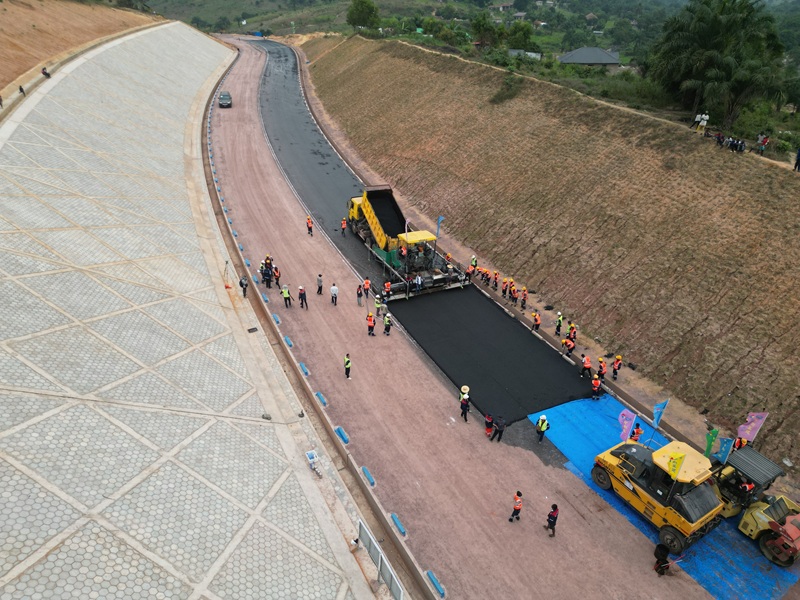
Critical delays in the Sino-Congolese infrastructure programme are threatening the completion of multiple key projects across the Democratic Republic of the Congo (DRC). Despite robust technical, financial, and institutional coordination, the clearance of essential materials and equipment at the Matadi customs post has stalled progress, with severe consequences for project timelines.
bitumen shipment stuck for over six months
According to Nico Nzau Nzau, Director-General of the Congolese Agency for Major Works (ACGT), a significant shipment of bitumen imported by SISC SA has been held up at Matadi customs since January 2026. This material is vital for road surfacing projects, including the Rocades Sud-Est et Sud-Ouest in Kinshasa, the Matadi-Tshela-Singini route, and the Kananga–Kalamba Mbuji highway. Despite the project’s exemption status under the Law No. 14/005 of February 11, 2014, and the Avenant No. 5 to the 2024 Cooperation Agreement, clearance delays persist.
John Banza, Minister of Infrastructure and Public Works, highlighted the urgency during a recent infrastructure caravan in the Grand Bandundu region. He noted that while progress has been made on several sites—such as the General Reference Hospital of Kikwit, where 17 new buildings and 11 modernized wards are under construction—these achievements are now at risk due to logistical bottlenecks.
stuck materials across multiple regions
The impact of these delays extends beyond Kinshasa. Approximately 1,477 tonnes of bitumen intended for the Matadi–Tshela–Singini route and the Kananga–Kalamba Mbuji road remain stranded at Matadi Port. Meanwhile, 1,650 tonnes of bitumen for the rehabilitation of the RN1 (Mbujimayi–Nguba) segment are blocked in the Grand Katanga region. Additional equipment—including concrete plant machinery for the Idiofa Stadium, heavy machinery, spare parts, and other critical materials—is also held up at customs checkpoints, preventing deployment to active construction sites.
seasonal and economic repercussions
The dry season, typically ideal for construction, is now exacerbating delays. Minister Banza emphasized that unblocking these shipments is essential to meet government delivery targets before the onset of the rainy season, which could further hinder progress. Key projects at risk include:
- The Rocades Sud-Est and Sud-Ouest in Kinshasa
- The Manterne–Tshela–Singini road
- The Kananga–Kalamba Mbuji highway
- The RN1 (Mbujimayi–Nguba) national road
- The Idiofa Stadium
- The General Reference Hospital of Kikwit
Without timely intervention, the entire country risks losing valuable time and infrastructure development, leaving communities without access to modern facilities.
role of the apcsc in unblocking bottlenecks
The Agency for Oversight, Coordination, and Monitoring of Conventions (APCSC) plays a pivotal role as the intermediary between stakeholders and customs authorities. Its responsibility includes expediting the clearance of infrastructure-related imports under the Sino-Congolese programme. Failure to address these delays risks not only project slowdowns but also broader economic setbacks for the DRC.
Industry insiders stress that resolving the customs impasse is not just a logistical challenge—it is a national priority to ensure that critical infrastructure projects deliver the promised benefits to the Congolese people.