Northern Mali is currently experiencing a period of intense instability as the regional security landscape undergoes a rapid and dramatic transformation. Following the symbolic fall of Kidal, various armed factions have maintained a swift offensive, while the Groupe de soutien à l’islam et aux musulmans (JNIM) has initiated an unprecedented political challenge by advocating for the dissolution of the current transition government.
A significant military setback reminiscent of past crises
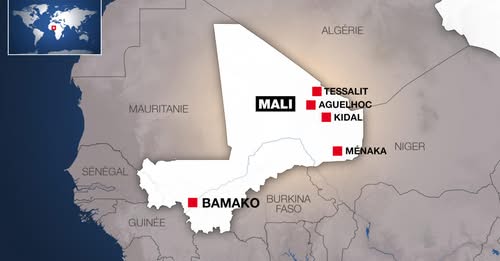
The current situation draws troubling parallels to the events of 2012. On Friday, May 1, 2026, JNIM militants alongside separatist forces from the Front de libération de l’Azawad (FLA) successfully seized control of the strategic military installations at Tessalit and Aguelhoc. The withdrawal of the Forces armées maliennes (FAMa) and their Russian partners from Africa Corps allowed these groups to occupy the sites without significant resistance.
A widely circulated image has come to symbolize this tactical defeat, depicting Seidane Ag Hitta, a prominent JNIM leader, holding the keys to the Tessalit camp. This development occurs five years after the conclusion of the French Barkhane mission. Since April 25, several other locations, including Ber, Tessit, Hombori, and Gourma Rharous, have fallen out of government control, causing deep concern for the residents of Gao and Tombouctou.
The response from Bamako and continued support from Moscow
Despite these territorial losses, the administration at the Koulouba palace remains resolute. General Assimi Goïta has issued a call for a “national awakening,” asserting that the state will not be deterred by tactics of intimidation. The government’s defensive strategy is currently operating on two primary levels:
- Military operations: The Malian air force is conducting targeted strikes in Kidal, focusing on administrative buildings and logistical hubs. While the FLA disputes the effectiveness of these raids, Bamako maintains that numerous hostile elements have been neutralized.
- Logistical resilience: In response to a jihadist blockade affecting major supply routes to the capital, a substantial convoy of 800 fuel tankers successfully reached its destination this Friday, supported by heavy aerial and ground protection.
In Moscow, Kremlin spokesperson Dmitri Peskov reaffirmed Russia’s unwavering commitment to the Malian transition authorities, dismissing any suggestions that recent setbacks in Kidal would lead to a reduction in Russian military cooperation.
JNIM adopts a political narrative: Sovereignty and religious law
A notable shift in the conflict is the changing rhetoric employed by JNIM. In a statement released on the night of April 30, the group moved away from purely militant language, adopting a political discourse that mirrors the terminology of its opponents.
The organization is now appealing to civil society, political parties, and religious leaders to form a “united front” aimed at establishing a “peaceful transition” to replace what they term the “junta’s dictatorship.” By utilizing concepts such as “souveraineté” and “dignity,” JNIM is attempting to gain traction with a public weary of ongoing conflict, though their ultimate objective remains the implementation of Sharia law.
The political class in Mali is currently grappling with a severe dilemma, as some wonder if engaging with former enemies is a necessary step to prevent further national collapse.
Internal pressures on the transition government
The crisis is also manifesting within the state’s own institutions. The public prosecutor in Bamako recently announced the detention of several Malian military personnel on suspicion of collaborating with insurgent forces during recent attacks.
Faced with territorial losses, a sophisticated political challenge from JNIM, and the economic strain of a blockade, the transition regime is navigating its most significant challenge to date. The future of Mali is being contested not only in the northern deserts but also through a struggle for political legitimacy within Bamako.