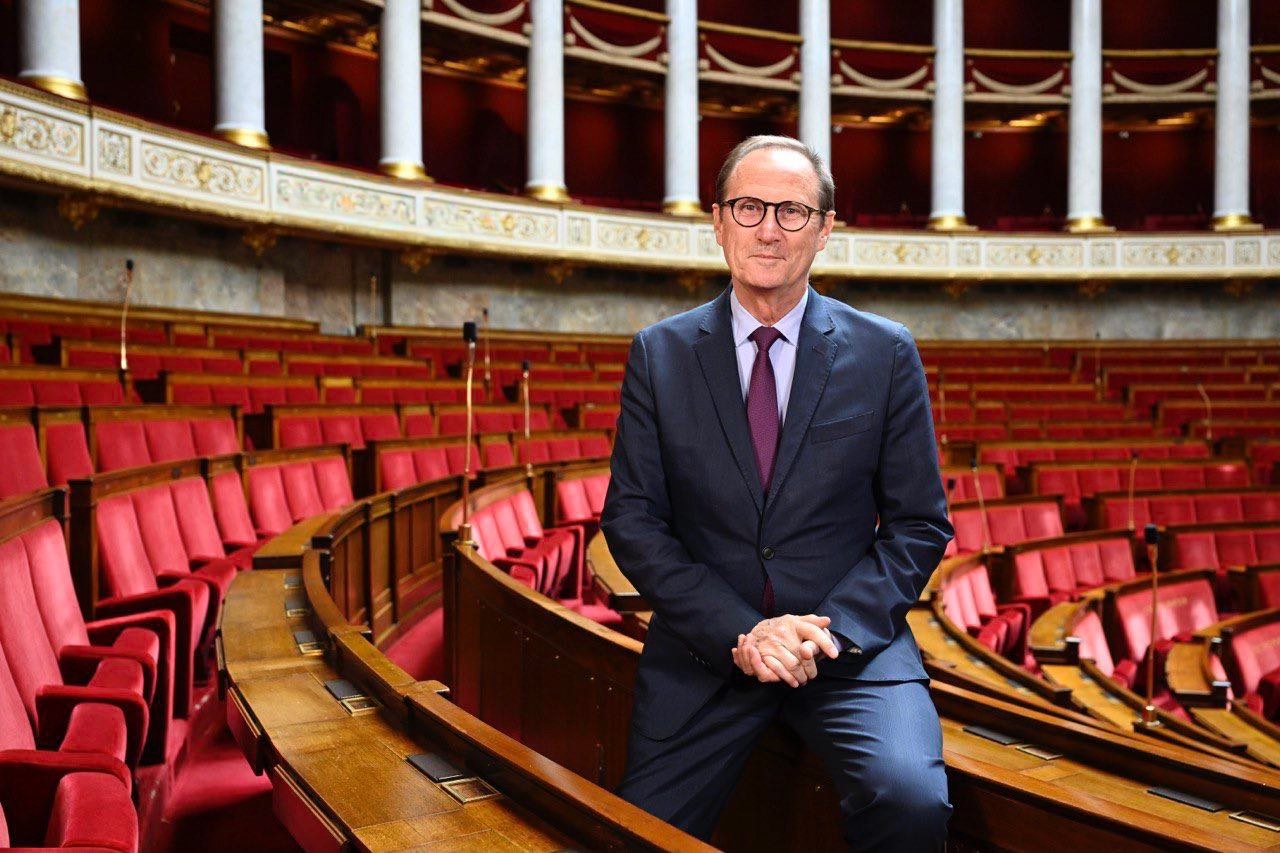
France’s evolving stance on Mali’s severe crisis is becoming increasingly clear. Bruno Fuchs, the centrist (Modem) President of the National Assembly’s Foreign Affairs Committee, who frequently accompanies President Emmanuel Macron on his travels, openly shared his perspective on the situation.
Beyond optimistic assertions about France’s future on the continent — “if we eliminate all irritants, like the CFA franc, visa issues, etc., we will once again be a desired power” — the most striking aspect of this discussion is the inherent contradiction it reveals. It juxtaposes pledges to abandon the colonial-era ‘Françafrique’ relationship with a persistent drive to reclaim influence lost to Russian presence.
Most cynically and vexingly, Fuchs addressed Mali. He, along with certain French military and political strategists who likely view the complex April 25 attack favorably, confidently predicts the future: “Russian forces are currently negotiating their withdrawal from Mali, and the ruling junta in Bamako will collapse within weeks or months.”
Recalling President Macron’s statement in Nairobi days earlier — “the departure of French soldiers was probably not the best decision the putschists made for their country” — the interviewer questioned if France welcomed the military setbacks experienced by Russian forces in northern Mali.
“Excluding the french partner is counterproductive”
Bruno Fuchs sidestepped the direct question, paraphrasing the President: “Excluding the French partner has proven counterproductive.” The implication was clear. The deputy then continued with his scenario: “I believe the Malian junta has only days or weeks left. Today, it finds itself in a weak position relative to the FLA and JNIM. Therefore, the regime in Mali will change within weeks or months; it is inevitable.”
The parliamentarian then ventured onto particularly sensitive ground. “Malians face a choice between fundamentalist jihadists [a curious concept] – not all of them [even more fascinating] (…) and FLA rebels on one side, and on the other, democratic life, public liberties, the Mali of before.” He insisted, “Life in Mali is likely to change,” seemingly overlooking the fourteen years of conflict already endured by the beleaguered population.
“How to integrate JNIM?”
With continued assurance, Bruno Fuchs then outlined Mali’s political future. He presented two potential scenarios. In the first, Bamako agrees to negotiate. “If the junta and President Assimi Goïta are reasonable, they will open negotiations. There would be a transition period of three to six months with one of the military figures from the Transition – I won’t name names, but not Assimi Goïta – leading to elections within three or six months.” We can set aside the unrealistic timeline. Such a transition, initiated under JNIM pressure, would, in his view, pose a central question: “The question arises: within governance, within collaborative efforts, how do we integrate JNIM?” This phrasing demands attention: JNIM is an Al-Qaeda affiliate, and its leader, Iyad Ag Ghali, was once France’s primary adversary, a conflict in which France lost 57 soldiers across the Sahel.
Regarding JNIM, Bruno Fuchs appears to possess firsthand information, likely more than any Malian. A significant revelation!
“I believe JNIM is prepared to lay down arms and cease armed conflict, provided they can participate in the nation’s political life. This would involve participation, not outright control, of Mali’s political landscape.” The President of the Foreign Affairs Committee did not explain why the most powerful actor on the ground would merely participate without asserting its dominance. Perhaps, as everyone knows, the important thing is not to win, but to participate. This leads to a cruel dilemma: “The question for us, Europeans or French, is what do we do? Do we support this transition in which JNIM has a political role, or do we not? I don’t have the answer, but it’s a real problem of conscience and a real political problem.” Indeed, it is a serious question, not just “for us, Europeans or French,” but primarily for Malians.
“The worst: Afghanistan”
- Bruno Fuchs produced a second scenario. “The junta absolutely wants to resist, does not negotiate, and at some point, finds itself in a position of weakness. The Russians are negotiating their departure, contrary to what they claim (…) At that point, the junta will fall. If it’s not negotiated, it will certainly be worse than if there had been a negotiation.” Worse for whom — for Mali, for the region, for France? Fuchs did not specify. Returning to his first scenario, the deputy elaborated on the potential outcomes of the hoped-for negotiations.
“We could see a Mauritanian-style model, meaning a religious regime; or a Nigerian-style model, a federal state in Mali where some states apply Sharia law (…) and others do not. So, ultimately, a federal state with different regimes, guaranteeing the representativeness and role of each community in the country’s life, the political life of the country, like in Nigeria for example.” This scenario is favored by Bruno Fuchs: a not-too-extremist Islamic Republic where each community’s representativeness and role are guaranteed. How? He did not say. A missed opportunity to advance the debate. The challenge for Mali, in fact, is that communities share the same space; they do not yet live in separate bantustans. Thus, the whole concept remains vague, even nebulous.
The second scenario, the “ultimate model,” is Afghanistan. While Bruno Fuchs seemed at ease with the first, he expressed that he “does not wish for an Afghanistan in the heart of the Sahel, because that would have consequences for the entire region,” encompassing not only the Sahel countries but also their “innocent” neighbors: Guinea, Senegal, Côte d’Ivoire, Benin, and Togo. “Complicated,” he concluded. One could not put it better.
“The russians would be ready to withdraw”
Slightly taken aback by these definitive pronouncements, the interviewer pressed further. “Do you have information indicating that the Russians are preparing to leave Bamako?”
Yes, Bruno Fuchs replied without hesitation. “They are negotiating. They have repositioned their forces. There are ongoing negotiations.” Regarding the uncertain outcome of these discussions, “everything depends on JNIM, everything depends on the junta.” But he was certain that the Russians “would be ready to withdraw, provided certain guarantees are secured regarding the assets they currently exploit in Mali, such as the gold mines, which they are reluctant to see expropriated, even if their legitimacy to exploit them, in my opinion, is quite questionable.”
Bruno Fuchs, despite expressing a desire to close the unfortunate chapter of Françafrique with its “colonial-era behavior,” this history “we haven’t settled with Francophone Africa,” this tendency to impose “our truths and our views” and not tolerate “resistance,” still holds strong opinions on who is legitimate or not to exploit Mali’s resources.
The underlying message is that France and, say, Europe, “to avoid being immodest,” possess greater legitimacy than Russia. And why? Because France “is reliable in its commitments,” unlike the Americans and Russians “who are leaving Mali because things are not going well for them.” Not one to shy away from contradiction, he then cited the example of the Central African Republic, with which “we have normalized our relations, we have re-established normal relations with President Faustin Archange Touadéra,” even though “the Russians are there.” “We must learn to work with everyone.”
With everyone, it seems, except the disfavored leaders of the Alliance of Sahel States.