Gabon : Nkok, le modèle qui intrigue l’Afrique
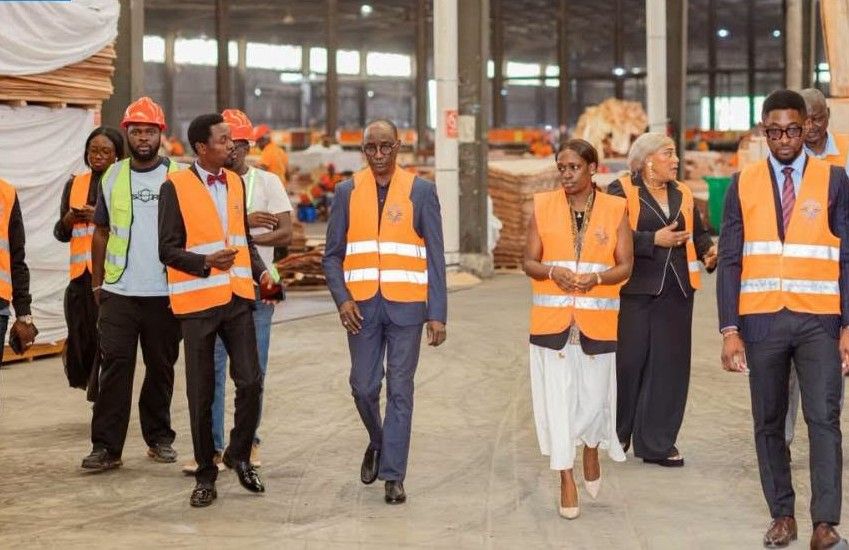
Libreville, June 27, 2026 – Shortly after presenting his credentials to President Brice Clotaire Oligui Nguema, Chad’s new ambassador extraordinary and plenipotentiary to Gabon, Zakaria Fadoul Kittir Jr., headed straight for one of the most visible symbols of Gabon’s economic transformation.
The diplomat visited the Nkok Special Investment Zone on Thursday, an industrial laboratory that has become a continental benchmark for local natural resource processing.
This trip, undertaken at the very start of his diplomatic mission, goes far beyond protocol. It reflects the growing interest many African states have in Gabon’s model as they face similar challenges of economic diversification, industrial transformation, and value addition from their raw materials.
Wood as an industrial showcase
The visit centered on the timber sector, a flagship of Gabon’s economic strategy. The Chadian diplomat toured Chanta Group’s facilities, a company specializing in plywood and veneer sheets whose production serves both African and international markets.
The immersion allowed the Chadian delegation to see firsthand the results of a policy Gabonese authorities have pursued for years. Once a major exporter of raw logs, Gabon gradually imposed local processing to retain a larger share of the wealth generated by its forest resources.
The results are now visible at Nkok. Dozens of industrial units process timber on-site, create skilled jobs, foster knowledge transfer, and build an industrial fabric that meets global standards. For many African observers, this evolution ranks among the continent’s most successful examples of natural-resource-based industrialization.
A window into economic diversification
Nkok’s zone is not limited to forestry. As an integrated industrial platform, it hosts companies in fields as varied as metallurgy, construction materials, agro-industry, and manufacturing. This concentration makes the zone a strategic lever for Gabon’s economic diversification policy. In a global context of uncertainty in raw material markets, developing local industries has become essential to reduce dependence on raw exports.
The interest shown by the Chadian representative illustrates a broader trend. More and more African countries are looking to learn from experiences that enable local resource transformation, develop national value chains, and strengthen economic sovereignty.
An instrument of influence for Gabon
Beyond industrial performance, Nkok is becoming a tool for Gabon’s economic and diplomatic outreach. Each official visit reinforces its status as a showcase of national know-how and a platform to attract international investors. For Libreville, this recognition validates the strategy to make the country a regional industrial hub capable of drawing capital, technology, and strategic partnerships.
The new Chadian ambassador’s visit comes at a time when African economic cooperation is gaining importance. Interstate exchanges no longer focus solely on raw materials but increasingly on industrial models, transformation experiences, and value-creation strategies. By attracting the attention of diplomats, investors, and decision-makers across the continent, the Nkok Special Investment Zone confirms it is no longer just a Gabonese project. It is steadily becoming an African reference in thinking about industrialization, local transformation, and building new development pathways.