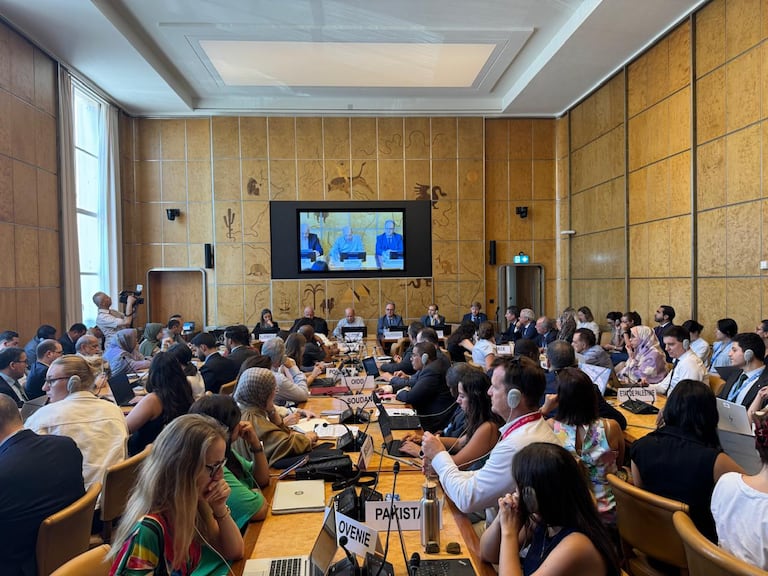
Against a backdrop of growing global recognition of corruption’s devastating impact, a high-level discussion took place in Geneva, echoing the ongoing discussions at the Human Rights Council. Central to this dialogue is the widely accepted view that combating corruption and safeguarding fundamental rights are not separate issues but mutually reinforcing pillars of justice and development.
International frameworks such as the United Nations Convention against Corruption, the 2011 Marrakech Declaration, and the 2021 UNGASS political declaration all underscore the need for a preventive approach rooted in the rule of law, democratic governance, and human rights protection.
Morocco’s integrated strategy gains international traction
Morocco took center stage to showcase its holistic strategy, which aligns domestic policies, national institutions, and international commitments. As the moderator of the session, Ambassador Omar Zniber, Permanent Representative of Morocco to the United Nations in Geneva, described the initiative as “a critical milestone at the multilateral level.”
He highlighted the “instrumental contributions of senior Moroccan officials” and the “leading role Morocco has played in shaping this agenda at the United Nations,” emphasizing the coordinated efforts of national bodies and alignment with the country’s strategic priorities in transparency and governance.
Corruption as a barrier to human dignity and equality
El Habib Belkouch, Interministerial Delegate for Human Rights, reframed the conversation by addressing corruption’s direct consequences on people’s lives. He warned that when corruption infiltrates justice systems, healthcare, education, or employment, it strips individuals of their most basic rights.
“Every diverted or wasted resource due to corruption is one less resource available to fund schools, hospitals, or public services,” he explained, stressing that the burden falls disproportionately on the most vulnerable—women and marginalized groups.
Belkouch argued that prevention must become the cornerstone of anti-corruption efforts, championing transparency, access to information, civic participation, and accountability as both fundamental rights and essential tools in the fight against corruption.
He also called for stronger institutional collaboration, stating that “coordinated governance is a top priority to enhance the effectiveness of public policies.”
From abstract principle to real victims: redefining the corruption debate
Mohamed Benalilou, Chair of Morocco’s National Authority for Probity, Prevention, and Anti-Corruption, expanded the discussion by framing corruption not just as financial misconduct but as a systemic violation of human rights.
“We are no longer talking solely about diverted funds—we are talking about real victims robbed of their rights,” he stated, urging a shift away from traditional paradigms.
Benalilou also drew attention to overlooked dimensions, noting that “gender-based corruption” remains a significant obstacle to equality, reinforcing systemic discrimination.
He introduced a conceptual shift, arguing that preventing corruption is evolving into a positive obligation for states to protect rights and freedoms. In this context, anti-corruption measures are becoming a key component of human rights due diligence.
He further advocated for “preserving civic space” and recognizing whistleblowers as human rights defenders. His vision calls for an “institutional integrity model”, where institutions go beyond merely avoiding corruption—they actively uphold rights and ensure equality.
A call for unified global action
On the international stage, Benalilou stressed the need for greater coherence between processes in Geneva, Vienna, and New York, emphasizing that obligations under the United Nations Convention against Corruption and human rights frameworks represent two sides of the same commitment.
He urged the creation of “structural bridges” between institutions and the adoption of a “rights-based preventive governance” model to strengthen collective action.
By the end of the discussions, participants reached a shared consensus: to make anti-corruption efforts a powerful lever for human rights protection, urgent action is needed. The focus is on education, capacity-building, civic engagement, and digital innovation as vital tools for promoting good governance, transparency, and accountability.