When security outsourcing leads to collapse: the Mali junta’s miscalculation
The speed at which allies abandon a failing strategy often reveals its true nature. In Mali, the junta’s decision to outsource national security to foreign paramilitary forces has backfired spectacularly. Recent military setbacks against a combined offensive by the Azawad Liberation Front (FLA) rebels and the Group for the Support of Islam and Muslims (GSIM) have exposed systemic weaknesses in Bamako’s leadership. By betting everything on Russian mercenaries, the transitional government led by Assimi Goïta has exposed the country’s deep vulnerabilities.
Kidal: the moment the Russian shield cracked
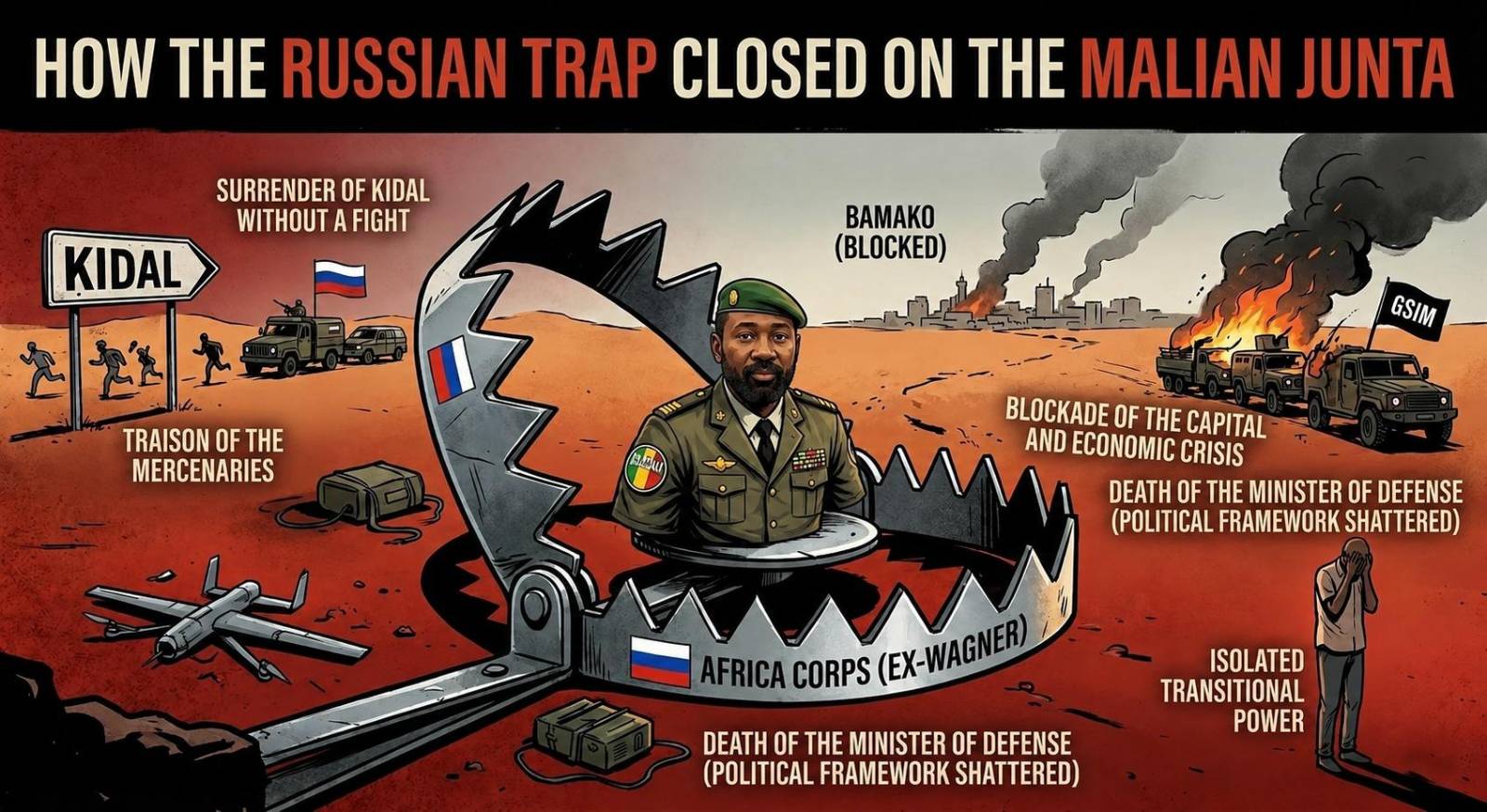
The turning point came in late April 2026 in Kidal, a city once hailed as a symbol of military recovery after its recapture by Malian forces and their Russian allies in 2023. The fall of the strategic stronghold was swift—and humiliating. Instead of a heroic last stand, the Russian mercenaries negotiated their own withdrawal with rebel forces, abandoning heavy weaponry to secure safe passage. Local officials in Bamako privately admitted the extent of the betrayal, with one stating, “The Russians left us to fend for ourselves in Kidal.”
This pragmatic retreat underscored a harsh geopolitical reality: mercenary forces serve only their own interests, not the nations they supposedly protect. Moscow’s decision to prioritize its operatives’ survival over Mali’s territorial integrity revealed the limits of its influence in West Africa.
From the North to Bamako: the junta’s unraveling
The collapse of this outsourced security model is no longer confined to the deserts of the north. In April, a major offensive reached the outskirts of Kati and Bamako itself, culminating in the death of General Sadio Camara, Mali’s Defense Minister and the architect of the junta’s alliance with the Kremlin. With its key strategist gone, the transitional government now faces a leadership vacuum amid a deepening humanitarian and economic crisis.
For months, the GSIM has enforced a tight blockade on fuel, food, and goods entering the capital. Schools have closed, electricity is sporadic, and the economy has ground to a halt. The promised Russian military shield failed to prevent the siege of Bamako or the infiltration of hostile forces into the heart of power.
The failure of drones and the illusion of control
To justify expelling traditional international forces like MINUSMA and Barkhane, the junta claimed the Malian Armed Forces (FAMa) could secure the country with Russian technology and surveillance drones. While drone strikes increased, they also fueled local resentment by causing civilian casualties, destabilizing communities without ever regaining control. Analysts now believe Russia’s remaining mercenaries are focused solely on protecting the regime in Bamako—abandoning any pretense of restoring stability nationwide.
Regional isolation and the junta’s final days
The Alliance of Sahel States (AES), once touted as a new bulwark of regional solidarity, has remained conspicuously silent. Abandoned by its Russian backer, ostracized by the Economic Community of West African States (ECOWAS), and rejected by a population suffocating under blockades, the junta’s days appear numbered. The gamble on imported security has proven to be Mali’s greatest strategic blunder in modern history.
By sacrificing diplomacy, national dialogue, and regional alliances in favor of a private military contract, Bamako has trapped itself in an inescapable deadlock. The question is no longer whether the regime will fall, but how long it can cling to power before the security void it created consumes it entirely.