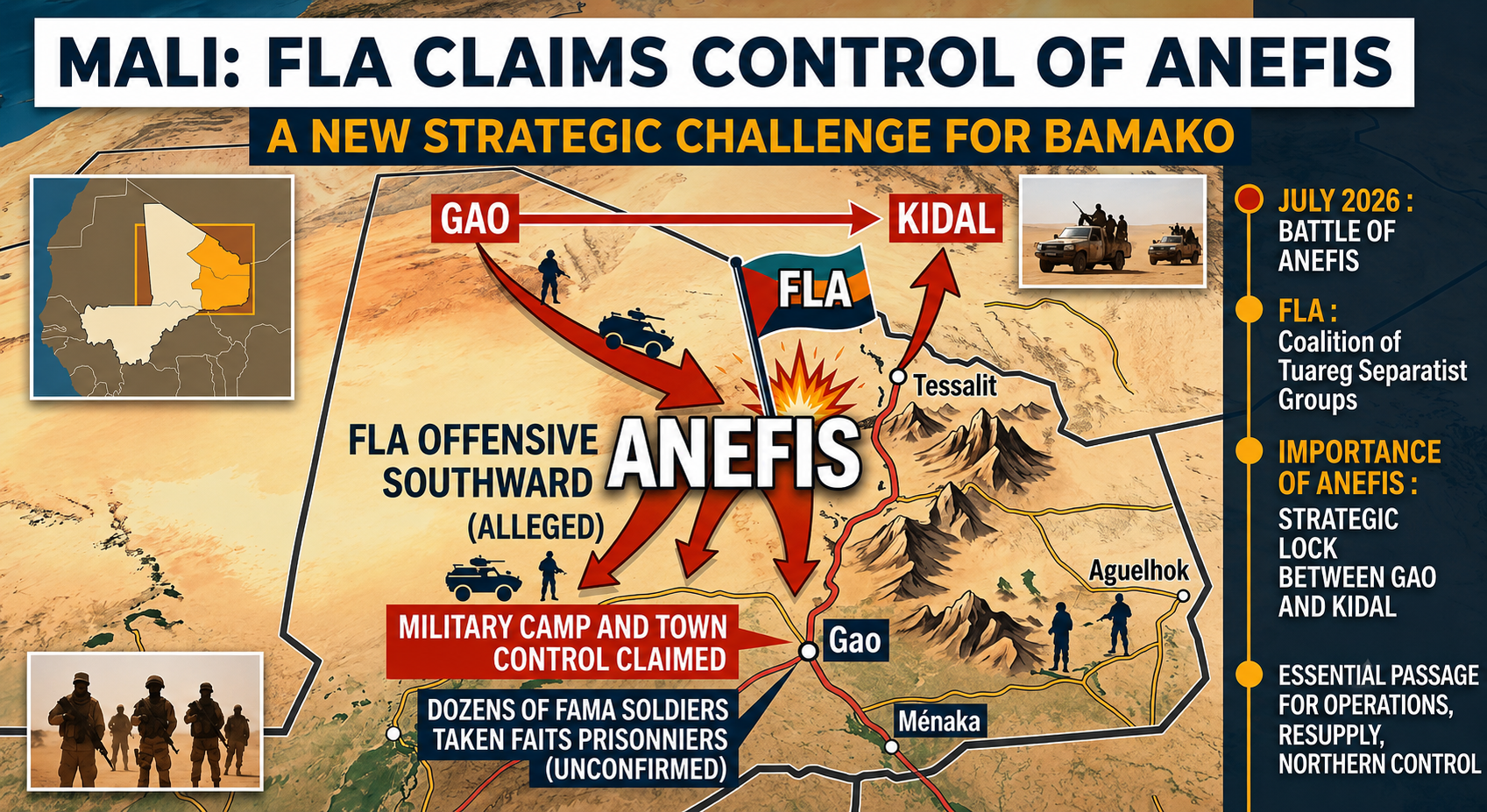
Northern Mali witnessed a significant military escalation this Saturday, July 4, 2026, centered around Anefis, a strategically vital locality situated along the crucial axis connecting Gao to Kidal. The Front de libération de l’Azawad (FLA), a coalition representing various Tuareg separatist factions, declared it had seized both the military camp and the town following a sustained offensive against the Malian armed forces.
The movement further asserted that dozens of Malian soldiers were taken captive during the intense engagements. As of now, these specific claims remain unconfirmed by independent sources, and Malian authorities have not released any official casualty figures or statements that would either corroborate or dispute the FLA’s announcements.
Simultaneously with these confrontations in the north, reports surfaced detailing another assault that occurred overnight from July 3 to July 4, 2026. This incident targeted the Kéniéroba civil prison, located approximately sixty kilometers from the capital, Bamako. Information indicates that armed individuals launched an attack on the correctional facility. By approximately 5:30 AM Universal Time on Saturday morning, fighting was reportedly still underway, with persistent heavy gunfire and detonations echoing across the area. Similar to the situation in Anefis, official figures or communications from Malian authorities were unavailable at the time of this report.
The synchronized nature of these events underscores the persistent and multifaceted security pressure confronting Mali. While the nation’s army remains deeply engaged in battling separatist groups in the northern regions, the reported attack near the capital, if verified, would suggest a concerning capacity for armed groups to open multiple fronts and stretch the resources of the security forces.
The battle for Anefis carries particular strategic weight due to its geographical positioning. Serving as a critical choke point between Gao and Kidal, it has for years represented an indispensable passage for military operations, logistical resupply, and the broader control of movements throughout the northern part of the country. Its confirmed loss would undeniably constitute a significant setback for the Malian army, which has been striving for months to solidify its hold over recently recaptured territories.
Since governmental forces successfully reclaimed Kidal in 2023, the region has remained a volatile theatre of regular clashes between the army and various armed groups. Despite successive offensives launched by Bamako, the security landscape continues to be extremely precarious. These recent engagements highlight the enduring capability of rebel groups to execute coordinated operations against established military positions, thereby challenging the perceived stability of areas considered to be under government control.
Beyond the immediate military implications, this series of developments brings into sharp focus the ongoing challenges faced by the Malian state in simultaneously ensuring security across multiple regions of the country. Between the claimed offensives in the north and the reported attacks on the periphery of Bamako, authorities are navigating an exceptionally complex security environment, which continues to raise questions regarding the conflict’s trajectory and the effectiveness of current response strategies.