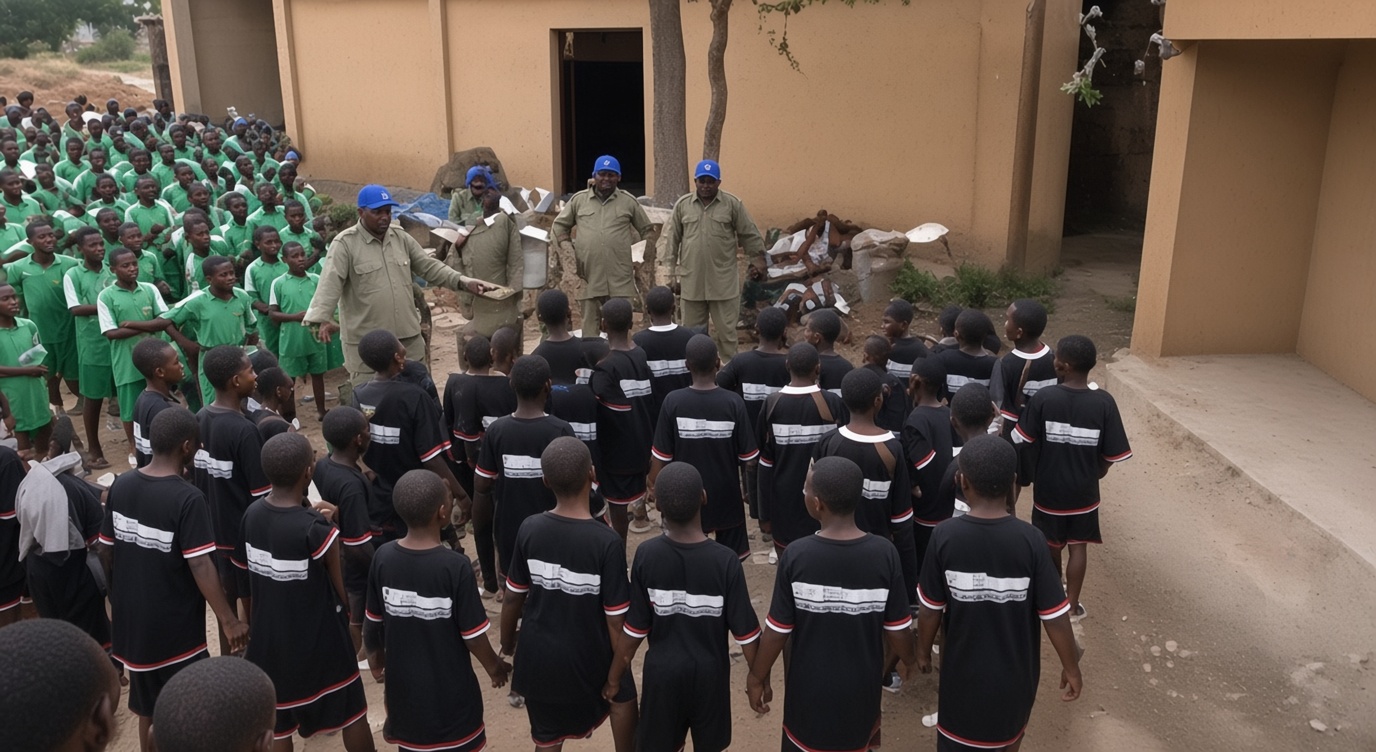
General Abdourahamane Tiani has recently inaugurated a training camp for over 300 young Nigeriens, framed as a civic engagement initiative aimed at fostering national renewal. While this program is presented as an opportunity to inspire patriotism and a collective awakening, its underlying motivations raise serious concerns. Modeled on the approach adopted in Burkina Faso under Captain Ibrahim Traoré, the initiative appears to be an attempt to embed military culture into civic education. However, this strategy may conceal deeper, more concerning ambitions.
A young person’s formative years should be dedicated to education, vocational training, sports, cultural enrichment and the development of critical thinking. Exposing adolescents to a militarised environment, with its emphasis on discipline, unquestioning obedience and perpetual readiness for conflict, risks normalising the idea that violence and confrontation are legitimate tools for societal progress. The long-term psychological and social impact of such conditioning on an entire generation cannot be overstated.
The central issue here is not merely the nature of the camp itself, but the political message it conveys. When a military-led government frames youth mobilisation as a patriotic duty, it blurs the line between civic duty and indoctrination. True civic engagement is not about blind obedience to authority; it encompasses the capacity for critical thinking, constructive debate and the defence of the public good. By presenting loyalty to the regime as the ultimate virtue, the state risks undermining the intellectual independence of its future citizens.
Patriotism versus militarism: striking the right balance
The blurred distinction between civic education and ideological conditioning becomes especially dangerous when young participants are constantly exposed to rhetoric centred on sacrifice, perpetual struggle and the defence of the nation. While mobilised youth can undoubtedly contribute to national development, their role should never be reduced to serving as a human resource pool for sustaining a military regime.
This approach also raises practical questions: why invest vast resources in ideological mobilisation when thousands of young Nigeriens lack access to functional schools, vocational training, employment opportunities and basic infrastructure? Patriotism, after all, does not fill empty stomachs, nor does it replace the need for education and economic stability. Instead of fostering a sense of nationhood, this rhetoric may serve as a political smokescreen, diverting attention from pressing economic challenges, systemic educational failures and the broader consequences of political instability.
Looking ahead: the long-term dangers of militarised youth
The risks extend far beyond immediate concerns. A generation raised in an environment of constant mobilisation may come to view societal militarisation as a normal, even desirable state of affairs. What is presented today as an exceptional initiative could tomorrow evolve into an institutionalised model of political and paramilitary youth indoctrination. This trajectory would have profound and lasting implications for the social fabric and democratic development of the nation.
The comparison with Burkina Faso is instructive, yet caution is warranted. While both countries face significant security challenges, the temptation to respond through the widespread militarisation of youth must be resisted. Military training has its place in crisis response, but transforming an entire generation into potential combatants is neither sustainable nor conducive to long-term stability or prosperity.
Niger’s youth deserve more than to be instrumentalised in the service of political narratives. They deserve quality education, vocational development, meaningful employment, intellectual freedom and the opportunity to engage in public life without being coerced into allegiance to a specific political or military doctrine. A robust state is not one that trains its children to obey and fight at an early age, but one that empowers them with knowledge, autonomy and the tools to shape their own future.
The essence of true patriotism lies not in prematurely cultivating a militarised mindset, but in cultivating citizens who are capable of building, innovating, thinking critically and defending their nation when necessary within the bounds of the law. The Republic of Niger must ensure that the fight against insecurity does not become the pretext for the enduring militarisation of childhood and adolescence. The preservation of its social and democratic values depends on it.