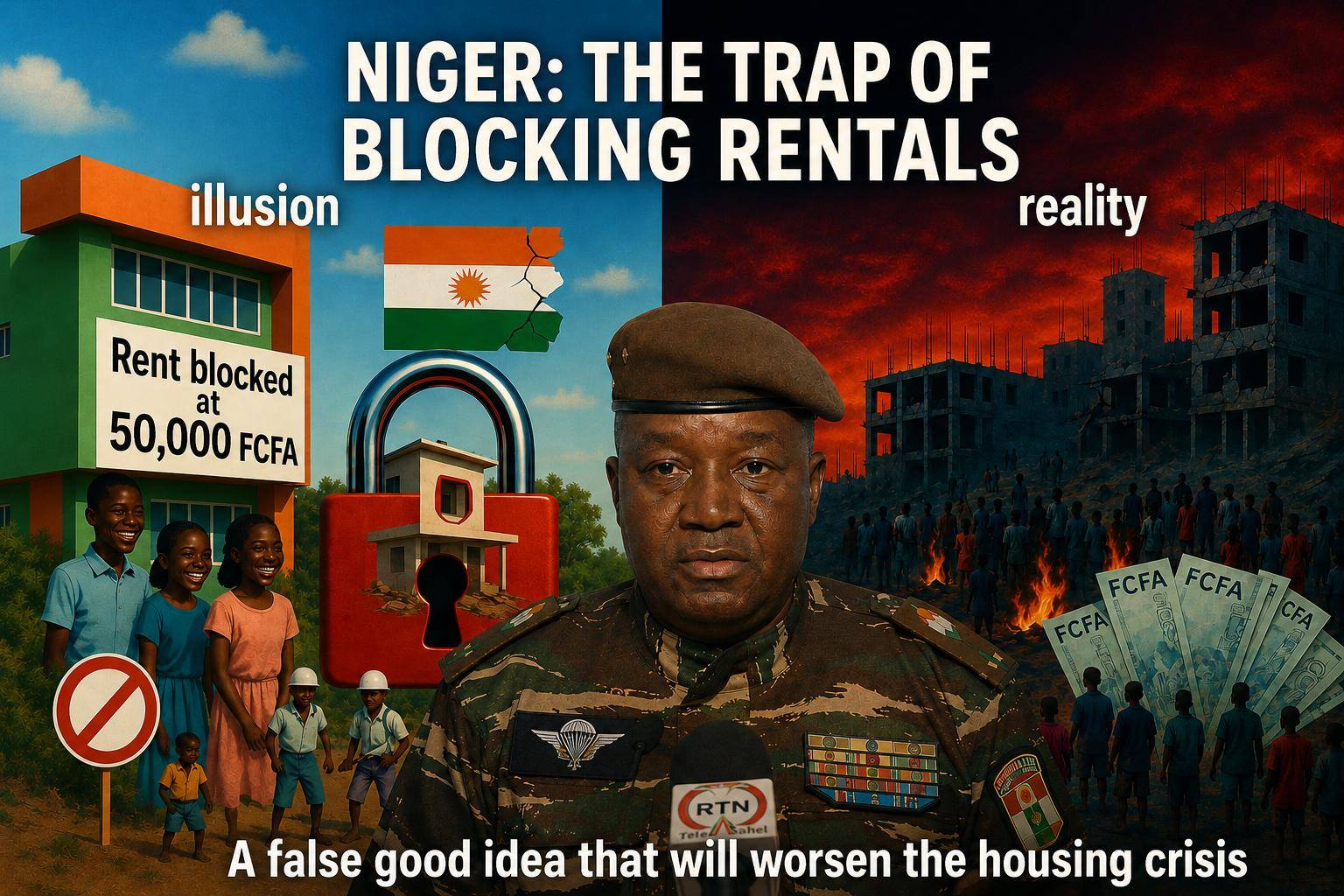
The Nigerien authorities have recently enacted a decree capping rental prices in Niamey, ranging from 15,000 to 80,000 West African CFA francs. While the measure aims to address housing affordability for low-income families, economists warn that such an approach neglects fundamental economic principles. Rather than alleviating the housing crisis, the policy risks exacerbating it by discouraging investment in new residential developments.
An ill-conceived solution to a complex issue
The transitional government’s stated goal—halt excessive rent hikes and curb real estate speculation—may appear commendable. However, history demonstrates that price controls imposed by administrative fiat rarely yield sustainable solutions. Instead, they often create unintended consequences that deepen the very problems they seek to resolve.
Why rent control destabilizes the housing market
The fundamental economic principle at play is supply and demand. When housing availability fails to meet demand, prices naturally rise. To reduce costs sustainably, the solution lies in increasing supply through new construction—not artificially suppressing prices.
The new decree imposes severe restrictions, particularly on social housing in Niamey, where monthly rents are capped at 80,000 CFA francs. This policy introduces three critical challenges:
- Investment paralysis: Developers and property owners lose financial incentives to build or maintain housing when profit margins are artificially constrained. New construction projects grind to a halt.
- Neglect of existing stock: Reduced rental income discourages property owners from maintaining their buildings, leading to rapid deterioration in housing conditions.
- Shadow market emergence: When demand outstrips supply, corruption thrives. Prospective tenants may resort to under-the-table payments to secure housing, undermining legal protections and fairness.
The state’s limited capacity to intervene
Effective rent control would require the government to massively invest in subsidized housing to offset the withdrawal of private developers. Yet, Niger’s public finances are already strained by political instability and reduced international aid, rendering such an initiative unfeasible.
Additionally, the decree sends negative signals to local banks, which are now less inclined to finance real estate projects. This ripple effect stifles economic activity across sectors, from construction material suppliers to local labor markets.
A short-term political move with long-term repercussions
The government’s decision appears driven by short-term political gains, aiming to bolster public support during a transitional period. However, economic theory and global experience confirm that price controls do not resolve underlying shortages. By disincentivizing construction, the decree risks transforming a cost-of-living crisis into a severe housing scarcity, making it even harder for Niamey’s residents to secure stable accommodation.