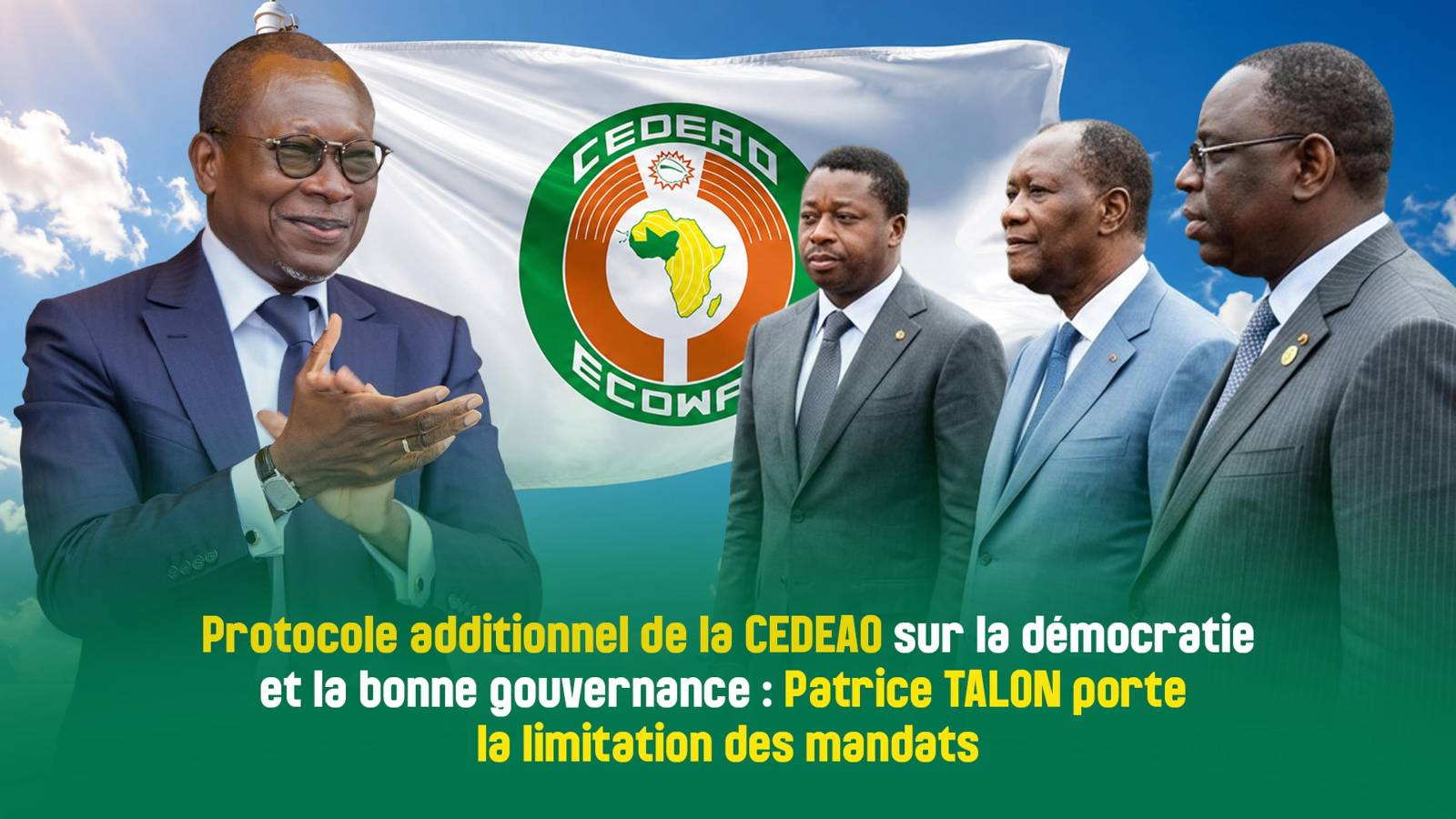
West Africa stands at a crossroads, where democratic principles clash with entrenched political interests. At the heart of this standoff is the limitation of presidential mandates, a doctrine championed by Benin’s President Patrice Talon. While Cotonou pushes for stricter term limits as a safeguard against constitutional coups, a powerful bloc of regional leaders resists, reshaping the dynamics of ECOWAS and Benin’s role within it.
Cotonou’s crusade for term limits
Since assuming office in 2016, Patrice Talon has made the mandate limitation a cornerstone of his foreign policy. For Porto-Novo, the wave of military takeovers in Mali, Burkina Faso, and Niger stems from a refusal to adhere to term limits, allowing leaders to cling to power indefinitely. Talon’s solution is radical: a blanket ban on more than two presidential terms across all ECOWAS member states, with no loopholes for constitutional amendments.
His argument is clear: without a unified and unbreakable rule, ECOWAS risks becoming a forum where democratic backsliding goes unchecked. By advocating for this stance, Talon positions Benin as a moral compass in a region plagued by instability, where leaders often bend rules to extend their stay in power.
Lomé, Abidjan, and Dakar: the resistance bloc
The push for term limits has hit a wall of opposition from three influential leaders. In Lomé, Faure Gnassingbé frames the proposal as an assault on national sovereignty, especially after Togo transitioned to a parliamentary system that effectively prolongs his grip on power. Meanwhile, in Abidjan, Alassane Ouattara’s government argues that term limits should remain a domestic affair—a stance that gained notoriety after his controversial third-term bid in 2020. Dakar, under Macky Sall’s leadership, also rejected supranational constraints, despite Senegal’s own recent turmoil over presidential term limits before the 2024 transition.
For these leaders, ECOWAS’ priorities lie elsewhere: combating terrorism and deepening economic integration. The imposition of term limits, they contend, would overstep the organization’s mandate and distract from more pressing challenges.
The cost of conviction: Benin’s empty chair diplomacy
Patrice Talon’s unwavering stance has come at a diplomatic price. Benin has been notably absent from several high-stakes ECOWAS summits, a move framed as a protest against what Porto-Novo sees as double standards. While the bloc sanctions military coups, it turns a blind eye to constitutional manipulations by civilian leaders—a hypocrisy Talon refuses to endorse.
Critics argue that Benin’s boycott isolates the country, but Talon defends it as a matter of principle. For him, consistency in governance is non-negotiable. His refusal to compromise sends a message: democratic integrity cannot be sacrificed for political convenience.
A solitary reformer with growing influence
Despite the resistance from regional heavyweights, Talon’s position resonates with civil society across West Africa. His commitment to stepping down in 2026—unlike many peers who cling to power—sets him apart as a rare leader prioritizing institutional stability over personal ambition. For a generation demanding change, his stance offers a glimmer of hope in a landscape dominated by entrenched elites.
Benin’s model of strict alternation, he argues, is the last line of defense against the region’s instability. Whether ECOWAS will heed this call remains uncertain, but Talon’s gamble is clear: real stability can only emerge from rules that apply equally to all, without exceptions or loopholes.
The broader stakes: a West Africa at the crossroads
This isn’t just a legal dispute—it’s a defining moment for West Africa. By challenging allies like Ouattara and Gnassingbé, Patrice Talon has shifted the conversation toward ethical governance, even if it means disrupting the status quo. While the opposition may have won a technical battle, the Beninese model of uncompromising term limits remains a beacon for those fighting against the erosion of democracy in the region. The question now is whether principle will triumph over the preservation of power—or if the cycle of instability will continue unchecked.