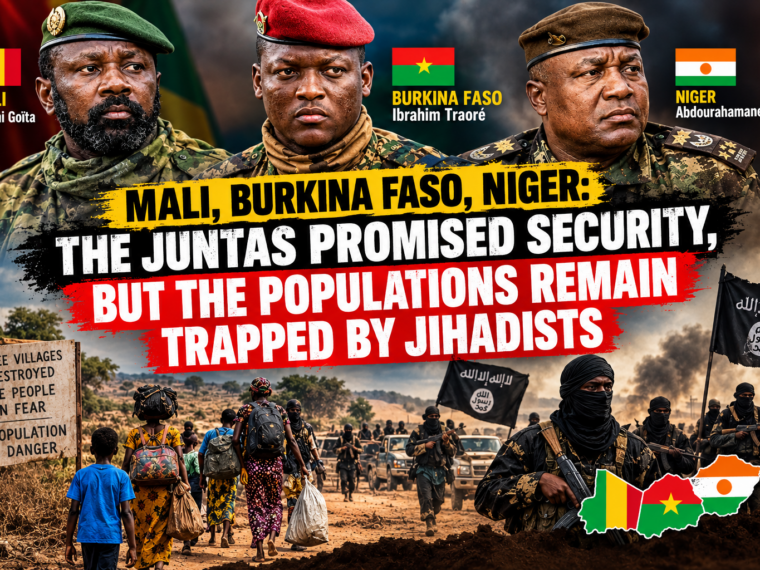
The battleground of the tri-border region: where civilians bear the cost of jihadist power struggles
The arid lands where Mali, Burkina Faso, and Niger meet have become a lethal playground for two deadly jihadist factions: the Islamic State in the Greater Sahara and the Group for the Support of Islam and Muslims (JNIM), an Al-Qaeda affiliate.
For months, these groups have waged an unprecedented war in this strategic area, each claiming hundreds of casualties in their escalating conflict. But the real victims are not the fighters—they are the civilians trapped in the crossfire. The violence has exposed a harsh truth: after toppling long-standing governments in the name of security, the region’s military juntas are struggling to deliver on their core promise.
From state attacks to territorial control: jihadists escalate their ambitions
The conflict between these two rival factions has shifted beyond targeting government forces or state symbols. Now, they are locked in a brutal struggle to dominate key territories, control trade routes, and exploit local resources. The civilian populations caught in the middle face displacement, restricted movement, and economic paralysis, with fears overshadowing daily life.
Displaced communities: Families forced from their homes with no safe return in sight.
Collapsing economies: Closed markets and paralyzed agriculture due to constant threats.
Fear as a weapon: Jihadists selectively punish those accused of aiding the rival faction.
Military juntas under scrutiny: sovereignty tested by insecurity
Mali, Burkina Faso, and Niger’s military governments rose to power on promises of reclaiming control and restoring security. They severed old diplomatic ties, restructured military alliances, and declared their move toward greater sovereignty. Yet, in the tri-border region, civilians remain trapped in a cycle of violence that their governments have failed to curb.
Sovereignty is not merely about rejecting foreign influence; it is also about shielding citizens from harm. When villagers cannot travel freely, farmers abandon their fields, and children miss school due to constant threats, the limits of political independence become glaringly obvious.
After years of promises, the juntas must now answer a critical question: How can they justify their policies when entire communities live under perpetual threat?
The propaganda of conflict: unreliable claims and real consequences
Both jihadist factions release conflicting casualty reports, each inflating their victories and downplaying their losses. Independent verification is nearly impossible in these remote, high-risk areas. But the human toll is undeniable.
Who, then, is left to protect civilians when battles rage near their villages? Who ensures access to healthcare, education, and safe trade when the state’s presence is weak or absent?
These are the benchmarks by which military regimes must be judged not merely by their words or military maneuvers, but by the security they provide to those most in need.
The crumbling authority of the state in rural zones
The problem of insecurity extends beyond sporadic attacks. In rural areas, local authorities struggle to maintain a presence, public services shut down, and security forces are stretched thin. Agricultural land becomes inaccessible, trade routes collapse, and families face an impossible choice: stay in danger or lose their livelihoods.
This does not mean the juntas have abandoned these territories out of malice. Rather, it reflects the harsh realities of a daunting conflict where military capacity is often outmatched by the adaptability of jihadist groups.
Still, the persistence of such conditions demands accountability. Authorities must clarify the results of their strategies, acknowledge shortcomings, and outline concrete steps to shield civilians not just with speeches, but with action.
The measure of success: security that resonates beyond borders
The Sahel’s military leaders have aligned their strategy through the Alliance of Sahel States, positioning cooperation as a cornerstone of their new vision. They argue this alliance breaks free from past failures and restores national control. But the true test of their approach lies in measurable outcomes.
Has the frequency of attacks decreased? Are villages safer? Have displaced families returned home? Are roads secure enough for trade and travel? Without clear answers to these questions, sovereignty rings hollow.
The Sahel crisis is not solved by denunciations of foreign interference alone. It demands a multifaceted response: robust intelligence, cross-border collaboration, justice, and the restoration of essential services.
For the juntas in Bamako, Ouagadougou, and Niamey, the challenge is no longer about seizing power it is about wielding it responsibly. Citizens do not measure their leaders by rhetoric or alliances, but by whether they can live without fear, cultivate their land, and send their children to school in safety.
Until civilians in the most vulnerable areas are truly protected, the promise of a secure Sahel will remain unfulfilled.
By Thomas Nkoulou — Journalist
