repression to mask failure
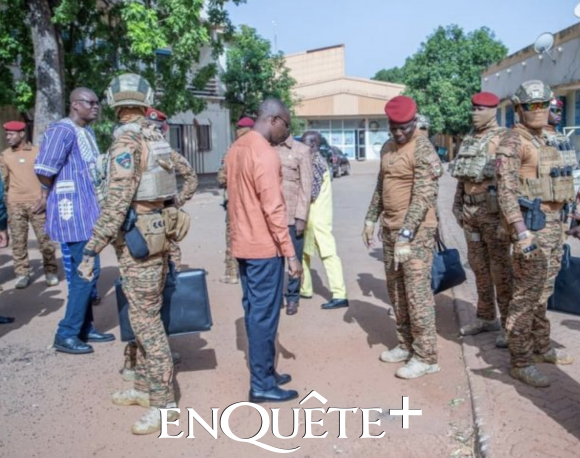
Widespread suppression, arbitrary arrests, and severe restrictions on fundamental freedoms mark a period of escalating authoritarianism for the military regimes within the Alliance of Sahel States (AES). Plagued by profound challenges to their legitimacy, these governments are making life increasingly difficult for human rights advocates and journalists across the region.
Those who rule by the sword often perish by it. Commenting on the recent developments, Alioune Tine, president of Afrikajom Center, echoed this sentiment. He observed that the regime led by Ibrahim Traoré in Burkina Faso is facing significant difficulties. Indeed, military authorities in Burkina Faso, Mali, and Niger find themselves at a critical juncture. A primary justification for their seizure of power was the deteriorating security situation. However, recent months reveal an even more alarming security landscape, frequently worse than before their ascension. As the saying goes, those who seize power by force are perpetually haunted by the specter of losing it the same way.
Reflecting on past pledges, Mr. Tine recalled Captain Ibrahim Traoré’s initial firm commitment to swiftly return power to civilian hands. At the outset of his rule, Traoré had declared the ECOWAS-mandated transition period too lengthy, promising rapid elections to allow Burkinabé citizens to choose their leaders. Today, not only has this promise gone unfulfilled, but the regime increasingly resorts to repressive tactics to maintain control. The human rights situation has worsened considerably, with reports of massacres targeting specific communities, particularly the Peuls. This escalating violence is a source of grave concern for the human rights defender.
military regimes at an impasse
Contrary to official narratives, the nation’s security continues to deteriorate, marked by increasingly frequent attacks that contribute to an already tragic death toll. A recent incident, the attack in Mansila on June 11, reportedly claimed around a hundred lives, according to multiple sources. The BBC noted on its website that these events allegedly “dented troop morale,” citing social media rumors. The report added that reaching Mansila is virtually impossible without a military convoy, as communication networks in the town are cut off, making contact with local actors extremely difficult.
Amidst this tense atmosphere and the junta leader’s prolonged silence, an artillery shell landed in the compound of the public broadcaster, RTB, on June 12, causing several injuries. This incident plunged Ouagadougou into confusion, sparking rumors of military mutiny or even an attempted coup. In response, Ibrahim Traoré broke his silence to calm the situation and reassure the populace. Following the weekly Council of Ministers meeting, which was originally scheduled for the previous day, he visited the RTB station. Describing the shelling as an “incident,” he urged Burkinabé citizens to disregard “enemy media” spreading “fake news.” He vehemently denied any mutiny, dissent, or coup attempts, dismissing them as “imaginary.” To those claiming his position was vacant, he defiantly retorted, “If the position is vacant, they can come and take it. They haven’t understood anything. These people have been paid to lie.”
hundreds of soldiers killed in Burkina, deep suspicions within ranks
The prevailing conditions in Burkina Faso have not gone unnoticed by Amnesty International and the Senegalese Coalition of Human Rights Defenders. Both organizations are planning a peaceful demonstration to protest the “repression of press freedom and freedom of opinion and expression” within the country. They are demanding the “release of human rights defenders who have been incarcerated or forcibly enlisted into the Volunteers for the Defense of the Homeland,” specifically mentioning lawyer Guy Hervé Ham, who has been detained since January 24.
The situation in Burkina Faso mirrors a broader trend across military-dominated nations. Initially hailed as saviors upon taking power, these regimes have largely failed to deliver better outcomes than the elected leaders they overthrew, with very few exceptions.
In Mali, despite some reported progress in controlling the northern regions, the underlying issues persist. Socio-economic conditions, in particular, are deteriorating. Alioune Tine asserts, “There is a failure. As in Burkina Faso, all these countries are in a kind of impasse. The people suffer not only from a lack of legitimacy but also from the regimes’ inability to alleviate their hardships. In Mali, exiled opposition figures have even established a government. A significant problem of legitimacy clearly exists.”
alioune tine: “ECOWAS is divided between pro-russians and pro-westerners.”
Confronted with growing dissent, military authorities increasingly deploy a strategy of terror. Through arbitrary detentions, abductions of human rights defenders, and the closure of domestic and international media outlets, these juntas escalate abuses to cling to power. Alioune Tine describes these developments as the emergence of “total dictatorships.” He highlights extreme cases, stating, “They even dare to abduct civil society figures. This is a true dictatorship. People are kidnapped and sent to the front lines. Individuals as old as 70 are abducted and forced into combat.” Furthermore, driven by political opportunism, these regimes have sought refuge under the protective wing of nations like Russia, which show little regard for human rights. Alioune Tine laments, “Unfortunately, the dynamics of integration within ECOWAS have been shattered by accepting to play into the hands of major powers. ECOWAS is now deeply divided between those considered pro-Western or pro-French and those aligned with Russia. This is detrimental to inter-African cooperation and a catastrophe for the sub-region. I believe ECOWAS must also re-evaluate its approach to better address the concerns of its people, especially the youth.”
Among these pressing concerns are the issues surrounding the CFA franc and foreign military bases. Tine expresses regret that “the only thing I regret about military bases is the lack of an alternative following the departure of French bases.”