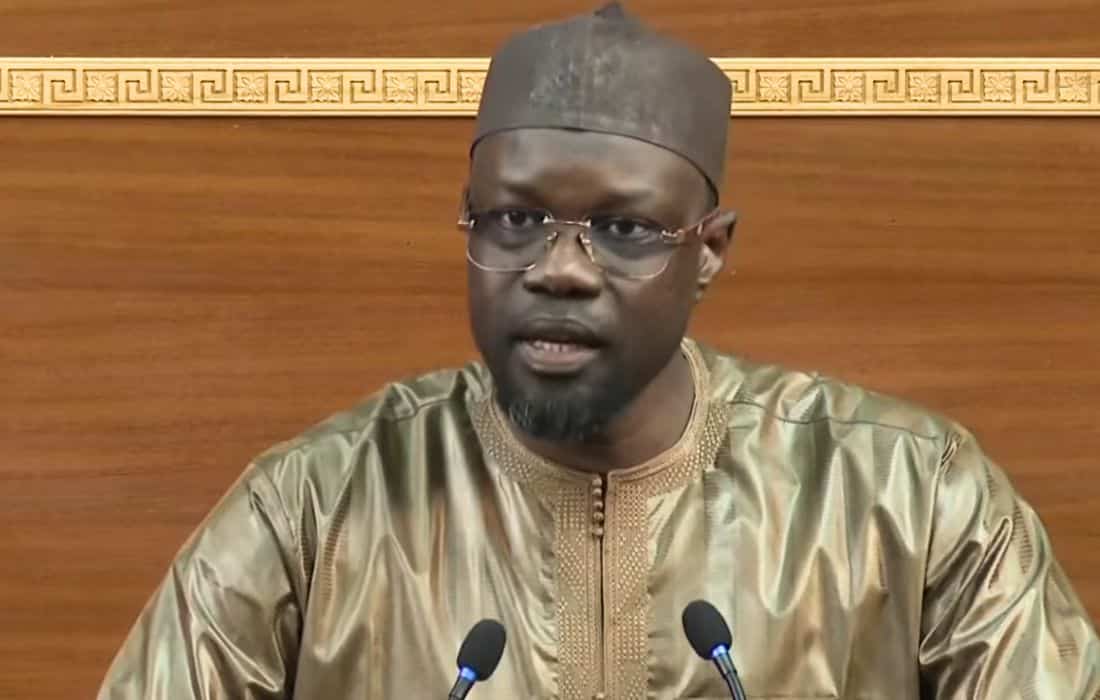
Dakar — Senegal’s Prime Minister Ousmane Sonko has sharply criticized what he calls Western « diktats », accusing foreign powers of attempting to « impose homosexuality » on the nation. Speaking before the National Assembly, he framed the debate as a clash between national sovereignty and human rights, particularly regarding LGBT+ rights. This stance comes amid a broader political context where Senegal has intensified its legal stance against same-sex relationships.
The Prime Minister’s remarks reflect a growing rhetoric in Senegal that rejects external pressures, positioning LGBT rights as a political and geopolitical battleground. This narrative has gained traction as the government strengthens penalties for same-sex relations, with sentences now ranging from five to ten years in prison—a legal shift implemented in early 2026.
a polarizing debate on LGBT rights in Senegal
Public reactions to LGBT rights in Senegal remain deeply divided, especially on social media, where slogans like « we won’t let our laws be dictated » and « these are our values » dominate. At the heart of this discourse lies a persistent tension between national identity and human rights, often overshadowing the lived realities of LGBT individuals.
In this climate, discussions about LGBT rights are frequently dismissed as foreign interference, while legal restrictions are justified under the guise of culture, tradition, or national pride. This deflection shifts focus away from the actual challenges faced by LGBT people in Senegal, including social stigma, arrests, and violence.
Senegal’s stringent anti-LGBT laws
In Senegal, same-sex relations are criminalized under the Penal Code, and recent amendments have further tightened these provisions. The updated legislation, passed in 2026, now imposes prison sentences of up to a decade for individuals found guilty of such acts.
Beyond the legal framework, human rights organizations have documented the severe real-world consequences of these laws. LGBT individuals in Senegal face systemic discrimination, arbitrary arrests, and heightened risks of physical harm. The public debate, therefore, extends far beyond legal technicalities to encompass the very safety and dignity of those affected.
why international attention on LGBT rights in Senegal matters
The involvement of international human rights groups in Senegal’s LGBT rights situation often sparks debate. Critics argue that such engagement constitutes unwarranted interference, but the fundamental principle at stake is the universality of human rights. When individuals are persecuted or threatened due to their sexual orientation, it is not merely a domestic issue—it is a violation of their most basic rights to dignity, security, and life.
To dismiss these concerns would be to accept that human rights protections end at national borders, despite their intended global scope. The international community’s engagement is not about imposing external norms but about upholding commitments already made by Senegal itself.
human rights: a global commitment, not an imposition
Contrary to claims that human rights are an external imposition, they are grounded in commitments that Senegal has voluntarily embraced. The nation’s 2001 Constitution explicitly references the Universal Declaration of Human Rights, embedding the principles of non-discrimination and human dignity into its legal framework. In this context, advocating for LGBT rights is not about forcing a foreign model but about demanding the fulfillment of existing legal and moral obligations.
This distinction is crucial in the African context, where debates about LGBT rights are often framed as cultural clashes. The reality is that human rights are not a Western construct but a universal framework to which Senegal has already pledged adherence.
LGBT identities are not foreign to Senegal
A common argument against LGBT rights in Senegal is the claim that such identities are alien to African societies or imported from abroad. This narrative overlooks the long-standing presence of LGBT individuals in Senegalese society. Historical and anthropological research has documented diverse gender and sexual identities across West Africa, including figures like the goor-jigeen in Senegal. These realities challenge the notion that LGBT identities are a recent or foreign imposition.
Dismissing LGBT identities as un-African ignores the lived experiences of countless individuals who have always existed within these communities, contributing to Senegalese society in every sphere of life.
the debate is shaped by deep-seated tensions
The discourse surrounding LGBT rights in Senegal is entangled in broader societal tensions, including the legacy of colonialism, internal political struggles, and entrenched social prejudices. In this environment, discussions about LGBT rights are often reduced to simplistic binaries—sovereignty versus foreign influence, tradition versus progress. Such framing strips the debate of its nuance, reducing complex human experiences to political slogans.Public rhetoric has at times escalated to dehumanizing language, with LGBT individuals framed as a « threat » or « scourge ». These characterizations do not merely reflect disagreement; they contribute to a climate where individuals are denied their humanity, making violence and discrimination more likely.
defending rights without imposing change
Advocacy groups emphasize that their mission is not to impose a specific societal model but to ensure that no individual is punished, excluded, or harmed because of their sexual orientation. Behind the debates over sovereignty and cultural relativism lies a stark reality: real people are living in fear, their identities criminalized, and their basic rights denied.
This is a reality that should not be tolerated, regardless of the political or cultural justifications offered.
global solidarity in defending human rights
The fight for LGBT rights is not confined to Senegal. Similar struggles unfold worldwide, from Russia to China, where LGBT individuals face persecution and legal repression. Human rights organizations respond based on local contexts, available resources, and urgent needs. Their engagement does not imply a ranking of suffering but reflects a commitment to universal principles of dignity and justice.
This solidarity is not about hierarchy but about recognizing that human rights violations anywhere demand a response everywhere.
taking action: supporting LGBT individuals in Senegal
In response to the growing challenges faced by LGBT individuals in Senegal, advocacy groups have launched initiatives to provide direct support. These efforts include legal aid, emergency assistance, and community resources aimed at mitigating the impact of criminalization.
Supporting these campaigns offers a tangible way to translate concern into action, providing critical aid to those most affected by oppressive laws and societal hostility.