The political landscape in Senegal today is far more than a clash between two prominent figures. It reflects a deeper tension between the legitimacy of institutions and the influence of a charismatic leader. This dynamic, often studied in political science, can sometimes lead to an overreliance on individual leadership, overshadowing the strength of collective governance.
Ousmane Sonko’s rise and the shifting power dynamics
Ousmane Sonko has emerged as a pivotal figure in Senegal’s political evolution. His rapid ascent stems from a bold break with the country’s recent political past. By addressing the frustrations of a disillusioned youth, he challenged a system perceived as opaque while championing themes like national sovereignty, dignity, and the central role of the people in governance.
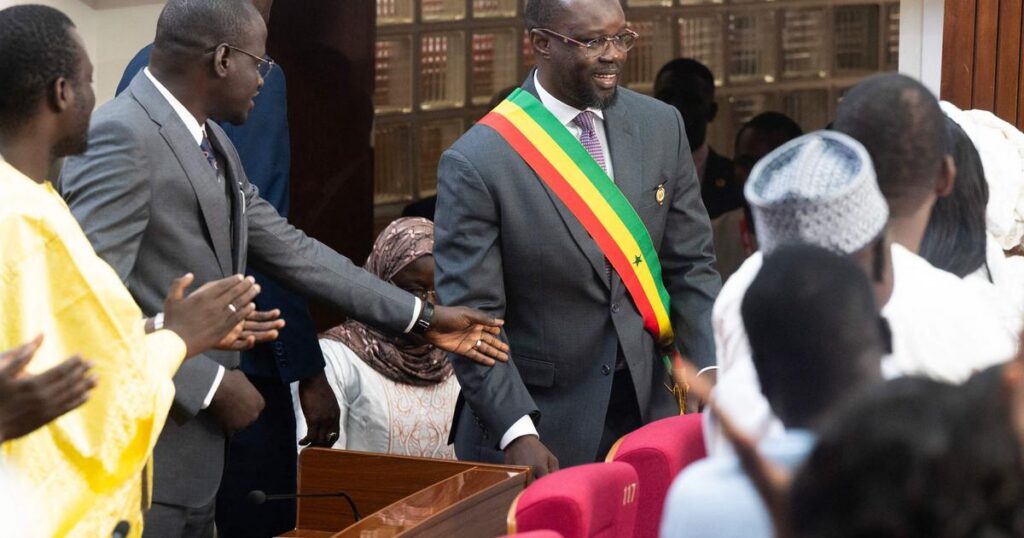
Initially, Sonko hinted at the possibility of a “peaceful cohabitation” with the presidency. His recent election as president of the National Assembly—just days after his removal as Prime Minister—could mark a turning point in turning that vision into reality. The sequence of events unfolded with striking speed: on May 22, President Bassirou Diomaye Faye dismissed Sonko from his Prime Ministerial role. The next day, Malick Ndiaye, then president of the National Assembly, resigned, strategically clearing the way for a new speaker. By May 25, Ahmadou Alhaminou Mohamed Lô had been appointed Prime Minister. Finally, on May 26, Sonko was elected president of the National Assembly with overwhelming support, securing 132 out of 165 votes. This historic election, viewed by some as a landmark moment and by others as an “institutional coup,” positions Sonko as the leading opposition figure to his former ally, President Bassirou Diomaye Faye, with whom he had recently formed a complex dual leadership arrangement.
The Pastef party, which unanimously backed Sonko’s candidacy, now faces a critical question: will it align with the new government led by a technocrat Prime Minister? The ruling party has underscored its demands, emphasizing “fidelity to the 2024 election program,” a platform largely shaped by Sonko himself. His recent statements oscillate between calls for institutional calm and firm messages directed at the presidency, including a warning that the National Assembly would “fully exercise its constitutional prerogatives.” He also expressed disappointment over the lack of consultation with Pastef regarding the Prime Minister’s appointment. Amid this political turbulence, the country’s sovereign credit rating was downgraded from “stable” to “negative.”
The duality of leadership: charisma vs. institutional strength
The undeniable impact of Sonko’s political influence has reshaped the national stage. Yet, charismatic leadership carries inherent contradictions. While it unites followers under a strong figure, it can also weaken the foundations of institutional democracy by overshadowing the role of structured governance.
Legitimacy in question: who holds the real power in Senegal?
The months-long uncertainty in Senegal has raised a fundamental question: where does true authority reside? Is it with President Bassirou Diomaye Faye, who secured his mandate through the ballot box, or with Ousmane Sonko, the historic leader of the Pastef party—the party now in power? Is legitimacy derived from electoral victory, militant commitment, constitutional authority, or personal charisma? This duality was unsustainable. Every democracy must, at some point, see its institutions reassert their primacy. A state cannot thrive under two symbolic centers of power.
Sonko’s influence extends beyond his role as Prime Minister. He embodies multiple roles: government leader, movement figurehead, activist voice, and the emotional representation of a significant segment of Senegalese youth. This convergence is where the risk of hubris—excessive pride or self-confidence—becomes most apparent. The danger isn’t necessarily a blatant threat to democracy through force, but a subtle erosion of its foundations as institutions yield to the symbolic pull of a dominant personality.
The resilience and vulnerability of Senegal’s institutions
Political parties in Senegal remain largely structured around emblematic figures. The Parliament continues to struggle in asserting itself as an independent and effective counterbalance. While institutions demonstrate some resilience, they remain susceptible to the emotional sway of prominent leaders.
A test of leadership: can charisma yield to institutional power?
The crux of the current challenge is not moral, but structural. Will Ousmane Sonko accept the supremacy of institutional legitimacy over personal charisma? Can he acknowledge that the movement he initiated no longer belongs exclusively to him? Is he prepared to transition from being the catalyst of historical change to a participant within a durable institutional framework designed to outlast individuals?
This is perhaps the most daunting challenge for any leader who has embodied a major political rupture. African political history offers numerous examples of movements that shone in opposition only to falter when confronted with the complexities of state governance. Leading requires different skills than mobilizing. It demands compromise, sacrifices, respect for institutional hierarchies, and at times, a willingness to step back for the sake of the state’s continuity.
The true measure of a leader lies not only in their ability to seize power, but in their capacity to embrace the constraints of institutional democracy. Senegal now faces this test of truth. How this tension is resolved will shape not only the future of the Pastef project, but also a significant part of the nation’s democratic stability.