Recent unprecedented developments in Togo have cast a harsh light on the nation’s governance crisis. The arrest of two French citizens in the country’s northern region has triggered alarm bells, with reports indicating their detention followed direct orders from President Faure Gnassingbé. Instructing his Justice Minister, Pacôme Adjourouvi, to resist external pressures, the President appears to be tightening his grip on power amid mounting concerns over democratic erosion.
Beyond the immediate diplomatic fallout, this incident exposes a deeper malaise: the erosion of institutional legitimacy in Togo. The fundamental question now looms large: who truly governs the country, and on what authority?
Institutional engineering: a world first
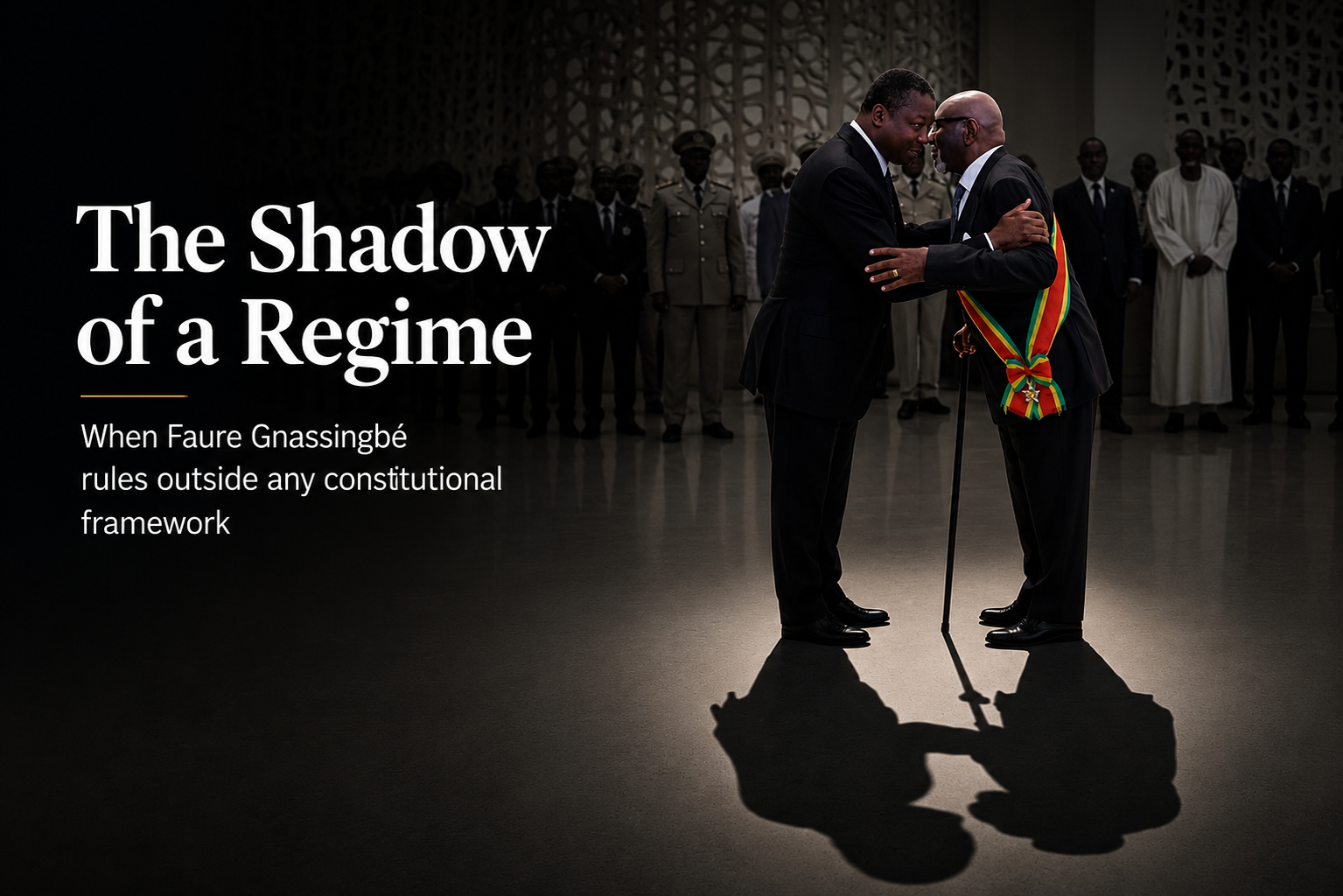
Faure Gnassingbé no longer holds the title of President but has remained the de facto leader through a carefully crafted constitutional overhaul. By pushing through a new Constitution and replacing the presidency with a ceremonial figurehead, his administration has created a unique global precedent a hybrid system where formal titles obscure the realities of power.
This unprecedented institutional manipulation reveals a troubling trend: the ruling elite treats constitutional law as a malleable tool, rewriting rules to suit political convenience. By bypassing judicial independence and dictating outcomes to prosecutors, Gnassingbé has dismantled the separation of powers, reducing governance to a mere playground for personal authority.
The 2024 reform, rammed through a parliamentary supermajority dominated by the ruling UNIR party, abolished the presidential system in favor of a parliamentary model. The ceremonial President (Jean-Lucien Savi de Tové) now wields no executive authority. Instead, all real power defense, diplomacy, civil and military appointments has been concentrated in the office of the Prime Minister, a position Gbassingbé assumed on May 3, 2025.
The new arrangement eliminates term limits entirely, enabling perpetual rule. Since UNIR commands 108 out of 113 parliamentary seats a victory secured in 2024 legislative elections widely boycotted by the opposition the outcome was predetermined. This isn’t democratic transition; it’s a dynastic perpetuation disguised in constitutional garb.
Justice as a political pawn
The detention of journalists Sébastien Perez Pezzani and Gaël Mocaër while filming for a French television program is far from an isolated incident. It exemplifies a pattern: security services and courts operate under direct executive orders. The alleged instruction to « resist pressure » underscores a command chain that nullifies judicial independence. When the executive branch dictates legal outcomes, the rule of law collapses into compliance.
This tactic isn’t new it’s visible in crackdowns on June 2025 protests, prosecutions of critics, and selective enforcement of laws. Law has become a political weapon, wielded or shelved based on exigency rather than justice.
A crisis of legitimacy
Who truly holds power in Togo? The answer is unequivocal: Gnassingbé, who inherited office in 2005 and has spent two decades reshaping the state to retain control. The constitutional amendments were implemented without popular referendum, and legislative elections were held under a cloud of protest and boycott. Even the Senate, with a third of its members appointed by the Prime Minister, reinforces his dominance.
This isn’t reform it’s a consolidation of personal rule cloaked in procedural formality. Titles shift, documents multiply, but the locus of decision-making remains unchanged: Gnassingbé, now Prime Minister, armed forces commander, and final arbiter, governs Togo as an institution unto himself.
A powder keg of instability
When arbitrary power supplants law, when institutions exist in name only, and when justice becomes an extension of politics, the social compact frays. Togo no longer faces a constitutional debate it confronts a regime that has abandoned republican governance for unchecked authority.
The question now isn’t merely who rules, but how long this unsustainable system can persist. The interplay of internal contradictions and rising dissent may soon force a reckoning one whose outcome remains uncertain.