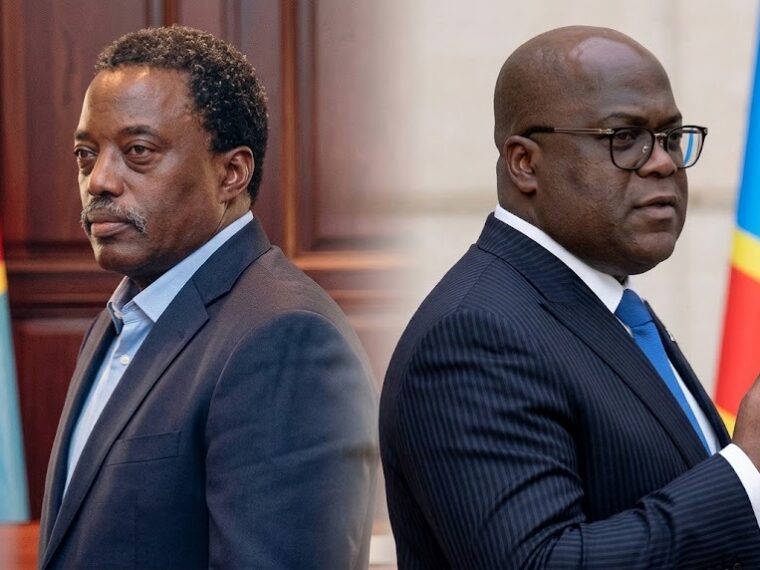
The political and military landscape of eastern Democratic Republic of Congo (DRC) has just entered a defining new phase. Former Congolese President Joseph Kabila has officially assumed leadership of the Front for the Renaissance of the Nation (FRN), a newly formed politico-military alliance announced in Goma, North Kivu.
This restructuring brings together key figures from the Alliance of the Congo River (AFC) and the March 23 Movement (M23), signaling a strategic shift in both leadership and operational dynamics. The move comes at a critical juncture, as diplomatic efforts to end the conflict gain momentum while the region braces for renewed uncertainty.
From AFC-M23 to FRN: a deliberate power shift in Congo’s rebellion
The creation of the FRN is far more than a name change—it represents a calculated realignment aimed at consolidating influence within Congo’s opposition forces. The new front replaces the AFC, merging military command with high-profile political leadership under Kabila’s direction.
Among the prominent leaders now aligned with the FRN are Corneille Nangaa, Bertrand Bisimwa, and Sultani Makenga, each with deep ties to the M23 rebellion. Their inclusion underscores a deliberate strategy to bridge former state leadership with active insurgent command structures.
According to the formal announcement in Goma, the FRN commits to a strategy of confrontation with Kinshasa, including the potential use of force. While the precise future of the M23 within this new framework remains unresolved, the formation of the FRN marks a clear consolidation of rebel factions under a unified political banner.
Diplomatic echoes: how international observers saw this coming
Long before the official declaration, signs of this restructuring were already emerging. A June 2026 UN Group of Experts report had flagged the possibility of an AFC-M23 reorganization and highlighted increasing interactions between Kabila and rebel leadership. Those signals have now crystallized into a formal alliance.
Yet this development raises critical questions: Will the FRN succeed in uniting its diverse components, or will internal divisions resurface? The stakes are high, not only for Congo’s rebels but for regional stability and ongoing peace negotiations.
Rwanda’s shadow: how external alliances shape Congo’s conflict
The M23 rebellion has long been linked to external support, with Rwanda repeatedly accused of providing military backing—a claim Kigali consistently denies. The inclusion of Kabila, a former head of state, adds a new political dimension to the conflict, blending national opposition with regional geopolitics.
For Kinshasa, the challenge is no longer just military containment; it now faces a more complex adversary that combines political opposition, armed rebellion, and regional alliances. This fusion of forces could further strain already tense diplomatic relations between the DRC and Rwanda.
Peace talks at a crossroads: can diplomacy keep pace?
The timing of this shift could not be more delicate. International mediators are working to broker a lasting ceasefire and restore stability in eastern Congo. Yet the emergence of the FRN introduces new variables into the peace process.
Who will represent the rebellion in negotiations? Who holds command over armed groups? And how will Kabila’s controversial past—most notably his 2025 in absentia treason conviction—affect his credibility as a negotiating partner? These questions now loom over fragile diplomatic efforts.
The FRN’s formation coincides with persistent insecurity in North and South Kivu, where civilian displacement, economic disruption, and violence remain daily realities. For millions in the region, this latest development offers no immediate relief—only deeper uncertainty about what comes next.
What’s next for Congo’s rebellion?
The FRN’s creation signals a turning point, but its long-term impact remains unclear. Will this alliance strengthen rebel cohesion or deepen internal fractures? Can it broaden political support or remain confined to a military command structure? And how will Kinshasa respond to this bold new challenge to its authority?
One thing is certain: eastern Congo’s crisis is no longer a simple confrontation between government forces and the M23. With Kabila’s formal integration into the rebel command, the conflict now intertwines political ambition, military strategy, and regional influence. The question is whether this new configuration will escalate violence or, against all odds, open a path toward broader negotiations.