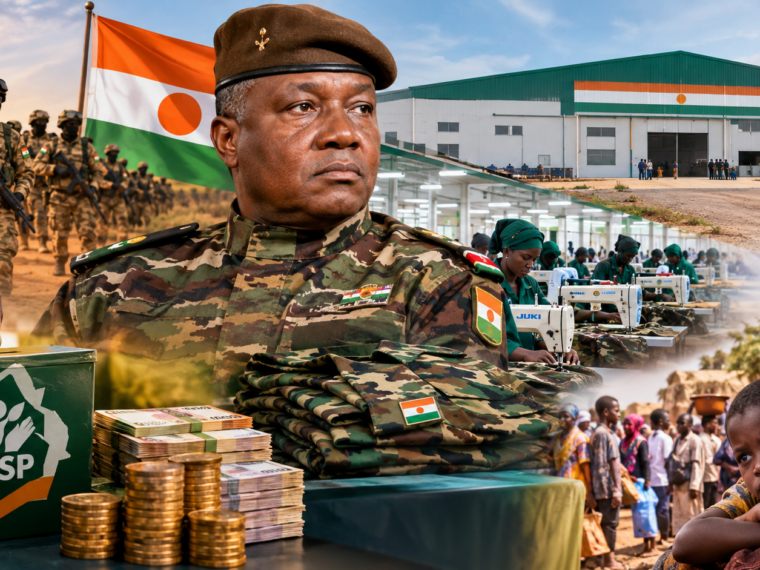
The inauguration of a new military uniform production facility in Niger has sparked intense debate about the nation’s priorities. Funded entirely by the Fonds de Solidarité pour la Sauvegarde de la Patrie (FSSP), the plant boasts an impressive capacity of 1,000 uniforms per day, raising critical questions about its alignment with Niger’s most urgent challenges.
From symbolic investment to tangible impact
While the facility promises to bolster local defense production and reduce reliance on imports, its strategic necessity remains under scrutiny. A production capacity of 365,000 uniforms annually if fully utilized could theoretically meet the armed forces’ long-term needs. However, the project’s true value hinges on far more than raw output: its economic feasibility, operational sustainability, and direct benefits to Nigerien citizens must be rigorously examined.
Does local uniform production address Niger’s core challenges?
The country continues to grapple with persistent security threats, economic strain, and pressing humanitarian concerns. Against this backdrop, the allocation of FSSP funds to this initiative demands transparent justification. Key questions linger:
Need validation: What proportion of the armed forces’ uniform requirements will this facility supply?
Cost efficiency: How does the local production cost compare to imported alternatives?
Economic ripple effects: What local jobs and supply chain opportunities will it create?
Operational feasibility: Are there guarantees for steady raw material supply and maintenance?
Without clear answers, the project risks becoming a symbolic gesture rather than a catalyst for systemic improvement.
Balancing defense priorities with civilian welfare
The FSSP’s financing model rooted in national solidarity further complicates the debate. While defense capabilities are non-negotiable, citizens rightfully expect fiscal responsibility. The erosion of purchasing power, food insecurity, and underfunded public services remain daily realities for many Nigeriens. How, then, does this investment align with broader welfare objectives?
To bridge this divide, the government must demonstrate:
Transparency: Detailed breakdowns of FSSP funding allocation and long-term budgetary commitments.
Synergy: How the uniform factory integrates with national employment, industrial, and security strategies.
Measurable outcomes: Clear benchmarks for security enhancement, economic growth, and public accountability.
Only through such clarity can the project justify its place among Niger’s top priorities.
The Sahel’s industrial ambitions: a coordinated path forward?
Niger’s initiative mirrors similar endeavors across the Alliance of Sahel States (AES), where member nations seek greater self-sufficiency. Burkina Faso and Mali have also announced local arms and equipment production projects, signaling a regional trend toward industrial autonomy.
Yet this shared ambition raises critical questions:
Strategic coherence: Do these projects form part of a unified, needs-based industrial policy, or do they reflect uncritical replication of initiatives?
Long-term viability: How will these facilities avoid becoming financial liabilities without sustainable demand or economic returns?
Regional collaboration: Could shared resources, expertise, or markets enhance efficiency across the AES?
Without coordinated planning, the risk of wasted resources looms large undermining both economic progress and public trust.
Beyond capacity: evaluating real-world impact
The facility’s theoretical output of 365,000 uniforms per year does not guarantee success. Actual performance will depend on:
Demand alignment: Are military orders sufficient to justify full capacity?
Cost competitiveness: Does local production offer savings over imports?
Operational resilience: Are supply chains, maintenance, and training systems in place?
Social return: Does the project create local value beyond defense, such as vocational training or ancillary industries?
The government’s ability to address these dimensions will determine whether the factory serves as a turning point or another unfulfilled promise.
A call for accountability and results
For Niger’s citizens whose contributions underpin the FSSP symbolic gestures are insufficient. The uniform factory must deliver tangible dividends: strengthened security, economic resilience, and improved living standards. To achieve this, authorities must:
Publish verifiable production and cost data.
Outline clear links between military readiness and civilian welfare.
Present sustainable financing models to prevent the project from becoming a fiscal burden.
In a nation where security and prosperity are intrinsically linked, this initiative’s true measure lies not in its capacity, but in its legacy.
By Agnès Mvogo — Journaliste / Rédacteur