The Cameroonian philosopher Achille Mbembe contends that true democracy has never genuinely taken root across the African continent. In a recent exclusive discussion, he offered his uncompromising views on critical issues ranging from the CFA franc and political inertia in Central Africa to the complex debate surrounding reparations for the transatlantic slave trade.
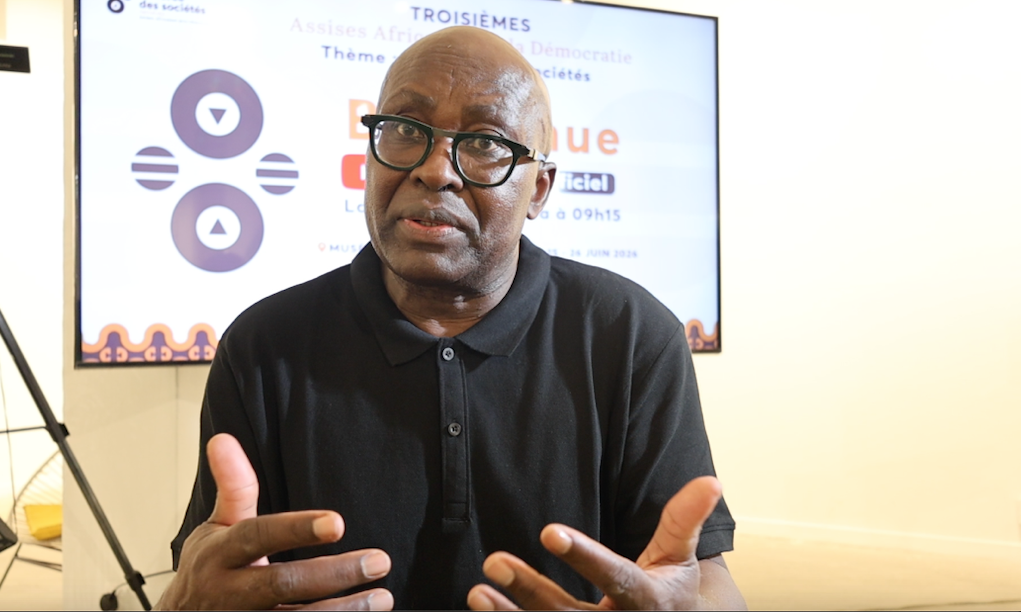
Professor Achille Mbembe, a distinguished historian, philosopher, and research scholar, shared his insights during the 3rd edition of the African Democracy Summits held at the Théodore Monod Museum in Dakar.
As president of the Foundation for Innovation for Democracy, Mbembe provided a penetrating critique of democratic experiments in Africa. Challenging the widespread belief that the continent is experiencing a crisis of democracy, he asserted that in most African nations, democracy has simply never been truly established.
“There cannot be a crisis of democracy where it does not exist”
For Achille Mbembe, framing the current situation as a crisis of democracy in Africa is fundamentally misguided.
“There can only be a crisis of democracy where democracy actually exists. What is currently in crisis is not democracy, because it has never truly been practiced. What has been practiced is a system based on a form of purely administrative multi-partyism, involving elections or electoral consultations, most of which are disputed.”
He argues that many African states have implemented an administrative multi-party system rather than fostering a genuine democratic framework.
The concept of “tropical democracy” is meaningless
When questioned about the notion of “tropical democracy,” Achille Mbembe unequivocally dismissed the term.
“To ‘tropicalize’ democracy makes no sense. Tropicalism is a concept invented by colonial geography and climatology to stigmatize anything that did not originate from the West.”
The philosopher advocates instead for an endogenization of democracy, one rooted in the political, social, and cultural resources inherent within African societies.
Financial capitalism weakens democracies
Achille Mbembe also condemned the pervasive influence of speculative financial capitalism on contemporary democracies, including those in Africa. He explained that this trend underscored the theme of the African Democracy Summits, “The strength of societies,” which underscores the vital role of citizens over that of states.
CFA Franc: “Africa needs a true African currency”
Regarding monetary sovereignty, Achille Mbembe emphasized that the discussion should extend beyond merely abolishing the CFA franc.
“Africa needs a true African currency.”
He further elaborated on the differing levels of public engagement between West Africa and Central Africa, attributing it to distinct political cultures. He noted that West Africa benefits from more dynamic civil societies, whereas Central Africa remains characterized by deep political stagnation.
“Central Africa, in my view, represents the heart of darkness of postcolonial African politics: Cameroon, Chad, Equatorial Guinea, Congo-Brazzaville, Central African Republic… These are shadowy regimes from another era, completely closed off to anything that could help people achieve emancipation.”
In contrast, he depicted West Africa as a region driven by active civil societies and an influential diaspora.
Reparations: “The more irreparable the loss, the more essential the demand for reparations”
Reflecting on the Accra conference dedicated to reparative justice, Achille Mbembe acknowledged that the atrocities of the transatlantic and trans-Saharan slave trades are inherently irreparable. Nevertheless, he asserted that this very reality strengthens the legitimacy of the demand for reparations.
“There are things that are irreparable, things that can never truly be repaired because what was lost is priceless. Therefore, we must seriously consider the idea that some things possess such immense value that they cannot be measured, and if lost, cannot be replaced. It is a radical loss. This does not mean that reparations should not be demanded. Indeed, the more irreparable what was lost, the more essential it is to demand reparations.”
“There is an African responsibility”
The philosopher also maintained that the reparations debate must include an examination of the responsibility and complicity of certain African elites in these crimes against humanity.
“Consequently, we cannot escape our own responsibility, because one undeniable truth is that during the slave trade, both transatlantic and trans-Saharan, throughout these historical processes that spanned centuries, we, as Africans, were involved. There is an African responsibility, and this question must be addressed. It must be part of the broader discussion on universal justice, ensuring justice is not only vertical but also horizontal, if we truly wish to pave the way for the reconciliation of Africa’s various fragments, both here on the continent and within our diasporas.”
Through this profound interview, Achille Mbembe presented an in-depth reflection on democracy, monetary sovereignty, the lasting legacies of colonialism, and the political challenges Africa faces today. His compelling analyses invite a fundamental rethinking of the continent’s democratic paths, the prerequisites for genuine political and monetary sovereignty, and the imperatives of historical justice founded on memory, accountability, and reconciliation.