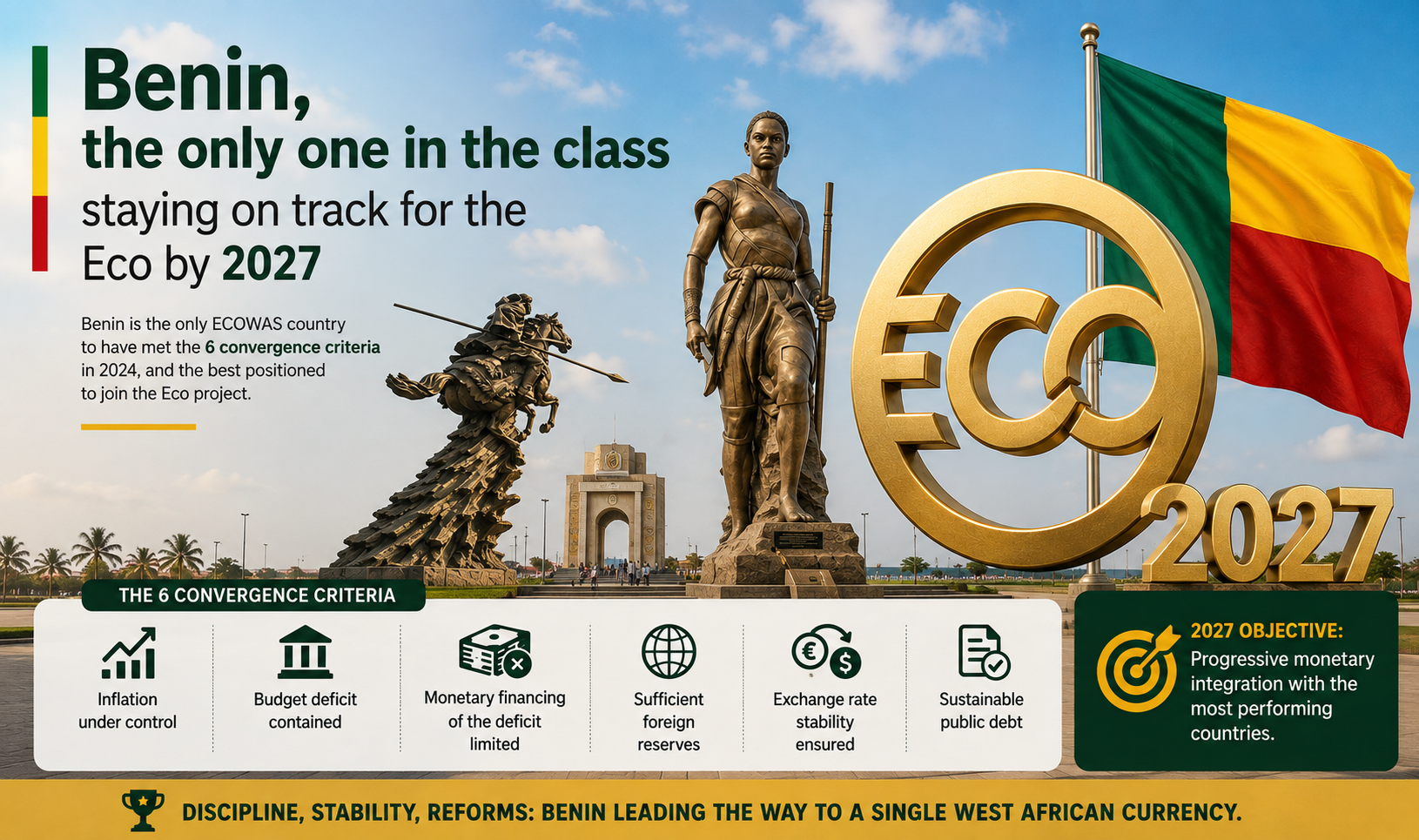
As the Economic Community of West African States (CEDEAO) maintains its commitment to launching the Eco by 2027, regional economic realities reveal stark disparities in the pace at which member states can progress. Amid this uneven landscape, Benin stands out as one of the most promising candidates to participate in the initial phase of monetary integration.
The concept of a single West African currency is not a recent ambition. For years, it has been a cornerstone of CEDEAO’s economic integration agenda. However, the gap between political ambition and economic reality remains significant, with challenges such as inflation, public deficits, debt levels, foreign reserves, monetary stability, and divergent national economic policies posing substantial hurdles.
Benin’s Macroeconomic Performance: A Benchmark in the Region
In 2024, Benin distinguished itself as the sole CEDEAO member to meet all six macroeconomic convergence criteria required for monetary integration. This achievement is particularly noteworthy because these criteria encompass multiple dimensions of economic stability, including inflation control, budgetary discipline, monetary financing limits, foreign reserve adequacy, exchange rate stability, and sustainable debt levels.
The simultaneous fulfillment of these benchmarks underscores the consistency of Benin’s economic policies. For Cotonou, this is not merely about achieving short-term targets but demonstrating a long-term commitment to the structural reforms necessary for a sustainable transition to a shared currency.
The Six Pillars of Convergence: A Technical Foundation
The convergence criteria serve as the technical backbone of the Eco project, designed to prevent the new currency from being undermined by divergent national economic policies. These indicators include:
Inflation control: Keeping price increases within sustainable limits to protect purchasing power and monetary stability.
Budgetary discipline: Ensuring fiscal deficits remain within predefined thresholds to avoid excessive public debt.
Monetary financing restrictions: Preventing excessive money creation to fund government spending, which could fuel inflation.
Foreign reserve adequacy: Maintaining sufficient reserves to cover several months of imports, ensuring external financial resilience.
Exchange rate stability: Preserving a stable nominal exchange rate to foster confidence in the new currency.
Debt sustainability: Keeping public debt at levels deemed manageable to avoid future financial strain.
These criteria collectively aim to establish a baseline of economic discipline before countries adopt a unified monetary system. Without such alignment, disparities in national policies could destabilize the shared currency over time.
A Deliberate Path to Economic Rigor
Benin’s current performance is the result of several years of targeted reforms. The government has prioritized enhancing revenue mobilization, optimizing public finance management, and sustaining high levels of investment in infrastructure and public services. However, these efforts have required difficult trade-offs, particularly in balancing fiscal restraint with the need to fund critical development projects and social programs.
The true test for Cotonou will be maintaining this convergence over the long term. While meeting the criteria in a single year sends a positive signal, consistent adherence over multiple years would significantly bolster Benin’s credibility in the eyes of regional partners.
A Phased Approach to Monetary Integration
The primary obstacle to the Eco project lies in the economic heterogeneity among CEDEAO member states. These countries vary widely in terms of economic structures, debt burdens, fiscal flexibility, and external pressures. Some grapple with high inflation, while others face chronic deficits or severe constraints on their public finances. Additional challenges include the fallout from security crises, geopolitical tensions, and disruptions in regional trade.
Given these realities, a phased implementation of the Eco appears more pragmatic than a simultaneous transition across all member states. Rather than mandating that every country adopt the new currency at once, the focus could shift toward enabling those that meet the criteria to lead the way.
Benin’s Strategic Advantage in Regional Monetary Integration
Should this phased approach materialize and Benin sustain its macroeconomic performance, Cotonou is well-positioned to join the first cohort of countries meeting the convergence requirements. This early adoption would not only validate Benin’s economic reforms but also enhance its influence in regional negotiations.
A shared currency is far more than a transition from one set of banknotes to another; it demands deeper coordination in fiscal, financial, and economic policies. For Benin, being among the first to qualify could yield strategic benefits, including heightened economic attractiveness, strengthened financial credibility, and expanded trade integration.
Uncertainties Surrounding the 2027 Timeline
Despite these promising developments, it would be premature to assume that the Eco will launch in 2027 as planned. The feasibility of this timeline hinges not only on individual economic performances but also on collective political decisions among participating states.
Key questions remain unanswered, including the governance structure of the new currency, the roles of regional institutions, the design of monetary policy, and the mechanisms for solidarity among member states. The withdrawal of several countries from the CEDEAO framework particularly those part of the Sahel States Alliance further complicates the regional landscape, necessitating a reevaluation of the integration process.
Consolidating an Advantage, Not Taking It for Granted
Benin’s current standing as the regional leader in convergence is a significant achievement, but it is not a guarantee of future success. To retain this position, the country must prioritize several critical objectives:
Maintaining macroeconomic stability to prevent inflationary pressures and fiscal imbalances.
Ensuring debt sustainability through prudent borrowing and efficient public spending.
Continuing structural reforms to enhance economic resilience and competitiveness.
Sustaining infrastructure and social investment without compromising fiscal discipline.
As the 2027 deadline approaches, the challenge for Benin will not merely be to lead the pack but to remain at the forefront when the Eco transitions from a political vision to an economic reality. If the phased implementation materializes, Benin could emerge as a key player in West Africa’s monetary integration, having successfully navigated the majority of technical and policy hurdles.