Benin swears in Romuald Wadagni as president with 94% mandate amid opposition absence
Romuald Wadagni was inaugurated Sunday, May 24, in Cotonou for a seven-year term after winning 94% of the vote in an election where the main opposition party was barred from participation. The former Finance Minister inherits a tightly controlled political landscape and pledges economic continuity while signaling a new diplomatic approach toward Sahel allies.

With a landslide 94% victory in an election where the leading opposition party was disqualified, Romuald Wadagni’s inauguration marks a pivotal moment for Benin’s political trajectory. The former Finance Minister, sworn in at the Palais des Congrès in Cotonou, now leads a nation navigating economic expectations and regional security challenges under transformed electoral conditions.
At 49 years old, Wadagni becomes Benin’s fifth democratically elected president since the 1990 return to civilian rule. His predecessor, Patrice Talon, completed two terms under the previous constitutional framework, now adjusted to a seven-year mandate following reforms finalized last year. The vote on April 12, 2026, proceeded without major contestation after the Constitutional Court upheld the exclusion of the opposition’s candidate, effectively clearing the path for Wadagni’s uncontested victory.
Economic stewardship as political inheritance
Wadagni’s rise to power reflects a continuity of governance centered on fiscal discipline and international credibility. A Chartered Accountant by training, he spent 17 years at Deloitte before joining the government in 2016 as Economy and Finance Minister. During his tenure, Benin maintained its sovereign credit rating and successfully issued multiple international bonds, reinforcing investor confidence in West Africa’s second-largest cotton producer.
The election outcome—validated by the Constitutional Court—saw Wadagni secure over 94% of the vote in a contest reduced to a single opponent, Paul Hounkpè of the Forces cauris pour un Bénin émergent (FCBE). His running mate, Vice President Mariam Chabi Talata, shares the executive vision under the 2019 constitutional amendment that introduced the vice-presidential office. The new seven-year term structure, enacted in 2025, decouples presidential elections from legislative polls, reshaping the country’s political calendar.
A meticulously orchestrated inauguration
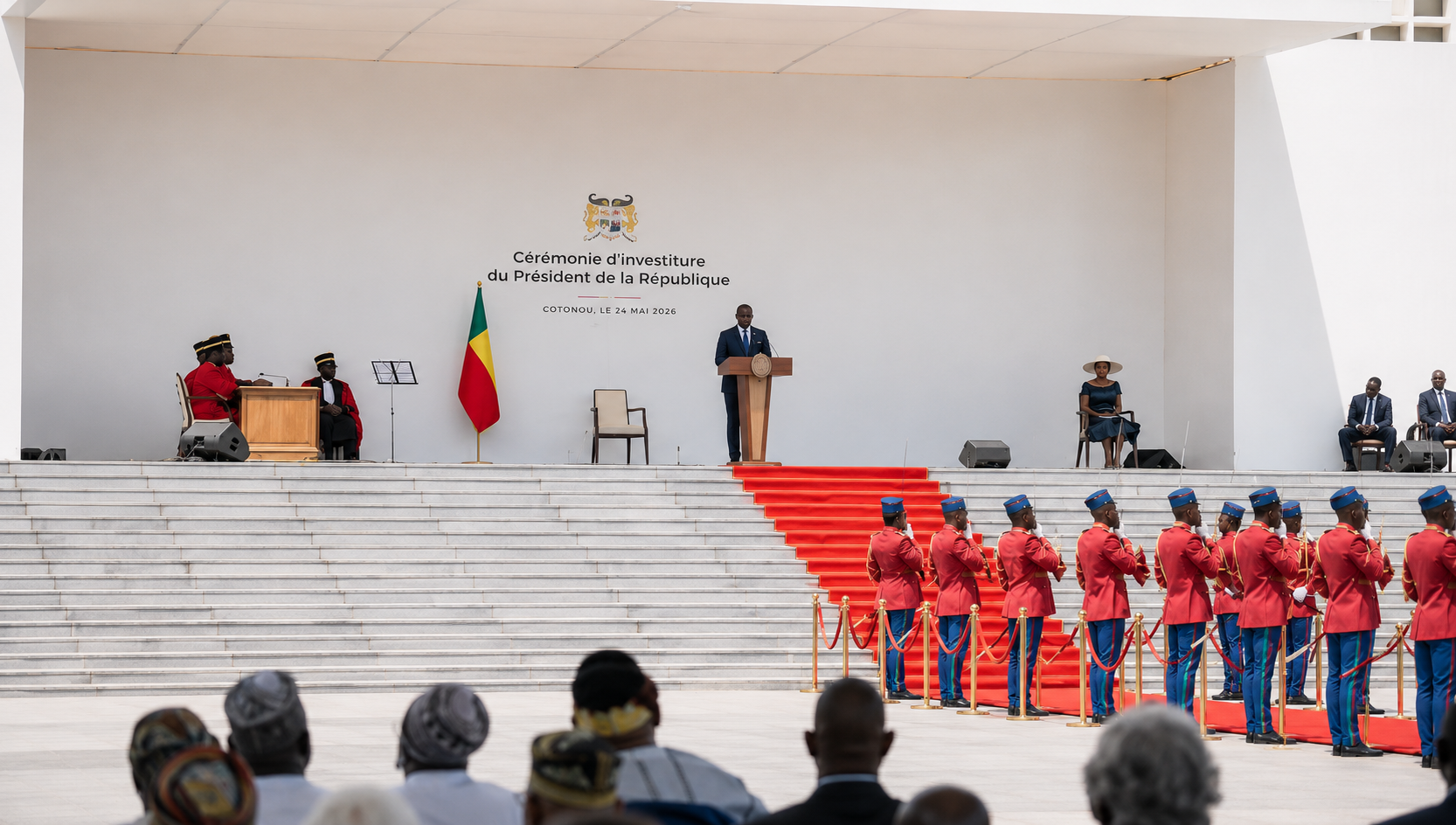
The ceremony unfolded with military precision between 9:30 AM and 12:00 PM, beginning with Patrice Talon’s handover of presidential symbols at the Palais de la Marina. By 11:10 AM, the Constitutional Court convened the solemn oath-taking session, followed by the presentation of the Grand Collar of the National Order and the command flag to the Chief of Staff. Over 6,000 guests, including former presidents Nicéphore Soglo and Thomas Boni Yayi, attended the event in Cotonou.
Observers noted the seamless execution, though the political context remains tightly constrained. The principal opposition party, Les Démocrates, was barred from the ballot after its candidate duo—Renaud Agbodjo and Judes Lodjou—failed to secure the required parliamentary sponsorship in October 2025. A last-minute withdrawal by a supporting legislator and the Constitutional Court’s subsequent validation of the exclusion underscored the heightened barriers to electoral participation.
A shrinking space for political dissent
The exclusion of Les Démocrates extends a pattern critics argue has intensified since 2016. High registration fees, restrictive compliance certificates, and a 2025 threshold requiring parties to secure at least 20% of votes per district to retain seats have systematically reduced opposition representation. In January 2026 legislative elections, the party failed to win any parliamentary seats, effectively silencing its voice in the National Assembly.
Opposition figures like Reckya Madougou, sentenced to 20 years in 2021 on terrorism charges, and academic Joël Aïvo, sentenced to 10 years for conspiracy, remain incarcerated. Several opposition leaders have fled into exile, while the Economic and Terrorism Repression Court (CRIET) faces recurring accusations from NGOs of being weaponized against political adversaries. These developments have drawn international scrutiny to Benin’s democratic backsliding, though domestic coverage has been limited.
Diplomatic overtures amid regional tensions
Wadagni’s inauguration speech set two priorities: translating economic growth into tangible household benefits for youth, women, rural communities, and the middle class, and reinforcing security against armed groups operating in northern Benin since 2022. Yet the most notable shift came in foreign policy, where the new president signaled a thaw with the Alliance of Sahel States (AES).
Sixteen foreign delegations attended the event, a rarity for Benin’s inauguration protocol, which traditionally excludes heads of state. While France sent a mid-level representative, the presence of Mali’s Foreign Minister Abdoulaye Diop, Burkina Faso’s Karamoko Jean-Marie Traoré, and Niger’s Prime Minister Ali Mahaman Lamine Zeine—alongside Nigeria’s vice president—sent a deliberate message. The prolonged applause for Niger’s delegation stood in stark contrast to the frostiness that has defined Cotonou-Niamey relations since July 2023, when the Nigerien military seized power.
The border between Benin and Niger, a critical transit route for Nigerian oil via the regional pipeline, has seen repeated closures, straining economic ties. Wadagni’s conciliatory tone signals a potential reset, departing from the hardline stance Benin previously maintained toward military-led governments in the Sahel. His address, structured around repeated invocations—“to you, I say”—addressed youth, women, rural populations, the diaspora, and descendants of the transatlantic slave trade, reaffirming Benin’s identity as “the house of return.”
Key milestones to watch in the coming weeks
The composition of Wadagni’s cabinet, expected within days, will reveal whether he broadens his government beyond the Talon-era inner circle. The fate of imprisoned opposition figures, including calls for an amnesty law, could signal his commitment to political reconciliation. Equally pivotal will be the pace and substance of diplomatic rapprochement with Niamey, Bamako, and Ouagadougou—a process that may begin with an official visit to one of the AES capitals.
Benin enters a seven-year term under an institutional framework reshaped by its outgoing administration. The ceremony underscored economic stability praised by international lenders but also laid bare a political landscape where dissent finds little room to breathe. As the new president takes office, the question is not whether Benin will remain stable, but whether pluralism can endure in a system where electoral competition has been effectively neutralized.