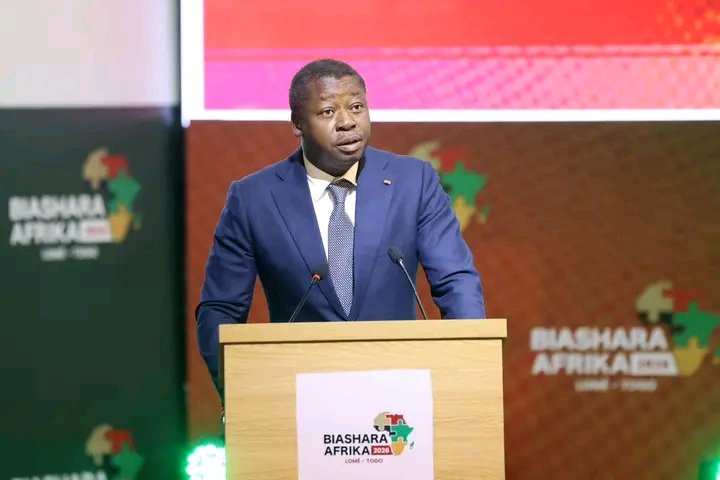
The third edition of Biashara Afrika kicked off in Lomé on May 18, 2026, bringing together African leaders, investors, and private sector representatives to tackle the continent’s most pressing economic challenges. The annual forum, dedicated to trade, investment, and continental partnerships, has become a pivotal platform for shaping Africa’s economic future.
Addressing the gathering, Faure Essozimna Gnassingbé, Chair of the Togo Council, delivered a keynote speech emphasizing the urgent need to transition from policy ambitions to tangible economic outcomes. With the African Continental Free Trade Area (AfCFTA) at the forefront of discussions, he underscored that the time for visionary declarations must now give way to measurable progress.
a tribute and a call for afcfta implementation
Faure Gnassingbé began his address by paying tribute to Issoufou Mahamadou, a key champion of the AfCFTA, recognizing his relentless efforts in advancing Africa’s economic integration. He stressed that while legal frameworks and agreements are essential, they alone are insufficient to drive real change.
« The era of declarations must evolve into an era of results, » he declared, highlighting critical bottlenecks such as non-tariff barriers, cumbersome border procedures, and exorbitant logistics costs that continue to stifle intra-African trade. For the Togolese leader, the AfCFTA’s success hinges on overcoming these systemic inefficiencies through robust infrastructure, streamlined logistics, and modern payment systems.
biashara afrika as a solutions-driven platform
The Togon President made a compelling case for transforming Biashara Afrika from a mere discussion forum into a dynamic hub for actionable solutions, strategic partnerships, and the tangible implementation of the AfCFTA. He framed the event as a catalyst for turning policy into practice, ensuring that the continent’s integration efforts yield measurable benefits for businesses and citizens alike.
In a world grappling with geopolitical tensions, rising protectionism, and shifting global supply chains, Faure Gnassingbé positioned the AfCFTA as a strategic imperative. « No single African economy can defend its interests in isolation in today’s fragmented global landscape, » he asserted. The AfCFTA, he argued, is not just a trade agreement but a cornerstone for achieving continental economic sovereignty.
building continental champions and industrializing africa
The Togolese leader criticized Africa’s over-reliance on raw material exports while importing high-value processed goods, calling for a fundamental shift in the continent’s economic model. « The AfCFTA must help us break free from the shackles of fragmented national markets and build competitive African industries, » he emphasized.
Faure Gnassingbé advocated for the emergence of homegrown African multinational corporations capable of operating across the continent. « We need enterprises owned by Africans, for Africans, that can compete globally, » he stated, stressing the role of regional value chains in driving industrialization and economic resilience.
prioritizing youth, women, and smes in africa’s economic future
Concluding his remarks, the Togolese President turned his attention to Africa’s youth, women entrepreneurs, and small and medium-sized enterprises (SMEs). He argued that sustainable integration must extend beyond large corporations and institutions, directly benefiting grassroots innovators and local businesses.
« The success of Africa’s economic integration will be measured by its ability to create jobs, foster entrepreneurship, and provide tangible opportunities for our people, » he said. « This is not a project for elites—it is a collective endeavor that must uplift every African. »
Togo’s role in africa’s economic transformation
In his closing statements, Faure Gnassingbé reaffirmed Togo’s commitment to Africa’s economic integration, citing the country’s strategic location, advanced logistics infrastructure, and regional connectivity as key assets. Togo aims to play a central role in shaping the future of the AfCFTA-driven market, fostering collaboration that spans the entire continent.
The 2026 edition of Biashara Afrika concludes with a renewed sense of purpose. As African leaders, investors, and entrepreneurs converge in Lomé, the forum stands as a testament to the continent’s determination to turn its economic aspirations into reality—one partnership, one policy, and one initiative at a time.