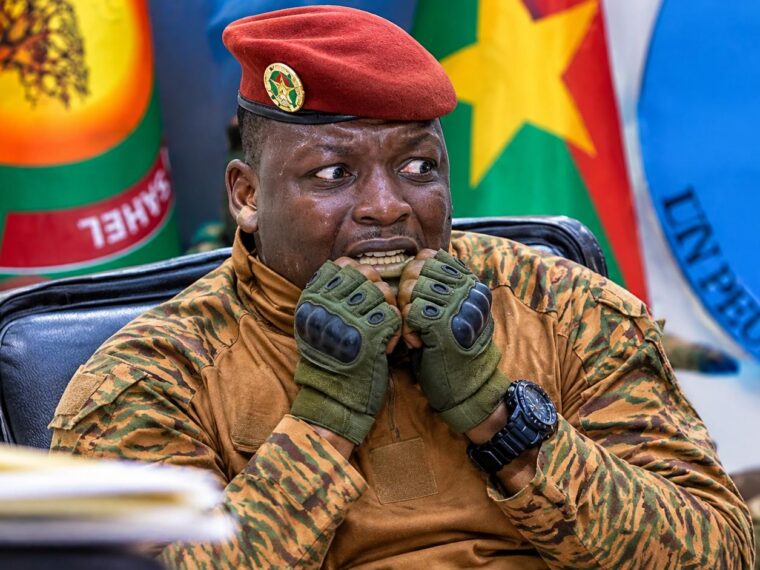
Ibrahim Traoré’s absence from the Russia-Africa summit in Moscow has sent ripples through diplomatic corridors, casting new light on the fragile balance of power within Burkina Faso’s transitional government. Reports indicate the Burkinabè leader’s decision to skip the high-profile event stems not from logistical oversight, but from tangible concerns over the stability of his own administration.
Traoré’s strategic alliance with Russia under scrutiny
The Burkinabè president has long positioned himself as a vocal advocate for Burkina Faso’s sovereignty, forging a high-profile partnership with Moscow to signal a decisive break from former colonial ties. This diplomatic pivot, reinforced through military cooperation and public declarations, has served as both a political shield and a narrative of renewal for Traoré’s government.
Yet the very alliances he has cultivated to project strength abroad may now be at the heart of his domestic vulnerabilities. A trusted confidant within his inner circle previously regarded as a loyalist has emerged as a perceived threat, prompting the leader to prioritize internal security over international engagements.
Propaganda versus political reality: the risks of an overmanaged image
Traoré’s administration has mastered the art of political messaging, using state-aligned media and digital platforms to amplify a narrative of unyielding leadership. The president’s youthful defiance, paired with anti-imperialist rhetoric, has resonated with segments of the population weary of perceived foreign interference.
Critics, however, argue that this highly controlled public image masks deeper fissures within the transitional government. Socioeconomic challenges, spiraling insecurity, and unmet promises of reform risk eroding confidence not only among civilians but also within the military and political elite who once united behind his ascent.
Internal power dynamics: loyalty tested in a military regime
Transitional governments born from coups often hinge on the fragile cohesion of their security apparatus. As Traoré’s tenure lengthens, the loyalties of those who supported his rise are increasingly tested by shifting loyalties, competing ambitions, and divergent visions for Burkina Faso’s future.
The specter of infighting within the ruling junta raises critical questions: Are internal disputes compromising the government’s ability to govern? Could rival factions exploit Traoré’s absence to consolidate influence? While unverified, reports of heightened vigilance within the presidential orbit suggest a leadership acutely aware of these dangers.
Diplomacy or distraction: assessing the real stakes behind Traoré’s absence
The Kremlin summit was an opportunity for Traoré to reinforce his global image as a sovereign actor. Yet his no-show signals caution, if not distress. Was this a preemptive security measure, a calculated diplomatic delay, or an acknowledgment of unresolved instability at home? Without official clarification, speculation intensifies particularly as the junta faces mounting pressure to deliver security and stability amid ongoing insurgencies.
The dilemma is stark: A leader who relies on external partnerships to validate his legitimacy now grapples with the fragility of those very alliances when tested by internal dissent.
Unanswered questions and the road ahead for Burkina Faso
At present, Traoré’s reluctance to attend the summit does not constitute definitive proof of an imminent coup or widespread mutiny. It does, however, underscore a precarious truth: The strength of a regime is ultimately measured not by its alliances abroad, but by the cohesion within its inner circle.
As Burkina Faso navigates this moment of uncertainty, one question remains paramount: Is the transitional government strong enough to weather its own contradictions or are the cracks already too deep to ignore?
By Agnès Mvogo — Journalist