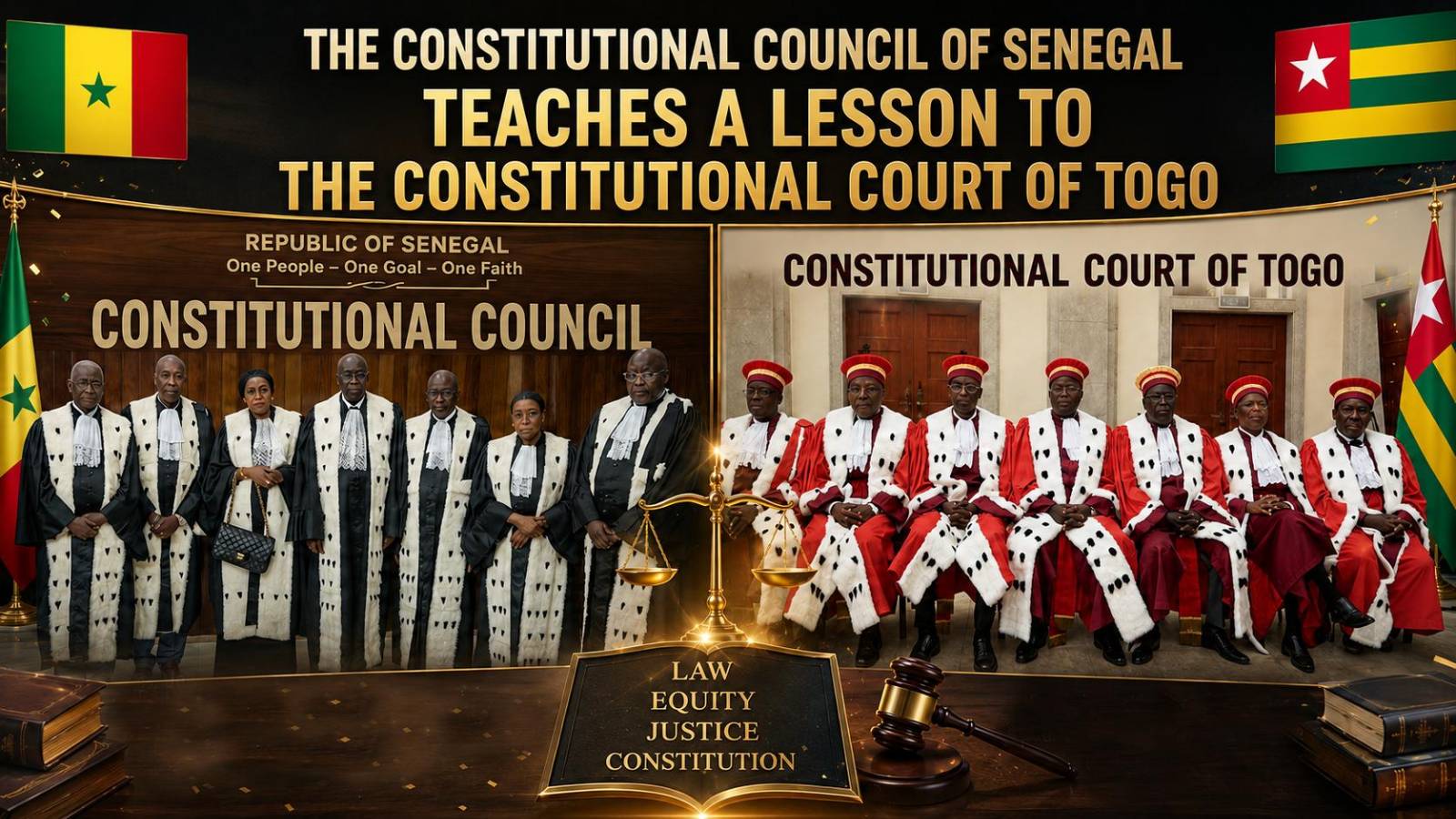
Two capital cities, two visions of state authority
The contrasting stances taken by constitutional bodies in Dakar and Lomé have laid bare two fundamentally opposing interpretations of the rule of law. Recent constitutional amendments in both cities have highlighted these divergent approaches to institutional authority and the limits of political power.
In Senegal’s capital, the Constitutional Council demonstrated a firm commitment to upholding the Constitution by blocking a proposed amendment backed by the government of Prime Minister Ousmane Sonko and the parliamentary majority. This bold decision underscored a critical principle: electoral victory does not grant unlimited authority. Within a state governed by law, political legitimacy is constrained by constitutional boundaries.
Meanwhile, in Togo’s capital, the Constitutional Court approved sweeping changes to the country’s foundational charter, despite widespread political and legal opposition. Critics argue that the reforms, which significantly alter the nation’s institutional framework, were not subjected to inclusive national debate. A Constitution is meant to serve as the bedrock of social contract; when it appears to be shaped by political leverage rather than broad consensus, its legitimacy is inevitably undermined.
The judiciary’s independence as a safeguard against crisis
The Senegalese experience illustrates how a truly independent judiciary can act as a bulwark against political crises. By enforcing constitutional limits on executive power, the Constitutional Council not only preserves legal principles but also safeguards institutional stability. It prevents political disputes from escalating into institutional conflicts or legitimacy crises.
Such judicial assertiveness also strengthens public trust. When a constitutional body can overrule government decisions without apparent interference, it signals that democratic rules apply equally to all. This legal predictability is vital for political stability, investor confidence, and international credibility.
In contrast, a constitutional court perceived as merely endorsing the executive’s agenda risks losing moral authority. Citizens may come to view domestic legal avenues as ineffective, pushing political actors to seek recourse in regional or international courts. The recurring intervention of the ECOWAS Court of Justice in Togo on rights and freedoms cases underscores the shortcomings of the country’s internal judicial mechanisms.
The Constitution must not serve short-term political ends
The process by which a Constitution is amended significantly shapes the quality of democracy. In mature democracies, constitutional reforms are preceded by extensive consultations, robust debate, and efforts to build consensus. This caution stems from the fact that a Constitution does not merely govern the present; it sets the rules for future power transitions.
When amendments are seen as serving immediate political objectives, they set a dangerous precedent. Each incoming majority may be tempted to reshape institutions to its advantage, fostering chronic instability and concentrating power in the hands of the few.
Politically, a Constitution that fails to unite becomes a perpetual source of contention. Institutions lose their role as neutral arbiters and instead become objects of conflict. This erosion of trust in constitutional bodies can erode the very foundations of democratic governance.
Learning from comparative experiences
To facilitate its transition toward a parliamentary system, Togolese authorities have undertaken numerous study missions abroad, including visits to India, to examine foreign institutional models. While comparative analysis can offer valuable insights, it cannot replace the study of African experiences shaped by similar political, social, and historical realities.
Across the continent, numerous examples show that democratic consolidation depends less on adopting foreign models than on the strict adherence to constitutional principles. Senegal’s Constitutional Council exemplifies this: its credibility stems not from rhetoric, but from its willingness to challenge executive authority, even when doing so conflicts with the government’s agenda.
This distinction is far from trivial. It influences governance quality, public trust, international standing, and economic appeal. Investors, development partners, and international organizations closely monitor the resilience of institutions and the predictability of the legal framework. A country whose rules appear stable and respected commands far greater confidence than one where institutions seem to shift with political winds.
Ultimately, the difference between Dakar and Lomé is not merely one of constitutional text, but of institutional philosophy. In Senegal, the Constitution is a constraint on power. In Togo, critics argue it has become an instrument for adapting to momentary political priorities. A strong democracy is not measured by the frequency of constitutional amendments, but by the ability of its institutions to protect citizens from the excesses of all branches of power.