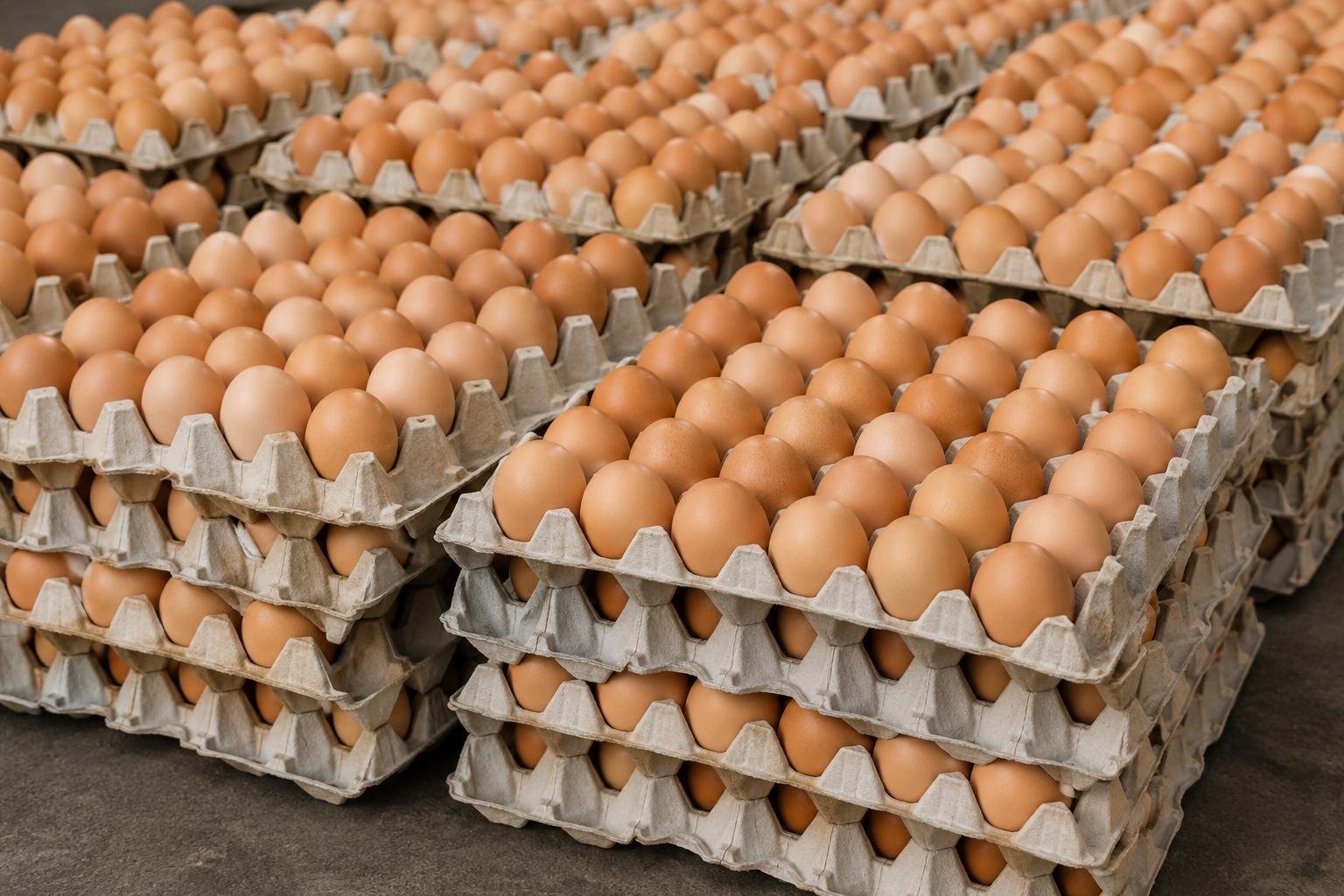
In a sweeping move that has sent shockwaves through Burkina Faso’s poultry industry, the government has imposed a price ceiling on eggs, capping the retail price of a single egg at 100 F CFA. Under the directive, wholesalers must sell eggs at 2,600 F CFA per tray, while retailers are restricted to 2,750 F CFA. While framed as a measure to ease the financial burden on households, this decision is poised to suffocate local businesses and disrupt an already vulnerable economic sector.
The price control paradox: ignoring rising production costs
Setting a fixed price for a finished product without addressing the spiraling costs of its raw materials is a flawed economic strategy. Poultry farming, especially egg production, relies heavily on feed inputs such as maize, soybean and cottonseed cakes, as well as mineral supplements. Over recent months, the price of these essential ingredients has surged due to inflation, transportation expenses, and supply chain disruptions.
By capping the retail price of eggs without subsidizing feed costs, the government is effectively forcing producers into an unsustainable position. Farmers are left with no choice but to sell at a loss or operate with razor-thin margins, putting their livelihoods—and the entire industry—at risk.
Stifling entrepreneurship: when regulation becomes suffocation
At the heart of a thriving market economy is the freedom to innovate, invest, and price goods according to real-world costs and demand. When the state oversteps by dictating internal pricing policies for private enterprises, it doesn’t regulate—it strangles growth.
Why would any business owner invest millions in poultry infrastructure, secure bank loans, or hire local workers if the government reserves the right to cap their revenue while ignoring their financial obligations? The message is clear: entrepreneurship in Burkina Faso is now hostage to arbitrary administrative decisions, not market realities.
The ripple effect: shortages and shadow markets
History has repeatedly shown that artificial price controls backfire. In this case, the potential consequences are severe and immediate:
- Collapse of small-scale producers: Unlike industrial farms, small poultry farmers lack the financial cushion to absorb losses. Many will be forced to shut down, costing thousands of jobs across the country.
- Reduced output: To avoid further losses, farmers may scale back production or even cull their flocks, leading to a sharp drop in egg supply.
- Black market surge: As legal supply dwindles, eggs will disappear from official markets and reappear in unregulated channels—sold at prices far above the capped 100 F CFA, further burdening consumers.
Toward smarter regulation: supporting producers, not punishing them
Ensuring affordable food for all Burkinabè households is a valid goal, but it should not come at the expense of those who power the economy. Real solutions lie upstream: subsidizing feed production, waiving taxes on poultry inputs, and expanding access to low-interest credit for farmers.
Imposing a price ceiling on eggs while ignoring the soaring cost of feed is not regulation—it’s economic mismanagement. It sends a dangerous signal to investors that business success in Burkina Faso depends more on bureaucratic whims than on sound judgment and hard work. To safeguard the poultry sector and protect food sovereignty, the government must lift price controls and invest in sustainable production instead.