- Société
- Droits de l’homme
- Actualités
denouncing torture in the central african republic: a perilous act
In the Central African Republic, denouncing torturers is a suicidal act in the face of Wagner’s criminal empire and law enforcement.
In the Central African Republic (CAR), raising an alarm about torture perpetrated by Wagner mercenaries, the Central African Armed Forces (FACA), and figures like Commander Yarkokpa, is an act fraught with extreme danger. Victims, silenced by a pervasive culture of impunity, find their pleas for justice falling on deaf ears.
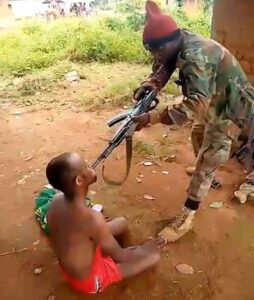
Across the Central African Republic (CAR), speaking out against acts of torture is tantamount to signing one’s own death warrant. Russian Wagner mercenaries, elements of the Forces Armées Centrafricaines (FACA), and even presidential guard gendarmes—often operating under the command of individuals such as Môn Gervais Simplice Yarkokpa—are spreading fear throughout Bangui and provincial towns. These groups engage in widespread looting, brutal torture, and killings, brazenly showcasing their atrocities on social media platforms as macabre trophies. Rather than prosecuting these crimes, the government dismisses compelling evidence as mere “fabrications” and labels victims as “enemies of the Central African Republic.” In such a terrifying environment, where justice remains an elusive concept, exposing these abuses carries severe risks, including imprisonment, forced exile, or even death.
Bangui: Yarkokpa, a thug in uniform
In Bangui, Commander Yarkokpa, an officer within the presidential guard, brazenly presides over a criminal network. Early in 2025, he brutally assaulted police officer Ouadole Freddy at Bangui-Mpoko airport, handcuffing and beating him with a machete for daring to expose Yarkokpa’s alleged drug trafficking activities. In August 2023, he orchestrated the baseless arrests of soldiers Dongomalé Dieubeni, known as Fort Papy, and Selekoy Tanguy, falsely accusing them of arms sales. Subsequently, he leveraged his connections with Defense Minister Claude Rameau Bireau to ensure their dismissal from service. More recently, Yarkokpa targeted Jefté Ngaïndiro, a young man from the Combattant neighborhood. Falsely accused of stealing 9 million Central African CFA francs, Jefté was abducted, subjected to torture, and had his new motorcycle and 150,000 CFA francs confiscated. Released without any avenue for redress, Jefté’s ordeal exemplifies the fate of countless victims crushed by a system where a military uniform serves as a shield for criminal enterprises.
Zémio: a hunt for witnesses
In Zémio, located in Haut-Mbomou, the crackdown on dissent is equally brutal. On May 15, 2025, Tisso René, a municipal councilor and history-geography teacher, was abducted by gendarmes and FACA personnel before being handed over to Wagner mercenaries. He has since vanished, widely believed to be a victim of extrajudicial killing. When his son, residing in Bangui, spoke out about the abduction on Radio Ndékè Luka, gendarmes immediately began pursuing Narcisse, known as Nara, a local merchant who witnessed the arrest. Nara, forewarned, managed to escape into the bush. However, on May 22, 2025, another son, Tisso Grâce, who had returned from the Democratic Republic of Congo, was apprehended by gendarmes. Falsely accused of speaking to the radio, he was subjected to torture “almost to the point of death” and is now fighting for his life. This relentless pursuit of witnesses appears designed to suppress the truth surrounding the disappearance of Tisso René, a respected figure in Zémio.
Justice paralyzed, government complicit
Victims like Jefté Ngaïndiro, Ouadole Freddy, and Tisso Grâce find themselves with no avenues for justice. At the Bangui courthouse, thousands of complaints lodged against Wagner and FACA forces languish, unaddressed. A court clerk, confronted with new grievances, reportedly admitted, “We cannot process these. These are classified confidential files.” This stark statement encapsulates the grim reality: the government appears to shield the very perpetrators it invited into the country. Even graphic videos of torture, such as one released by Wagner on February 25, 2025, in Ippy—depicting a young Central African beaten in a dilapidated house—are dismissed by authorities as “fabrications.” Furthermore, in 2024, Wagner operatives reportedly beheaded two Central Africans, filming their mutilated bodies, yet Bangui remained silent.
Yarkokpa: architect of terror
Yarkokpa is more than just a torturer; he is reportedly the mastermind behind an extensive criminal network. A former anti-balaka militiaman, he has ascended through his connections with the Minister of Defense and the President. Despite alleged illiteracy, he was integrated into gendarmerie officer training and now reportedly controls various illicit trades, including drug trafficking (tramadol from Zongo), counterfeit alcohol, and fake currency. In June 2024, he allegedly stole 800 million CFA francs worth of gold and diamonds from two Franco-Algerian traders, Samir Antonio Osmani and Haçade Bensalem, during a fraudulent search. Victims like Adjudant Kparambéti (Ozaguin), who was imprisoned for exposing Yarkokpa’s illicit activities, stand little chance against his entrenched impunity.
A populace silenced
Exposing torture in the Central African Republic is an act of unimaginable bravery. Wagner mercenaries, FACA forces, and Commander Yarkokpa operate with impunity, shielded by a government that consistently denies their crimes. Victims—including Tisso René, Tisso Grâce, Jefté Ngaïndiro, and Ouadole Freddy—are left abandoned, their pleas for help stifled by pervasive fear and widespread indifference. In a nation where justice remains a distant illusion, a critical question echoes: who will speak for the tormented? For now, the answer remains tragically, no one.