Gabon leverages science to boost food sovereignty
Libreville, Monday, June 8, 2026 – A bold gamble is taking shape at the heart of Gabon’s economic strategy. The goal? Slash food import dependence and phase out foreign chicken imports by 2027.
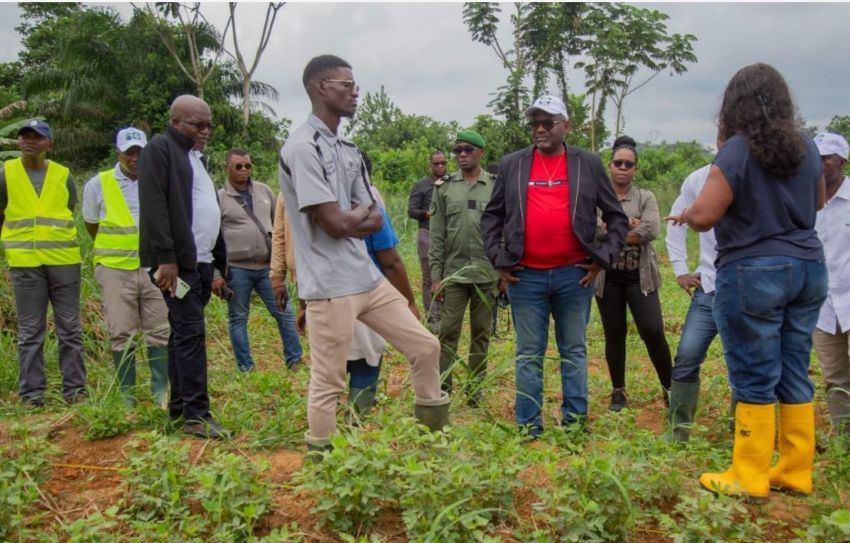
The battleground isn’t the bustling markets or congested ports but the experimental fields of the National Center for Scientific and Technological Research in Kougouleu. The visit by Gabon’s Minister of Higher Education, Scientific Research, and government spokesperson, Charles Edgar Mombo, underscored a pivotal shift: science is now Gabon’s frontline weapon in the fight for economic independence.
With food imports draining a significant portion of the nation’s foreign reserves, the ability to locally produce key livestock feed ingredients has become as strategic as mining or energy. The focus is on poultry feed, where maize and soybeans dominate the formula. Until these inputs are sourced domestically, the industry’s stability remains precarious.
Research drives national transformation
Gabon’s leadership has set a clear mandate: build a robust poultry sector capable of meeting domestic demand while steadily reducing reliance on imports. The linchpin? Feed production. Researchers at CENAREST are testing eleven maize varieties, meticulously screening each for adaptability to Gabon’s unique soil and climate conditions. The goal isn’t just higher yields—it’s securing a sustainable foundation for a burgeoning poultry industry.
Collaboration with research centers in Malawi has expanded the effort, introducing eleven soybean varieties for parallel testing. Field trials are also underway in Nyanga Province, particularly in Tchibanga, to assess performance across Gabon’s diverse ecosystems. This marks a turning point: research is no longer a distant academic pursuit but a cornerstone of economic development.
Toward an integrated agricultural future
Government strategy hinges on a straightforward principle: local production of essential livestock inputs to slash costs and boost competitiveness. This mirrors a broader trend across Africa, where food import bills have become a crippling economic vulnerability.
Gabon holds immense potential—fertile land, abundant water resources, and climates conducive to high-yield crops. Minister Mombo emphasized the progress already visible, praising researchers for their commitment and affirming the nation’s higher education system as a pillar in achieving presidential economic priorities.
The message is unmistakably political. Science is no longer confined to labs; it’s a driver of national priorities, shaping policies that directly impact livelihoods and economic resilience.
Challenges and the road ahead
Despite progress, hurdles remain. Researchers warn that scaling up experimental plots is critical to refining techniques and increasing output. The leap from lab to industrial production is fraught with challenges—financing, infrastructure, and streamlined supply chains top the list.
Yet for the first time in decades, Gabon is weaving together research, agriculture, and industry into a cohesive strategy for food sovereignty. The minister’s visit to Kougouleu symbolizes this paradigm shift: independence won’t come from policy alone but from the hands of scientists, farmers, and innovators.
By 2027, Gabon may prove that food sovereignty in Africa is built as much in research labs as in the fields. A quiet revolution, but one with the power to reshape the nation’s economic future.