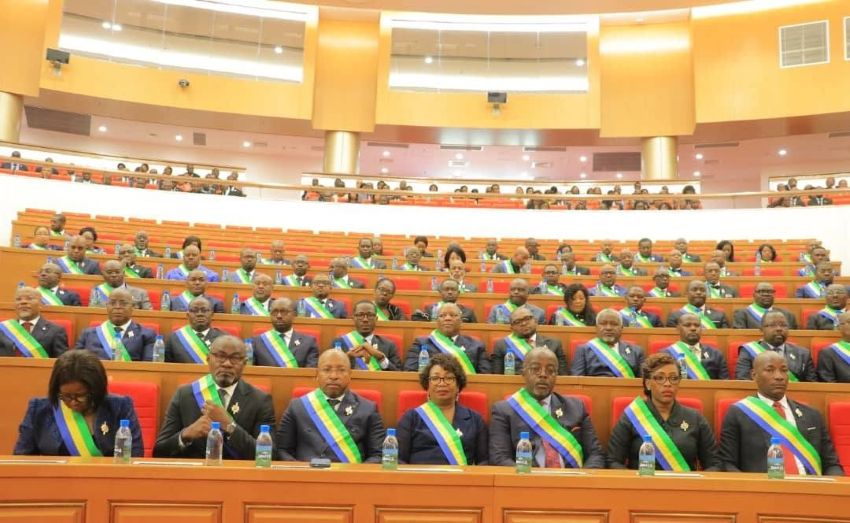
Libreville, Monday 15 June 2026 – A historic institutional milestone took shape in Gabon on 15 June 2026. For the first time since the Constitution of the Fifth Republic came into force, President Brice Clotaire Oligui Nguema addressed Parliament convened in Congress, in line with Article 59 of the new fundamental law.
Behind this unprecedented event lies far more than a mere institutional communication exercise. A new power architecture is taking form, with the stated ambition to make Parliament the pivot of republican life and accountability.
At a time when many democracies seek to restore trust between rulers and the ruled, Gabon is inaugurating a mechanism that could become one of the most visible markers of its new political era. The Palais Léon Mba, seat of the National Assembly, is no longer just a law-making venue; it becomes the symbolic space where each year the executive, national representation, and through them the sovereign people meet.
An institutional innovation with profound implications
Under previous regimes, presidential addresses to Parliament were exceptional circumstances. The Fifth Republic transforms this possibility into a constitutional obligation. Each year, the head of state must now present to lawmakers gathered in Congress his vision, record, and future plans.
This change may seem technical. In reality, it is highly political. It introduces a principle of regular accountability at the highest executive level. The president is no longer solely a holder of electoral legitimacy; he also becomes answerable to the national representation for actions taken in the name of the nation.
This provision distinguishes the Gabonese model from many classical presidential systems. It establishes a permanent republican rendezvous and helps institutionalise a culture of public evaluation of government action.
Moreover, the choice of the Palais Léon Mba as the Congress venue is not incidental. For decades, the centre of power gravity naturally revolved around the executive. By coming before Parliament, it is now the president who moves towards the representative institution. The symbolism is powerful: it asserts that democratic legitimacy is not limited to the presidential election but is embedded in ongoing dialogue with the people’s representatives.
Parliament, the new pillar of the Fifth Republic
The constitutional reform resulting from the inclusive national dialogue gives Parliament an unprecedented boost. Far from the image of a secondary institution, Parliament now appears as one of the main guarantors of the new institutional balance.
This evolution stems from a particular context. The political transition that began in 2023 placed the question of rebuilding public trust at the heart of national debates. The new Constitution aims to meet this demand by strengthening mechanisms of control, transparency, and responsibility.
The annual Congress fits fully into this logic. Even without a vote or direct debate, its impact is considerable. It creates a space of political visibility where majority and opposition share a common institutional moment. In a political landscape often marked by tensions, this ceremony introduces a ritual of republican unity.
Through this mechanism, Parliament also becomes the mirror of the nation. The 215 deputies and senators gathered together embody the country’s political, geographic, and social diversity. The presidential address is directed to them, but in reality it speaks to all Gabonese.
The birth of a new political culture
All major democracies rest on rituals. They give meaning to political time and anchor institutions in the collective imagination. The annual Congress could become one of these defining events for Gabon.
Beyond its protocolary nature, this meeting enshrines a philosophy of government based on transparency and institutional dialogue. It contributes to building a political culture where authority is exercised not only through decisions but also through explanation and accountability.
In an African continent where investors, international partners, and multilateral organisations often view institutional reforms with caution, this mechanism also sends a signal of stability. It reflects the desire to embed public governance in a predictable and sustainable framework.
The true significance of the 15 June Congress therefore far exceeds the content of the presidential address. What enters history is not just the speech of a head of state; it is the establishment of a republican tradition destined to shape national political life for years to come.
By making Parliament the common house where the executive and national representation meet each year, the Fifth Republic lays one of the foundations of its identity. Gabon thus inaugurates a new institutional balance where the strength of the state is measured less by the concentration of power than by its capacity to render accounts. This may well be the most profound transformation since the advent of the new Republic.