The Gabonese government has signaled a decisive shift in its approach to national development. Faced with persistent delays in several initiatives financed by the African Development Bank (AfDB), the authorities are now insisting on tangible progress and accountability. The era of simply securing loans is giving way to an era of mandatory results.
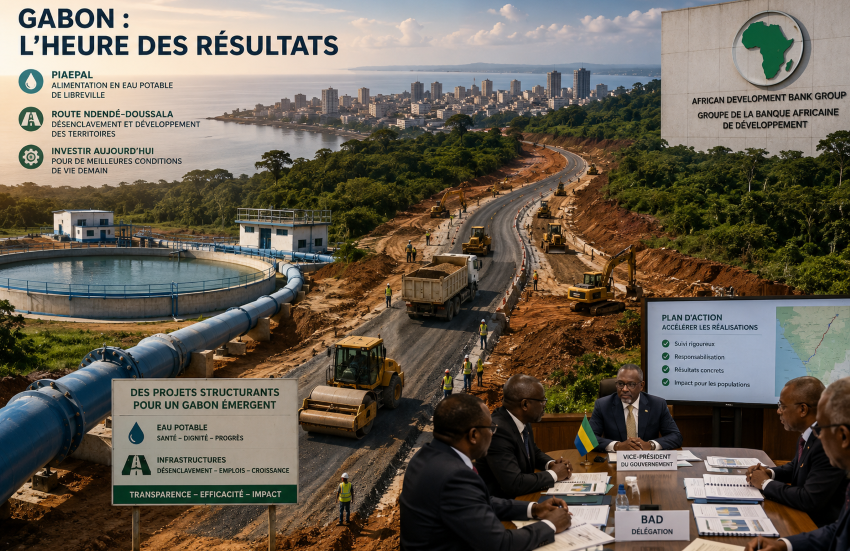
A high-level meeting held on June 29 in Libreville brought together the Vice President of the government, Hermann Immongault, and an AfDB delegation led by country administrator Mamour Ousmane Ba. This discussion underscored a growing priority for the executive branch: ensuring that mobilized capital is effectively converted into visible improvements for the population.
Critical infrastructure under scrutiny
Two major projects are currently at the center of these concerns. The first is the Integrated Program for Drinking Water Supply and Sanitation in Libreville (PIAEPAL), which is vital for securing long-term water access in the capital. The second is the Ndendé-Doussala road, a strategic corridor designed to boost regional integration and facilitate economic trade with neighboring nations. While both are considered high-priority sites, their slow pace of execution has sparked frustration and raised serious questions.
For years, Gabon has tapped into international financing to modernize its infrastructure. However, the recurring failure to meet project timelines has fueled public dissatisfaction. The recent dialogue with the AfDB marks a clear departure from past tolerance. The government is now adopting a performance-based model where every dollar of debt must have a measurable impact on the daily lives of citizens.
Addressing administrative bottlenecks
In a context of tightening budget constraints, the focus has moved beyond resource mobilization to resource efficiency. The public no longer judges success by the size of the investment, but by the completion of the work. The PIAEPAL project is a prime example; as water shortages persist in various Libreville neighborhoods, any further delay directly undermines the government’s credibility.
Similarly, the Ndendé-Doussala road has been promoted as a catalyst for economic development, yet the slow progress continues to stall the benefits intended for local businesses and residents. Hermann Immongault emphasized the need to clarify the roles of all stakeholders and pinpoint the exact bottlenecks hindering these projects.
This new transparency includes an admission of internal administrative failures. The government recognizes that delays are often the result of a complex web of issues, including heavy bureaucratic procedures, poor coordination between institutions, and slow decision-making processes. By acknowledging these systemic flaws, the administration is signaling a commitment to reforming how public projects are managed.
A test of government credibility
The AfDB remains a committed partner, with Mamour Ousmane Ba reaffirming the institution’s readiness to support Gabon‘s priorities. However, the ultimate success of these partnerships rests on the nation’s capacity to execute. In the global competition for development funding, the most attractive countries are those that can prove their ability to transform loans into operational infrastructure.
The message sent from Libreville is unambiguous: Gabon demands that every funded project becomes a reality. The completion of the Ndendé-Doussala road and the restoration of reliable water via PIAEPAL will serve as the primary benchmarks for this new policy. It remains to be seen if this change in tone will finally break the cycle of delays that has historically plagued the nation’s largest construction efforts.