
JNIM’s strategic shift reshapes Mali’s security landscape
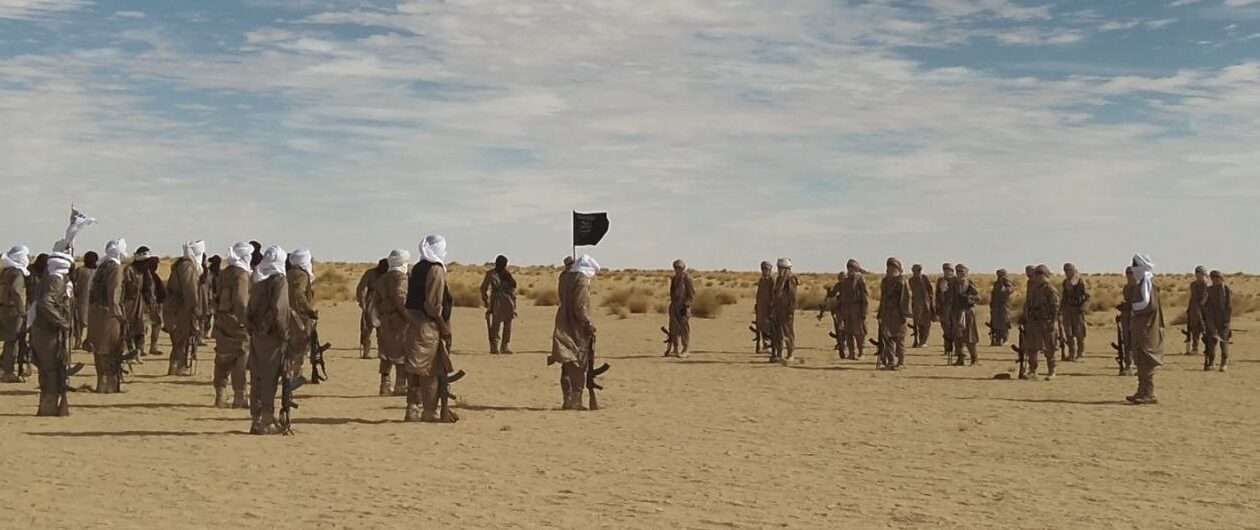
The northern and central regions of Mali no longer face sporadic armed threats alone. For years, they have endured a relentless cycle of violence and societal exhaustion. Recent offensives by the Group for the Support of Islam and Muslims (JNIM) and the Azawad Liberation Front (FLA)—targeting military outposts, supply convoys, and critical road infrastructure—signal a decisive strategic evolution.
Beyond territorial control: a new battlefield
These armed factions are no longer focused on seizing towns or orchestrating high-profile attacks. Instead, they aim to erode state authority systematically, pushing the military junta into increasingly isolated pockets around Bamako.
The conflict’s center of gravity has shifted. The question is no longer merely which force holds a village or barracks, but rather: Which actors can still facilitate movement—of people, goods, fuel, officials, or public services?
A war against mobility
Over recent months, road ambushes and military convoy strikes have surged. In several regions, administrative travel now requires armed escorts, crippling the state’s ability to function beyond major urban hubs. This erosion extends beyond military capacity, threatening Mali’s very territorial integrity.
The JNIM has grasped a critical insight: in a nation already weakened by institutional collapse, economic decline, and chronic insecurity, attrition warfare yields greater dividends than conventional battles. This approach avoids costly territorial campaigns while dispersing enemy forces, inflating security expenditures, and fostering a pervasive climate of fear. Its most insidious impact? Collective fatigue—military, economic, and social.
In rural areas, the crisis has evolved from armed presence to systemic absence: the gradual disappearance of stable administrative structures.
The limits of militarized governance
The Malian military regime has staked its legitimacy on restoring security, positioning recent coups as a path to sovereignty. The withdrawal of French forces and the growing influence of Russian military contractors were framed as assertions of autonomy.
Yet sovereignty cannot be measured solely by combat capability. It demands the preservation of territorial continuity—economic, administrative, and social. Here lies the paradox: intensified military action does not guarantee lasting stability. In some regions, it coexists with the fragmentation of rural spaces.
The prevailing security paradigm relies heavily on offensive operations, airstrikes, and troop deployments. Yet it struggles to rebuild enduring state infrastructure: schools, healthcare, local justice, roads, and economic circulation.
This void spawns its own dynamics. As public services vanish, communities increasingly depend on parallel systems for protection, dispute resolution, and survival.
The Sahel’s evolving armed landscape
The Malian crisis is no longer confined to Mali. Across the Sahel, armed actors, local alliances, and clandestine economies are rapidly recomposing. The porous borders of Mali, Burkina Faso, and Niger enable militant mobility, yet state responses remain fragmented. Despite forming a shared political-military alliance, these nations have proven unable to support one another effectively.
The JNIM’s recent campaigns exposed the fragility of this alliance and the isolation of the Malian junta, which now relies almost exclusively on the Africa Corps mercenaries. This asymmetry benefits groups that prioritize adaptability over static control. The JNIM leverages territorial flexibility, local anchoring in certain zones, and integration into informal economic networks.
Its goal is not to permanently govern every territory it traverses, but to impose unsustainable security costs on the state. The Sahel conflict has become a war of endurance—a struggle not to govern, but to prevent governance.
What Mali’s crisis reveals
A narrow counterterrorism lens distorts the Sahel’s realities. Reducing the crisis to military confrontation obscures its social, economic, and territorial dimensions.
In many rural areas, state abandonment, land disputes, communal rivalries, and structural poverty create enduring vulnerabilities. Armed jihadist groups do not always create these fractures, but they exploit them masterfully.
The core challenge is political: How can the state rebuild legitimacy in territories where its presence is intermittent and primarily military?
The future of Mali may hinge not on a single decisive battle, but on the ability—or failure—to restore a stable public presence beyond security operations.
Attrition warfare does not merely destroy military positions. It erodes roads, economies, administrations, social bonds, and ultimately, the very idea of a governed territory.
Mourad Ighil