Europe’s shifting borders isolate Russia’s military stronghold
Once a symbol of Moscow’s military might in the heart of Europe, the Russian exclave of Kaliningrad now faces an unprecedented tightening of controls by its NATO neighbors. Between tightened logistics and fortified borders, the once-formidable fortress has become a geopolitical prisoner, its strategic isolation growing by the day.
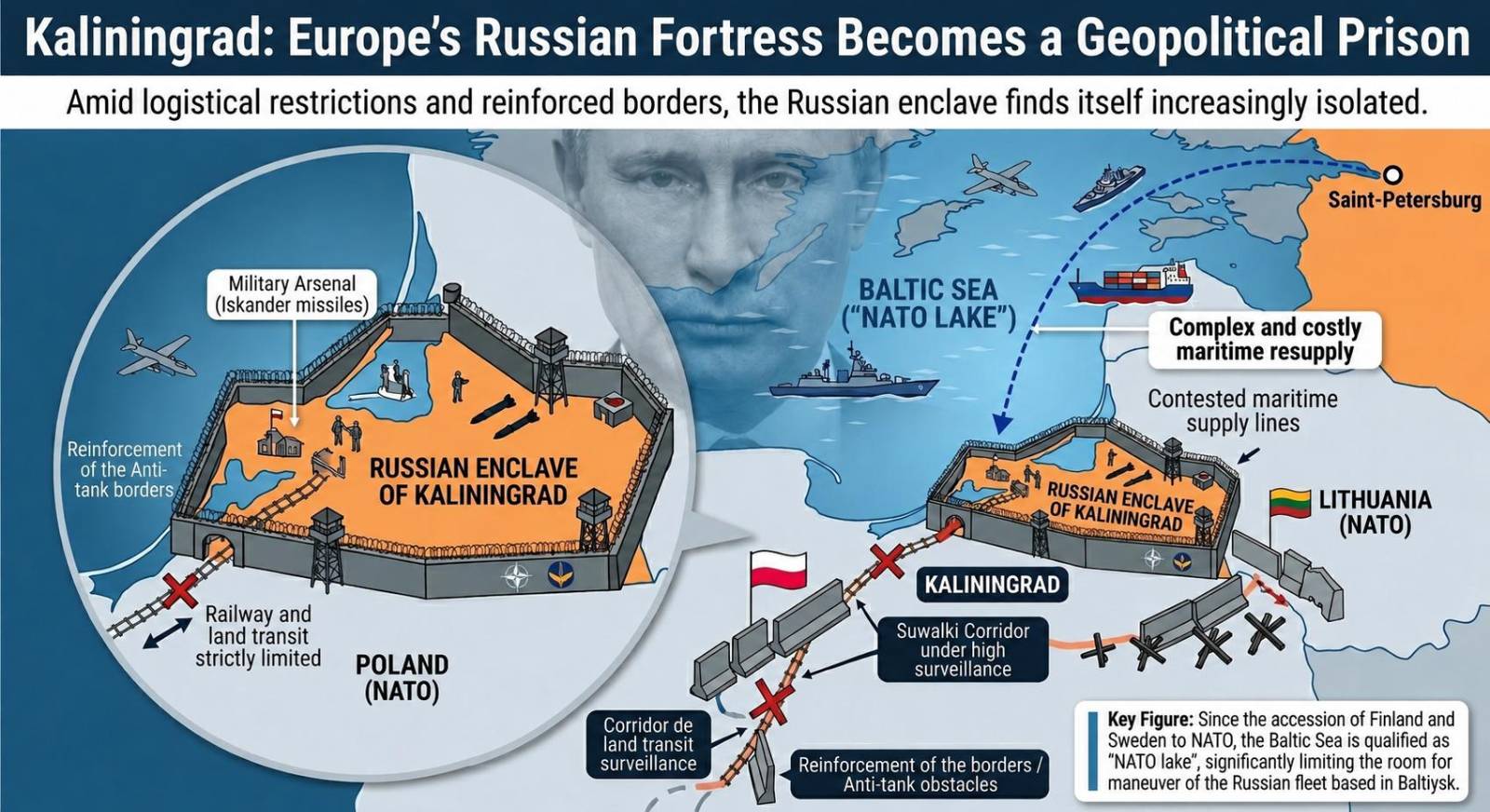
The Baltic Sea region is undergoing a historic shift. The Russian territory, sandwiched between Poland and Lithuania, is experiencing an unparalleled connectivity crisis. Long regarded by the Kremlin as a powerful projection tool—home to Iskander missiles capable of striking deep into European territory—Kaliningrad is now a besieged enclave, cut off from its hinterland by mounting barriers.
Driven by Warsaw, Vilnius, and Riga, NATO’s eastern flank is systematically dismantling the logistical lifelines that once sustained the exclave. What was once a seamless transit corridor has been transformed into a pressure point, turning Kaliningrad’s geographic vulnerability into a tool of deterrence for the Alliance.
Rail and road arteries choked by sanctions
The squeeze on Kaliningrad is not sudden but the result of a deliberate, incremental campaign. Poland, Lithuania, and Latvia have drastically restricted transit routes into the exclave:
- Rail disruptions: The Suwałki Corridor, the critical land bridge connecting Belarus to Kaliningrad, now operates under severe constraints. Freight transit via the Soviet-era railway network has been slashed, confined to what Brussels deems permissible under sanctions.
- Energy chokehold: Overland fuel and energy shipments have plummeted, forcing Moscow to rely on costly maritime supply lines through the Baltic Sea to prevent economic paralysis.
- Fortified borders: On the ground, access is all but impossible. Poland and Lithuania have transformed their frontiers into high-security zones, erecting anti-tank barriers, barbed wire, and surveillance systems to seal off the enclave.
The Baltic Sea, now dubbed the “NATO lake” following Finland and Sweden’s accession to the Alliance, further restricts Russia’s maneuvering room. The Baltic Fleet, based in Baltiysk, finds itself increasingly hemmed in, its ability to reinforce or resupply Kaliningrad severely compromised.
Moscow’s fortress at risk of becoming a liability
For President Vladimir Putin, the Kaliningrad conundrum represents a critical strategic dilemma. While the exclave remains heavily militarized, its long-term resilience is now in question. With ground supply lines severed, the Russian military in the region depends entirely on maritime and air routes—both increasingly contested and vulnerable to disruption.
Military analysts warn that what Moscow once saw as its “sharpest sword” against the West may now be a liability. In the event of open conflict, the enclave could find itself immediately besieged, encircled by a united and vigilant NATO.
Diplomatic deadlock looms as tensions escalate
Facing a de facto blockade, Moscow has repeatedly accused its neighbors of violating international transit treaties, threatening retaliatory measures. Yet Poland, Lithuania, and Latvia, backed by their Western allies, defend their actions as essential to national security amid Russia’s aggressive posture in Ukraine.
The question now is how far this logistical war of attrition can escalate before igniting a larger military confrontation in one of the world’s most heavily militarized zones.