
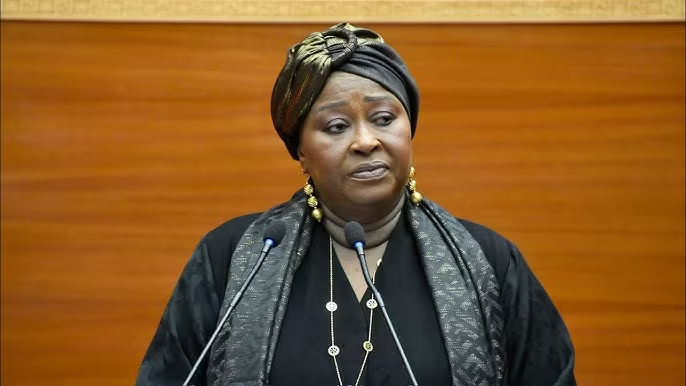
Khombole incident: political speech and religious boundaries in Senegal
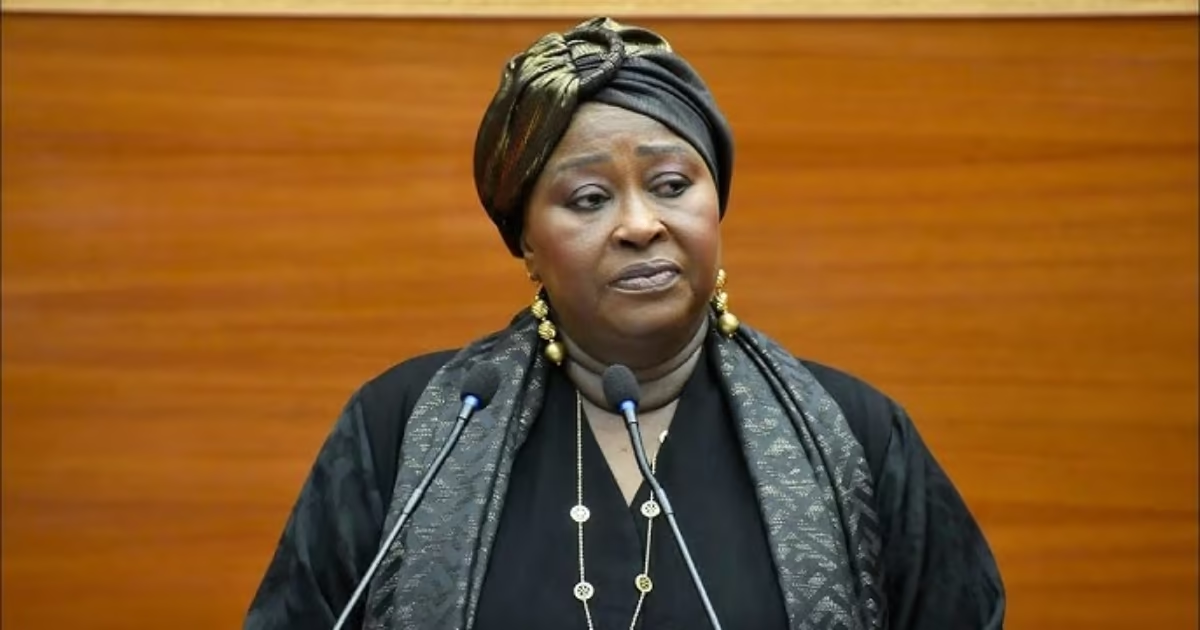
Khombole incident: political speech and religious boundaries in Senegal
When a political ally invoked a religious blessing for Ousmane Sonko during a Khombole gathering, it crossed a line that few in Senegal dare to touch. The incident has ignited a debate about where political admiration ends and religious sacralization begins.
A single phrase uttered this past Saturday in Khombole has exposed deep fault lines in Senegal’s political landscape. Maïmouna Dièye’s decision to frame her remarks about Ousmane Sonko with a sacred Islamic invocation sent shockwaves through the crowd—and directly into the heart of Senegal’s delicate balance between faith and governance.
What was said in Khombole
Maïmouna Dièye did not merely praise Ousmane Sonko; she elevated him to a spiritual plane reserved for the divine in Islam. By declaring her comments were made “under the presence of Seyidina Ousmane Sonko Salalahou Aleyhi Wa Salam,” she employed a formula typically reserved for the Prophet Mohammad (peace and blessings be upon him) and, by some interpretations, other recognized prophets. This invocation, known as salat, is a cornerstone of Muslim practice, recited whenever the Prophet’s name is mentioned. To apply it to a political figure—no matter how revered—is to blur the sacred and the secular, a transgression that carries significant theological weight in Senegal, where religious and civic identities are deeply intertwined.
Such a statement does more than raise eyebrows; it risks normalizing the sacralization of political leaders, a practice that religious leaders have long cautioned against. Ousmane Sonko’s immediate response revealed the tension: while acknowledging the genuine affection of his supporters, he firmly rejected any attempt to place him on a pedestal reserved for the Prophet. “I have never reached that level,” he stated, “and I do not aspire to.”
Ousmane Sonko’s response
In correcting his ally publicly, Ousmane Sonko demonstrated the high stakes involved. In Senegal, where religious discourse carries immense weight, even well-intentioned praise can be misconstrued or exploited. His swift clarification was not just a personal defense; it was a necessary safeguard against political weaponization of faith. By drawing a clear line between admiration and sacralization, Sonko reinforced the principle that political leaders, however influential, must not be elevated to divine status—a principle that resonates strongly in a country where religious respect shapes public discourse.
Ousmane Sonko