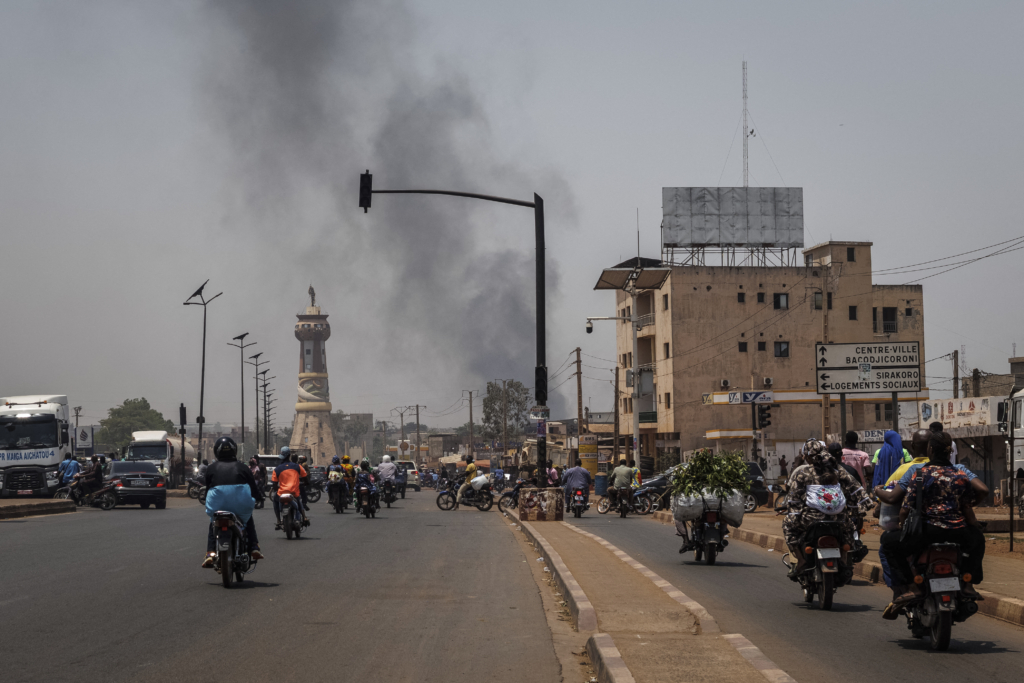
Bamako residents are facing severe hardships as GSIM enforces a blockade that has severed critical supply routes, directly impacting civilian safety and survival. Human rights advocates warn that this siege violates international humanitarian law and risks triggering widespread food insecurity, healthcare shortages, and loss of life.
Since 28 April, three of the six main roads connecting Bamako to regional trade hubs have been deliberately blocked or attacked, cutting off essential goods and humanitarian aid. On 6 May, GSIM—an armed faction linked to Al-Qaïda—conducted an ambush on a civilian convoy transporting fruits and other goods between Bamako and Bougouni. According to field reports, neither the trucks nor their cargo posed any military threat, yet they were deliberately targeted.
Attacks on civilian vehicles serving no military purpose are strictly prohibited under international law. All warring parties must differentiate between combatants and non-combatants, ensuring that civilians and civilian infrastructure remain protected. This principle is non-negotiable, particularly when entire communities depend on unimpeded access to food, medicine, and clean water.
Civilian populations cannot be held hostage by military blockades. The right to life, dignity, and survival must prevail over any tactical advantage.
Regional spokesperson, Amnesty International for West and Central Africa
How the blockade violates wartime conventions
The current blockade, announced by GSIM on 28 April, differs significantly from last year’s targeted fuel embargo. While previous restrictions focused solely on petrol tankers, this latest measure indiscriminately halts all commercial traffic entering Bamako. By 15 May, critical trade arteries linking the capital to vital ports had been rendered unusable, sparking sharp price hikes for staple goods.
Local sources and media reports confirm that essential commodities like food, medicine, and fuel are now scarce, with families struggling to meet basic needs. The United Nations Human Rights Office has urgently called for an end to hostilities, emphasizing that blockades must not deprive civilians of their economic and social rights.
GSIM claims to have relaxed restrictions on 6 May, allowing medical emergencies to pass. However, independent verification of this concession remains pending, leaving residents in limbo.
A survivor’s account of GSIM’s brutal tactics
In a chilling testimony, a truck driver recounted the horrors of an ambush carried out by GSIM militants on 29 January near Diboli, along the Kayes-Bamako corridor. Under military escort at the time, the convoy was overwhelmed by over two hundred attackers on motorcycles. Several drivers and apprentices were executed after fleeing their vehicles.
« We were ambushed twenty kilometers from Diboli. The attackers opened fire indiscriminately. When reinforcements arrived, they too were slaughtered. At least twelve of us were captured, forced to dig graves for fallen militants, and then executed.
This was not a battle—it was a massacre. Civilian lives were taken without hesitation.
International observers stress that such acts may constitute war crimes. Survivors and victims’ families are entitled to justice, reparations, and the truth under international law. Authorities must investigate these atrocities without delay.
Escalating violence and regional instability
On 25 April, GSIM and the Front de libération de l’Azawad (FLA) launched coordinated attacks across multiple cities, including Bamako, Kati, and Gao. Military installations and homes of officials were targeted, with Defence Minister Sadio Camara among those killed in Kati after a car bomb detonated near his residence.
A week later, militants stormed villages in central Mali, leaving at least forty dead and several missing. These assaults underscore the growing humanitarian crisis gripping the region, where civilians bear the brunt of unrelenting violence.
The blockade of Bamako, combined with these raids, has plunged the city into a state of siege, raising urgent questions about the protection of civilian lives in conflict zones.