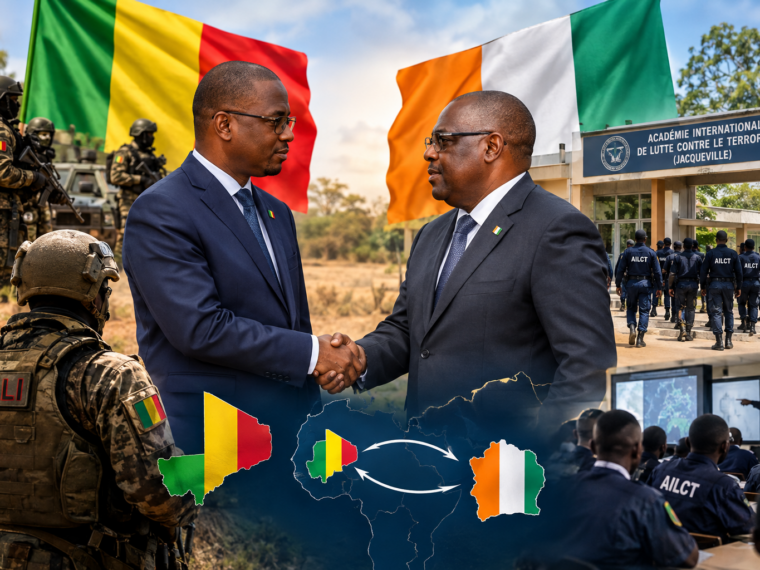
The head of Côte d’Ivoire’s intelligence services is scheduled to visit Bamako on October 15, 2026, at the invitation of Mali’s top security official. Vassiriki Traoré, director-general of Côte d’Ivoire’s intelligence agency, will meet with Modibo Koné, director of Mali’s National Agency for State Security (ANSE), to discuss critical counterterrorism strategies amid escalating regional threats.
Key questions on Mali’s approach to Sahel security
With Mali facing persistent terrorism challenges, the meeting raises a pivotal question: Could the country benefit from Côte d’Ivoire’s proven counterterrorism model? Over recent years, Abidjan has developed robust security frameworks, including intelligence sharing, coordinated operations, and preemptive training, which could offer valuable lessons for Bamako.
The visit comes as Mali grapples with expanding terrorist networks, prompting a re-evaluation of its security strategies. Côte d’Ivoire’s experience in preventing attacks and enhancing inter-agency coordination presents a potential blueprint for Mali to adapt to its own security realities.
How Côte d’Ivoire’s training academy could shape Mali’s security response
Côte d’Ivoire’s International Academy for Counterterrorism (AILCT) in Jacqueville stands out as a key asset. Since its launch in June 2021, the academy has trained defense and security personnel across strategic, operational, and tactical levels, fostering skills in intelligence, threat anticipation, and operational planning.
For Mali, this academy could serve as a model for strengthening its own forces. Potential areas of collaboration include specialized unit training, refined intelligence gathering, and improved coordination among military, police, and judicial branches. The goal is to move beyond theoretical discussions and implement actionable strategies.
Security cooperation: overcoming past tensions for a stronger Sahel
The anticipated visit follows years of strained relations between Bamako and Abidjan. However, the shared threat of terrorism has reignited dialogue, with both nations recognizing the need for regional solidarity. The meeting will focus on concrete steps to enhance counterterrorism efforts, including intelligence sharing and joint operational tactics.
The challenge now lies in translating these discussions into measurable results. Mali must assess how Côte d’Ivoire’s methods such as its emphasis on preventative measures and community protection can be tailored to its own context. The goal is not to relinquish sovereignty but to identify adaptable solutions that strengthen Mali’s security posture.
What’s next for Mali’s security strategy?
The October 15 meeting marks a potential turning point, but its success will depend on action. Mali’s ability to integrate Côte d’Ivoire’s best practices while addressing its unique security landscape will determine whether this cooperation yields tangible progress. For now, the exchange opens a critical window for regional collaboration in the fight against terrorism.
By Agnès Mvogo — Journalist