The anticipated transition from Wagner Group to Africa Corps in Mali has done little to halt a disturbing surge in human rights violations, according to a groundbreaking report released in late 2026. Despite the official handover, civilians continue to bear the brunt of executions, torture, and arbitrary detentions, with zero accountability for the perpetrators.
The shift in security operations was supposed to mark a new era of discipline and professionalism in Mali’s fight against armed groups. Yet the documented abuses—including massacres in marketplaces, systematic torture in detention centers, and targeted violence against ethnic communities—paint a starkly different picture. As experts warn, this continuity of violence threatens to undermine both the nation’s stability and its international standing.
Civilian casualties mount under Africa Corps operations
Between 2023 and 2025, at least 34 civilians were killed in seven villages along the Mali-Mauritania border during joint military operations involving the Malian Armed Forces (FAMa) and foreign security personnel. Survivors described extrajudicial executions, where detainees were shot during or after arrest, while others were subjected to gruesome methods such as throat-cutting and immolation.
Drone strikes, claimed to target militants, have also resulted in civilian casualties. In March 2025, a marketplace airstrike in Ejdeir reportedly killed 16 people, followed by a November strike in Tangata that claimed seven lives. Investigators found no evidence of armed combatants or military objectives at either site, raising serious questions about the precision and oversight of these operations.
The report highlights the tragic human cost of this so-called progress, with communities living in constant fear of being caught in the crossfire of a war they did not choose.
Torture and detention: a systemic pattern of abuse
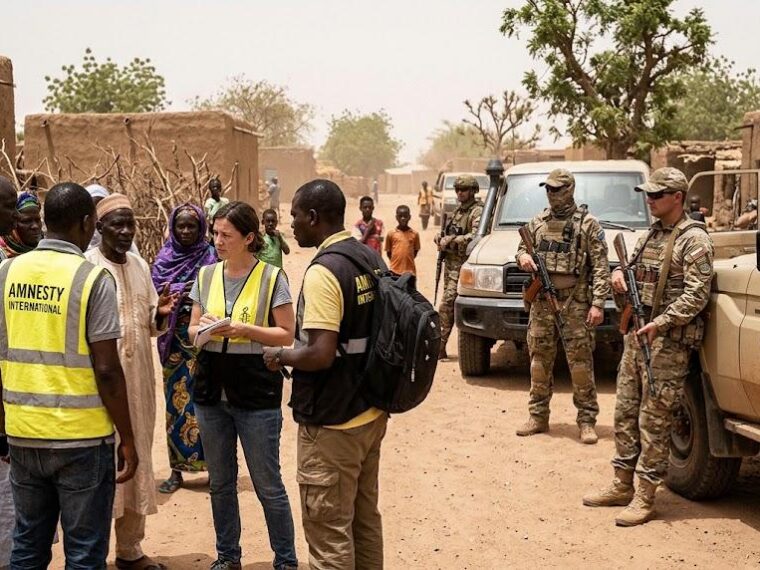
Amnesty International’s findings reveal a chilling pattern of torture and inhumane treatment in facilities across Léré and Nampala. Fifteen survivors recounted harrowing experiences, including:
- Suspension by the arms for hours on end
- Simulated drowning and electrocution
- Severe beatings using batons, iron bars, and rifle butts
- Sexual violence against detainees
At least five individuals died as a direct result of these abuses, while others remain detained without access to legal counsel or communication with their families. Shockingly, some survivors allege that Russian contractors formerly part of Wagner Group were present during interrogations, with Malian soldiers failing to intervene.
These revelations underscore the urgent need for independent investigations to identify and prosecute those responsible at all levels of the chain of command.
Ethnic targeting: the human cost of collective punishment
The report exposes a disturbing trend of targeting Fulani, Arab, and Tuareg communities under the guise of counterterrorism. Accusations of collaboration with armed groups—particularly the Group for Support of Islam and Muslims (GSIM)—have led to indiscriminate violence, including cattle theft, property destruction, and the seizure of valuables.
These actions exacerbate the already dire situation for these marginalized groups, who face displacement, food insecurity, and the loss of livelihoods. Experts emphasize that no armed conflict can justify collective punishment or violence based on ethnicity. The protection of civilians must remain non-negotiable, regardless of the circumstances.
Africa Corps’ unchecked rise: Moscow’s shadow over Mali
The Africa Corps, reportedly under direct control of Moscow, began its deployment in Mali in early 2025, with the official transfer of Wagner Group’s operations completed by June of the same year. But far from curbing abuses, the transition has introduced new layers of concern.
On July 10, 2026, in the Fulani quarter of Bombori village, approximately 80 men were rounded up, beaten, and interrogated about militant activities. Six individuals attempting to escape were shot, and three were summarily executed. These allegations cast doubt over the true nature of the cooperation between Bamako and Moscow, the scope of missions assigned to Russian personnel, and the accountability mechanisms in place.
The absence of transparent oversight raises critical questions about the long-term implications of this partnership and its impact on Mali’s fragile social fabric.
Impunity’s grip: a cycle of violence without justice
Perhaps the most alarming revelation is the complete lack of accountability. Since 2023, no judicial proceedings have been initiated against members of government forces for abuses against civilians. This culture of impunity not only emboldens further violations but also silences victims and witnesses, making it nearly impossible to document and address the full scale of the crisis.
Amnesty International is calling for immediate action:
- Independent investigations into all allegations of abuse
- Prosecution of responsible parties, from soldiers to high-ranking officials
- Full transparency regarding agreements with Africa Corps and military operation protocols
- Unrestricted access for monitors and humanitarian organizations to affected regions
The transition from Wagner to Africa Corps was supposed to bring change. Instead, it has exposed a deeply entrenched pattern of violence and lawlessness. For Mali to achieve lasting peace, the protection of civilians must take precedence over military objectives—and justice must be served.