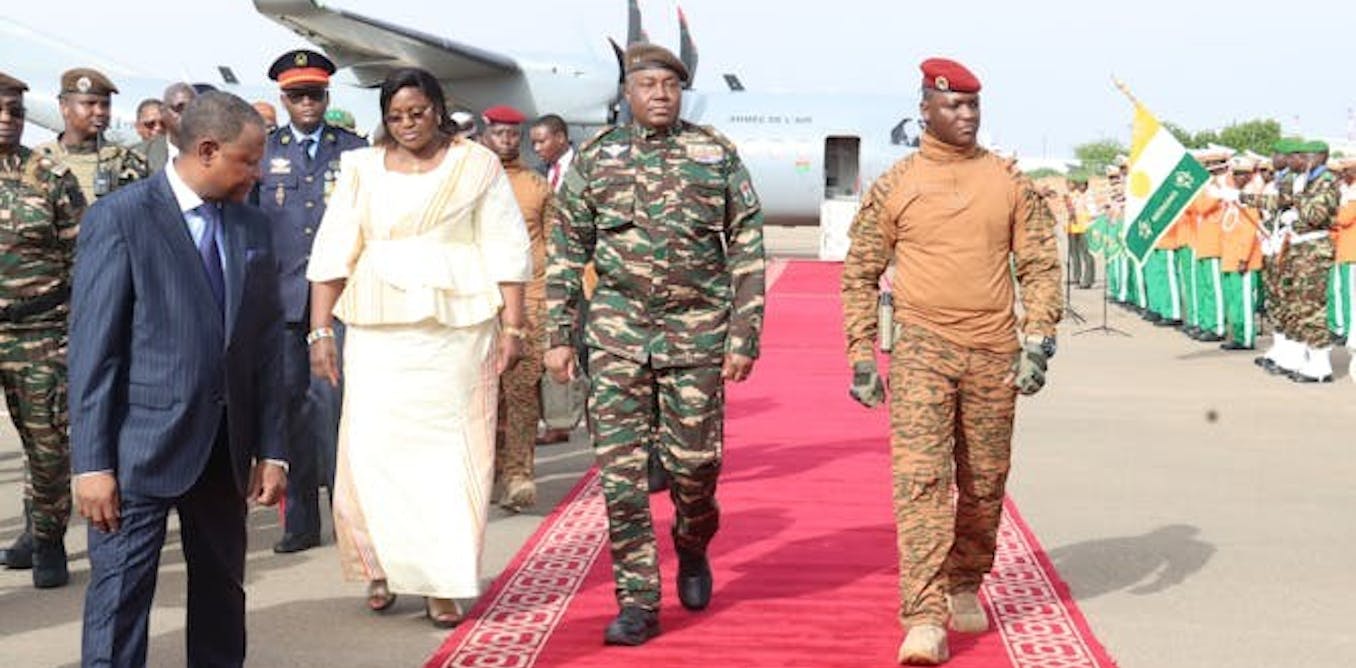
The late January 2026 marked the definitive end of partisan politics in Burkina Faso. On January 29, Captain Ibrahim Traoré’s government officially dissolved all political parties, including those that had backed his 2022 coup.
While these parties had already been temporarily banned since Traoré’s rise to power, the junta framed the move as part of a broader state restructuring aimed at reducing social divisions. In reality, this action eliminates the last remnants of independent civic participation and centralizes authority under Traoré. Party assets have since been seized by the state.
Though the junta initially relied on vocal civilian backing, this latest decision starkly contrasts with its earlier populist and revolutionary rhetoric. Yet, this pattern is far from unprecedented.
The pitfalls of civilian backing for military takeovers
Across the Sahel and beyond, African military coup supporters are learning the hard way that initial enthusiasm rarely translates into lasting political influence. Coups often begin with broad public support, only to end with the junta sidelining or openly suppressing the very groups that helped consolidate its power. This trend spans decades.
Drawing from nearly a decade of research on African military coups—particularly the recent wave sweeping West Africa—it becomes clear that once in power, juntas have little incentive to share authority. Civilian groups serve a purpose in the coup’s early days: they provide crowds, legitimacy, and the illusion of widespread public frustration. However, their leaders, supporters, and independent agendas soon become liabilities.
These groups may demand faster transitions or criticize delays, threatening the junta’s grip on power. Independence, even in a supporting role, is precisely what military leaders fear most. Enthusiastic civilian backing, while valuable in the short term, does not equate to a lasting mandate or inclusive governance.
From allies to adversaries: the Sahel’s shifting power dynamics
Contrary to popular belief, many African coups attract at least some civilian support. In some cases, civil society groups, opposition parties, and even religious leaders actively endorse military interventions, believing they will restore order or correct perceived injustices. This was evident in recent coups across Mali, Niger, and other Sahelian nations, where civil society and political figures celebrated or legitimized juntas as necessary correctives.
Yet history shows a recurring pattern: once juntas consolidate power, they systematically marginalize, sideline, or even repress former allies. This cycle has repeated itself in different eras and regions, defying ideological or social divides.
Sudan’s 1969 coup exemplifies this trajectory. The Sudanese Communist Party initially backed the military officers led by Colonel Jaafar Nimeiri, providing crucial political support. Within months, Nimeiri began purging communist leaders from government. By 1971, he launched a brutal crackdown, effectively crushing the party.
A similar fate befell Egypt’s 2013 coup. The Tamarod protest movement openly endorsed General Abdel Fattah el-Sisi’s takeover, only to see its influence evaporate as civic space shrank under military rule.
What the Burkina Faso crackdown reveals about Sahelian coups
Today, many civil society groups that once championed coups in the Sahel are experiencing the same disillusionment as their predecessors elsewhere. In Mali, the June 5 Movement–Rally of Patriotic Forces (M5-RFP), a coalition of opposition parties, religious leaders, and activists led by imam Mahmoud Dicko, has become one of the junta’s most vocal critics—despite initially backing Colonel Assimi Goïta’s 2020 coup.
After mass protests forced President Ibrahim Boubacar Keïta’s resignation, the M5-RFP hailed the military’s intervention and hoped to shape the transition. Those hopes were short-lived. The junta excluded many M5-RFP leaders from key government roles and further sidelined the movement after Goïta’s second coup in May 2021, which consolidated military control. What began as a tactical alliance ended in marginalization.
Guinea’s 2021 coup followed a comparable path. Opposition leaders initially welcomed General Mamady Doumbouya’s takeover, even urging the Economic Community of West African States (ECOWAS) to refrain from sanctions and legitimizing the coup as a necessary reset. Yet, like in Mali, the junta excluded opposition figures from meaningful transition roles. Within a year, some party members were arrested for opposing their exclusion.
Viewed through this lens, Burkina Faso’s recent party dissolution is not an isolated incident but part of a well-documented pattern. Early civilian support does not guarantee sustained access or influence once juntas solidify their power.