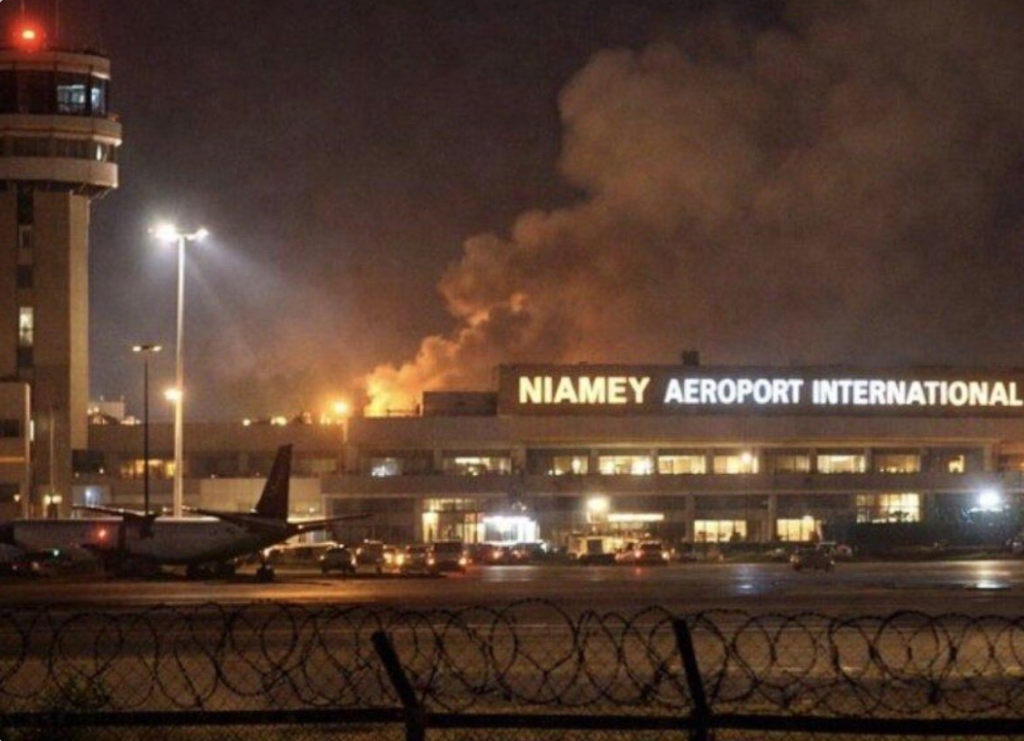
The night of Friday, August 28, to Saturday, August 29, 2026, marked a potentially pivotal moment in Niger’s ongoing security and political crisis. Intense gunfire, explosions, and significant movements of military vehicles were reported across sensitive areas of Niamey, the capital. These incidents were particularly concentrated around Air Base 101, adjacent to Diori-Hamani International Airport, as well as near the presidential palace and the administrative center. By morning, official channels remained silent, offering no clear explanation for the origin of the clashes or the identities of those involved.
This lack of official disclosure fueled widespread speculation. Was this a new jihadist assault targeting a strategic location? A covert infiltration attempt? Or, a far more alarming possibility, an internal confrontation within the armed forces, perhaps even a coup within the existing coup?
Currently, no credible information confirms an ongoing overthrow of General Abdourahamane Tiani. However, the geographic spread of the gunfire and the observed military activity within the capital lend credence to the idea of a potential internal power struggle. Eyewitnesses described military vehicle movements and exchanges of fire across several districts, with reports indicating Niamey’s barracks were placed on maximum alert.
A capital no longer immune
This night of violence unfolds against a deeply troubling backdrop. Since the ousting of President Mohamed Bazoum in July 2023, General Tiani’s regime has consistently championed the restoration of national sovereignty and the fight against terrorism as cornerstones of its political agenda.
Western partners have been steadily sidelined as Niamey forged closer ties with Moscow and its allies within the Alliance of Sahel States, including Mali and Burkina Faso. The departure of French and American forces was, according to the junta’s narrative, meant to usher in a new era of security autonomy. Yet, nearly three years post-coup, the actual situation appears far more complex.
Jihadist violence continues unabated, with armed groups repeatedly demonstrating their capability to strike at the very core of the state’s security apparatus. The overall security landscape had already significantly worsened following the 2023 coup, concurrently with authorities progressively curtailing domestic political and media freedoms.
The paradox is now glaringly apparent: the government, which positioned itself as the architect of security “reconquest,” struggles to prevent high-profile attacks even within the capital.
Diori-Hamani: a symbol of enduring vulnerability
The repeated targeting of Diori-Hamani International Airport proves particularly problematic for the ruling junta.
This critical infrastructure has suffered two assaults in less than six months. On the night of January 28-29, 2026, the airport and Air Base 101 were subjected to an unprecedented offensive. Then, on June 18, another attack targeted the airport’s entrance and the adjacent military installation. The Group for the Support of Islam and Muslims (JNIM), an Al-Qaeda affiliate, claimed responsibility for this second operation. Official figures reported eleven military personnel and two civilians killed, with twenty-two attackers neutralized.
Two attacks within months against the same military-airport complex are more than mere coincidences. They raise a fundamental question: how can armed groups effectively plan and execute operations against one of the nation’s most heavily guarded sites?
Following the January attack, authorities had ostensibly bolstered security around the airport, extending fences and installing hundreds of surveillance cameras. Eviction operations were also initiated in the surrounding airport zone. Despite these measures, the June assault demonstrated that the issue transcended mere proximity of dwellings or inadequate physical barriers.
The recurrence of these operations inevitably brings intelligence capabilities into question. An attack of this magnitude presupposes detailed knowledge of routes, schedules, security protocols, and target vulnerabilities. If assailants can repeatedly approach such a strategic location, it indicates a significant breakdown in the intelligence and anticipation chain.
The russian gamble put to the test
This is precisely where the junta’s narrative encounters its starkest contradictions.
Following the withdrawal of Western forces, Niger intensified its military collaboration with Russia. Moscow has increasingly asserted its influence with Sahelian military regimes, with new Russian entities, such as Africa Corps, taking over activities previously linked to Wagner. However, the Russian presence clearly does not offer an absolute guarantee of security. In January, after the airport attack, General Tiani commended the actions of Nigerien forces and their “Russian partners.” Concurrently, he accused France, Bénin, and Côte d’Ivoire of orchestrating the operation, without presenting public evidence.
This rhetoric exemplifies a recurring pattern: when the authorities face an attack, blame is frequently cast externally before any potential internal shortcomings are publicly scrutinized.
Yet, the facts compel a different line of questioning. If the new military partners are touted as capable of effectively replacing former Western powers, then why has Niamey’s airport been attacked twice in a matter of months? And why do armed groups still appear capable of maintaining such intense pressure around the capital?
Security populism versus reality
Since 2023, General Tiani’s regime has largely built its legitimacy upon a nationalist and sovereignist discourse. Slogans emphasizing “sovereignty,” denunciations of foreign interference, and the promotion of new partnerships have resonated with a segment of the populace.
However, political populism cannot sustainably substitute for tangible results.
Security is not gauged by the quantity of speeches delivered, flags waved, or external adversaries identified. It is measured by a state’s fundamental ability to safeguard its cities, strategic infrastructure, military personnel, and citizens.
It is precisely on this critical front that the recent events in Niamey could prove politically devastating for the junta.
For if this night’s gunfire indeed stems from a jihadist offensive, it will once again underscore armed groups’ persistent capability to breach the capital’s security perimeter. Conversely, if it proves to be an internal military confrontation, it would expose an even deeper vulnerability: that of a regime which seized power under the banner of stability and security, now facing fractures within its own coercive apparatus.
The scenario of a reckoning?
Therefore, it remains premature to declare a coup d’état. The available information does not substantiate such a claim. However, it would be equally imprudent to swiftly dismiss this possibility.
Simultaneous engagements or military movements around multiple strategic points in Niamey, including the airport, military installations, and the presidential zone, are serious enough to warrant close monitoring of the situation.
Within an army deeply politicized since the 2023 coup, a clash between factions would not be a trivial assumption. Tiani’s authority precisely hinges on a delicate balance among various military and security components. A disruption in this equilibrium could swiftly escalate an internal crisis into a national one.
For now, one certainty persists: Niamey has once again endured a night of fear. This particular night follows two major attacks against its airport in under six months.
The regime may continue to invoke external enemies, foreign powers, or terrorist groups. However, a crucial question now becomes unavoidable: if, after three years of military rule and shifts in security alliances, assailants can still strike at the very heart of the capital, where does the true failure lie?
The answer to this question will likely prove more decisive for Niger’s future than any pronouncements on sovereignty.