Amidst a West African landscape already fraught with geopolitical tensions, recent commercial decisions by Niger’s transitional authorities are sparking considerable debate among economic operators and regional analysts.
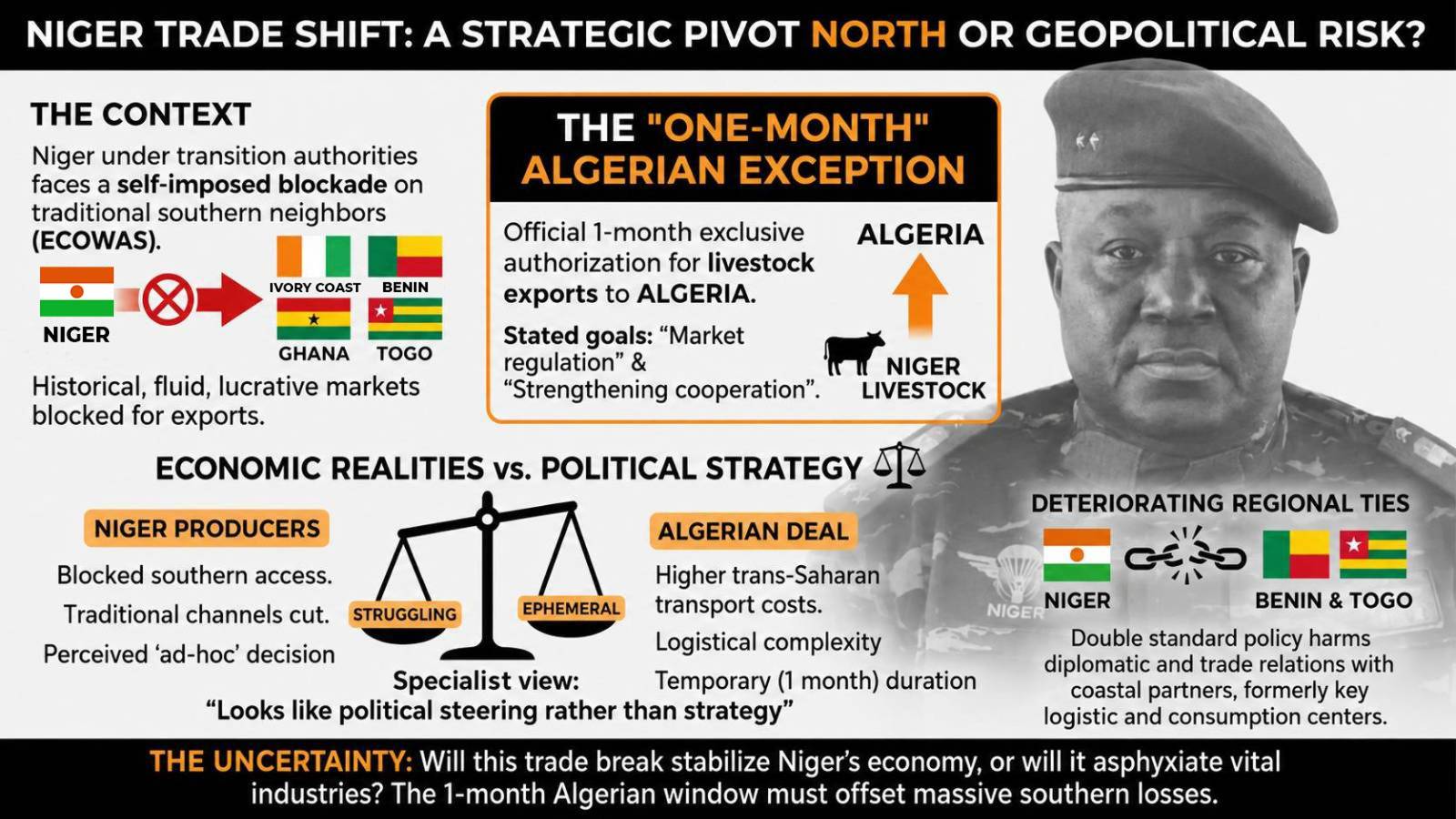
While trade routes remain either completely shut or severely restricted for exports to Gulf of Guinea nations, notably Côte d’Ivoire, Bénin, Ghana, and Togo, the Nigerien government has unexpectedly forged a new path northwards.
An exclusive temporary permit for Algiers
The government of Niger has formally authorized a special one-month window for the export of livestock to Algeria. According to official communications from Niamey, this exceptional measure is intended to facilitate the “regulation of the internal market” and is part of a broader “dynamic to strengthen economic cooperation” between Niamey and Algiers.
Although the argument for diversifying partnerships is officially promoted, the economic realities on the ground present a far more intricate and challenging scenario for local producers.
Economic actors voice their apprehension
For many observers, this stark asymmetry in how traditional commercial partners are treated raises concerns about the long-term rationality of such policies. Historically, the Gulf of Guinea has represented the most natural, efficient, and profitable outlet for Nigerien livestock.
“Blocking access to natural southern markets while simultaneously opening a fleeting one-month window to the North appears more akin to political short-termism than a well-considered economic strategy,” remarked a specialist in trans-Sahelian cross-border flows, who requested anonymity.
By prioritizing Algeria over its immediate ECOWAS neighbors, the ruling junta appears to be enacting an ideological rupture, potentially further destabilizing a pastoral sector already contending with successive crises.
Deteriorating regional relationships
This policy, perceived as employing a double standard, continues to astonish regional partners and is progressively eroding diplomatic and fraternal ties with coastal nations. Bénin and Togo, which traditionally served as crucial logistical hubs and consumer markets for Niger, now find themselves marginalized in favor of a trans-Saharan axis that presents greater logistical complexities.
Confronted with decisions that some view as impulsive or lacking a comprehensive understanding of the microeconomic fabric, Nigerien livestock breeders are effectively held captive by geopolitical maneuvering. The question remains whether a mere one-month authorization for exports to Algeria will adequately compensate for the lost revenue from the Ivorian, Beninese, or Ghanaian markets. Doubts persist, especially given that the elevated costs associated with trans-Saharan transport are likely to absorb a significant portion of any anticipated profits.
Only time will reveal if this new economic diplomacy, characterized by its break from tradition, will succeed in stabilizing the nation’s economy or if it will ultimately suffocate Niger’s vital economic sectors.